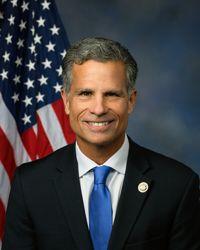
U.S. Representative for Pennsylvania’s 9th district
Republican
119th Congress, two-year term
Missed 5.2% of roll calls. Chamber median 1.9%.
The full voting recordCounts roll calls where most Democrats and most Republicans voted differently, leaving out procedural votes.
How we countFrom FEC filings, Voteview roll calls and Congress.gov.
Republican. In Congress since 2019, 4 terms in total.
Following saves Meuser to your list, which Chamber & Street keeps on its server, linked to a cookie on this browser and not to your name or email. Email alerts will come with constituent verification.
Bills and resolutions Meuser signed on to as a cosponsor. An original cosponsor signed on the day the bill was introduced. Source: govinfo bill status files, last updated Nov 6, 2026.
Restoring Court Authority Over Litigation Act of 2025
Sponsor Scott Fitzgerald (R). Joined May 9, 2025. 3 cosponsors. H.R. 3213 on Congress.gov
Introduced
Bank Failure Prevention Act of 2025
Sponsor Andy Barr (R). Joined May 8, 2025. 3 cosponsors. H.R. 1900 on Congress.gov(opens in a new tab)
Introduced
Bank Failure Prevention Act of 2025
This bill revises the Federal Reserve Board’s review process of merger and acquisition applications for bank holding companies.
Specifically, the board must notify the applicant within a certain time period regarding whether the application is complete or if additional information is required. The board must grant or deny such an application no later than 90 days after submission, regardless of whether the application was deemed complete. (Currently, the board must grant or deny an application no later than 90 days after receipt of a complete application.)
In addition, the board is prohibited from basing such application determinations on information provided by third parties.
Supporting the designation of May 8, 2025, as "National Scam Survivor Day".
Sponsor Bryan Steil (R). Original cosponsor. 2 cosponsors. H.Res. 397 on Congress.gov(opens in a new tab)
Introduced
Keeping Deposits Local Act
Sponsor Tom Emmer (R). Original cosponsor. 11 cosponsors. H.R. 3234 on Congress.gov(opens in a new tab)
Passed the House
This bill increases the amount insured depository institutions may accept as reciprocal deposits. (Reciprocal deposits are used by institutions to increase the availability of deposit insurance by splitting large deposits using a reciprocal network of institutions.) The bill creates a tiered system so that the allowable amount is based on the institution's total liabilities.
Additionally, the bill changes certain qualifications insured depository institutions may be required to have to accept reciprocal deposits. Under current law, institutions may qualify by having a composite rating of outstanding or good, among other requirements. The bill allows institutions with a 1, 2, or 3 rating under the CAMELS scale to qualify. (The Uniform Financial Institutions Rating System uses the characteristics of capital adequacy, asset quality, management, earnings, liquidity, and sensitivity to market risk (i.e., CAMELS ratings) to rate the health of financial institutions, with a 1 indicating the highest rating and least degree of supervisory concern and a 5 indicating the lowest rating and highest degree of supervisory concern.)
Financial Institution Regulatory Tailoring Enhancement Act
Sponsor Andy Barr (R). Original cosponsor. 2 cosponsors. H.R. 3230 on Congress.gov(opens in a new tab)
Introduced
Financial Institution Regulatory Tailoring Enhancement Act
This bill limits the regulations applicable to certain financial institutions by increasing several different asset levels.
The bill raises the asset level above which insured depository institutions and credit unions become subject to supervision by the Consumer Financial Protection Bureau for purposes of compliance with consumer financial laws and for risk assessments of products and services.
The bill raises the asset level above which banks must comply with the Volcker Rule, which prohibits banks from proprietary trading and having an ownership interest in private funds.
The bill raises the asset level below which financial institutions must comply with less prescriptive ability-to-repay determinations for residential mortgages.
Finally, the bill raises the asset level below which certain depository institutions and depository institution holding companies qualify as community banks and are therefore subject to a simplified leverage ratio.
Combating Organized Retail Crime Act of 2025
Sponsor David Joyce (R). Joined May 5, 2025. 206 cosponsors. H.R. 2853 on Congress.gov(opens in a new tab)
Passed the House
Combating Organized Retail Crime Act of 2025
This bill expands federal enforcement of criminal offenses related to organized retail and supply chain crime. The term organized retail and supply chain crime includes criminal offenses involving the interstate transportation of stolen property, the sale or receipt of stolen goods, or theft from an interstate or foreign shipment that is committed by, in coordination with, or at the instruction of an organization.
First, with respect to criminal offenses involving the interstate transportation of stolen property or the sale or receipt of stolen goods, the bill broadens the scope of conduct that qualifies as offenses by allowing prosecutions to be based on the aggregate value of stolen items over a 12-month period. Additionally, the bill makes the offenses predicate offenses (i.e., underlying offenses) for prosecutions under the federal money laundering statute and authorizes the criminal forfeiture of any property obtained from the proceeds of an offense.
Second, with respect to criminal offenses involving theft from an interstate or foreign shipment, the bill also makes an offense an underlying offense for prosecution under the federal money laundering statute and authorizes the criminal forfeiture of any associated property.
Third, the bill expands the federal money laundering statute to include offenses involving general-use prepaid cards, gift certificates, or store gift cards.
Finally, the bill temporarily establishes a center within the Department of Homeland Security to coordinate federal law enforcement activities related to organized retail and supply chain crime.
CFPB Budget Integrity Act
Sponsor Troy Downing (R). Original cosponsor. 6 cosponsors. H.R. 3141 on Congress.gov(opens in a new tab)
Introduced
No Social Security for Illegal Aliens Act of 2025
Sponsor John Moolenaar (R). Joined Apr 29, 2025. 15 cosponsors. H.R. 1172 on Congress.gov(opens in a new tab)
Introduced
No Social Security for Illegal Aliens Act of 2025
This bill excludes wages and self-employment income earned by non-U.S. nationals (aliens under federal law) who are not authorized to work in the United States from consideration for purposes of Social Security eligibility and benefits.
This exclusion applies with respect to all such wages and self-employment income earned both before and after the bill’s enactment. However, any change to the amount of an individual’s Social Security benefits as a result of these provisions may only apply to benefits for months after the bill’s enactment.
Small Business Regulatory Reduction Act of 2025
Sponsor Beth Van Duyne (R). Joined Apr 28, 2025. 5 cosponsors. H.R. 2965 on Congress.gov(opens in a new tab)
Passed the House
Small Business Regulatory Reduction Act of 2025
This bill requires the Small Business Administration (SBA) to ensure the annual small business regulatory budget for the SBA in each fiscal year is no greater than zero.
The small business regulatory budget is the cost to a small business of a federal rulemaking, including the cost resulting from the issuance of any new rule and the cost resulting from the modification or repeal of an existing rule.
Homebuyers Privacy Protection Act
Sponsor John Rose (R). Joined Apr 28, 2025. 89 cosponsors. H.R. 2808 on Congress.gov(opens in a new tab)
Became law
Homebuyers Privacy Protection Act
This act limits the circumstances in which credit reporting agencies may provide consumer credit reports to third parties in connection with residential mortgage transactions.
Specifically, the act prohibits a credit reporting agency from providing a consumer's credit report to a third party in connection with a residential mortgage transaction unless the transaction consists of a firm offer of credit or insurance and (1) the third party provides documentation certifying that it has the consumer's consent; or (2) the third party has originated a mortgage on behalf of the consumer, is a current mortgage loan servicer to the consumer, or has a current specified banking relationship with the consumer.
These provisions take effect 180 days after enactment.
The Government Accountability Office must study and report on the value of trigger leads (a marketing tactic facilitated by credit reporting agencies that may result in unsolicited credit offers to a consumer after a consumer applies for a separate type of credit) received by text message.
National Fallen Firefighters Memorial Coin Act
Sponsor Andrew Garbarino (R). Joined Apr 28, 2025. 47 cosponsors. H.R. 2257 on Congress.gov(opens in a new tab)
Introduced
Leveling the Playing Field 2.0 Act
Sponsor Beth Van Duyne (R). Joined Apr 28, 2025. 103 cosponsors. H.R. 1548 on Congress.gov(opens in a new tab)
Introduced
Leveling the Playing Field 2.0 Act
This bill addresses unfair trade practices by making various changes to U.S. antidumping and countervailing duty laws. Antidumping laws provide relief to U.S industries and workers that are materially injured or threatened with injury due to imports of like products sold in the U.S. market at less than fair value, while countervailing duty laws provide such relief from imports of products subsidized by a foreign government or public entity.
Specifically, the bill establishes a process for successive antidumping and countervailing duty investigations. Successive investigations may be concurrent (an ongoing investigation of the same product) or recently completed (not more than two years before the date of the initiation of the successive investigation). Further, the bill establishes a timeline for the Department of Commerce to issue determinations in successive investigations.
Among other provisions, the bill authorizes Commerce to
• apply countervailing duty law to subsidies provided by a foreign government or public entity to a company operating in a different country,
• use another method for calculating the cost of production in specific circumstances, and
• require importers to certify that the imported merchandise is not subject to an antidumping or countervailing duty order.
Additionally, the bill statutorily establishes procedures for Commerce to conduct circumvention inquiries, including by specifying the deadlines for preliminary and final determinations.
The bill also provides statutory authority for Commerce to investigate currency undervaluation as a countervailable subsidy.
United States-Israel Defense Partnership Act of 2025
Sponsor Joe Wilson (R). Joined Apr 28, 2025. 178 cosponsors. H.R. 1229 on Congress.gov(opens in a new tab)
Introduced
United States-Israel Defense Partnership Act of 2025
This bill requires or authorizes certain actions to increase defense-related cooperation between the United States and Israel.
Specifically, the bill requires the Department of Defense (DOD) to
• establish a cooperative program, with the concurrence of Israel's Ministry of Defense (MOD), to develop and deploy advanced technologies for countering unmanned systems that threaten the United States and Israel;
• establish in Israel an office of the Defense Innovation Unit (an organization that focuses on rapidly fielding and scaling commercial technology across the U.S. military); and
• seek to engage Israel's MOD on the ascension of Israel into the national technology and industrial base (currently defined in law as the persons and organizations engaged in research, development, production, integration, services, or information technology activities conducted within the United States, the United Kingdom, Australia, New Zealand, and Canada).
The bill authorizes DOD, upon request of Israel's MOD, to jointly conduct research, development, test, and evaluation (RDT&E) of emerging technologies such as artificial intelligence and robotics to meet defense challenges.
Additionally, the bill extends the authority for DOD to (1) carry out RDT&E on a joint basis with Israel to establish anti-tunnel and counter unmanned aerial systems capabilities through 2028, and (2) transfer defense articles intended for use as reserve stocks for Israel through January 1, 2029.
Protecting Privacy in Purchases Act
Sponsor Riley Moore (R). Joined Apr 28, 2025. 132 cosponsors. H.R. 1181 on Congress.gov(opens in a new tab)
Passed the House
Protecting Privacy in Purchases Act
This bill prohibits payment card networks from using merchant codes that distinguish firearms retailers from general-merchandise retailers or sporting-goods retailers.
The Department of Justice must enforce this bill and report annually on the resulting investigations and cases.
Business over Ballots Act
Sponsor Roger Williams (R). Original cosponsor. 15 cosponsors. H.R. 2968 on Congress.gov(opens in a new tab)
Passed committee
Neighborhood Homes Investment Act
Sponsor Mike Kelly (R). Joined Apr 17, 2025. 70 cosponsors. H.R. 2854 on Congress.gov(opens in a new tab)
Introduced
Secure Family Futures Act of 2025
Sponsor Randy Feenstra (R). Joined Apr 17, 2025. 54 cosponsors. H.R. 2547 on Congress.gov(opens in a new tab)
Introduced
ACRE Act of 2025
Sponsor Randy Feenstra (R). Joined Apr 17, 2025. 63 cosponsors. H.R. 1822 on Congress.gov(opens in a new tab)
Introduced
No Iranian Energy Act
Sponsor August Pfluger (R). Joined Apr 10, 2025. 21 cosponsors. H.R. 2574 on Congress.gov(opens in a new tab)
Introduced
Honoring Our Fallen Heroes Act of 2025
Sponsor Mary Gay Scanlon (D). Joined Apr 10, 2025. 180 cosponsors. H.R. 1269 on Congress.gov(opens in a new tab)
Introduced
Honoring Our Fallen Heroes Act of 2025
This bill extends death and disability benefits under the Public Safety Officers' Benefits Program (PSOB) to certain public safety officers who suffer from exposure-related cancer while on duty and their survivors. The PSOB program provides death, disability, and education benefits to public safety officers who are killed or injured in the line of duty and their survivors.
The bill specifies that exposure to a carcinogen shall be presumed to constitute a personal injury in the line of duty if
• the exposure occurred while the officer was in the line of duty;
• the officer began serving as an officer not fewer than 5 years before the date of the diagnosis of an exposure-related cancer and the diagnosis occurred not more than 15 years after the last date of active service; and
• the exposure-related cancer directly and proximately resulted in the death or permanent and total disability of the officer.
The Department of Justice's Bureau of Justice Assistance must periodically review the definition of exposure-related cancer and update the definition if appropriate based on medical evidence and in accordance with the requirements of a petition process.
States’ Education Reclamation Act of 2025
Sponsor David Rouzer (R). Joined Apr 9, 2025. 12 cosponsors. H.R. 369 on Congress.gov(opens in a new tab)
Introduced
States' Education Reclamation Act of 2025
This bill abolishes the Department of Education (ED) and repeals any program for which it has administrative responsibility.
The Department of the Treasury must provide grants to states, for FY2025-FY2033, for elementary, secondary, and postsecondary education purposes permitted by state law. The level of funding is set at the amount provided to states for federal elementary and secondary education programs and the amount provided for federal postsecondary education programs, respectively, for FY2025, minus the funding provided for education programs that the bill transfers to other federal agencies.
States must contract for an annual audit of their expenditures or transfers of grant funds.
Program administrative responsibility and delegation of authority are transferred as follows:
• ED's job training programs to the Department of Labor,
• each special education grant program under the Individuals with Disabilities Education Act to the Department of Health and Human Services (HHS),
• ED's Indian education programs to the Department of the Interior,
• each Impact Aid program under the Elementary and Secondary Education Act of 1965 to the Department of Defense,
• the Federal Pell Grant program and each federal student loan program to Treasury, and
• programs under the jurisdiction of the Institute of Education Sciences or the D.C. Opportunity Scholarship Program to HHS.
The Government Accountability Office must report to Congress on (1) the feasibility of reducing the federal tax burden and eliminating federal involvement in providing grants for education programs, and (2) the feasibility of successor federal agencies maintaining transferred education programs.
Safeguarding American Property Act of 2025
Sponsor Troy Downing (R). Original cosponsor. 36 cosponsors. H.R. 2708 on Congress.gov(opens in a new tab)
Introduced
Maximum Pressure Act
Sponsor Zachary Nunn (R). Joined Apr 7, 2025. 55 cosponsors. H.R. 2570 on Congress.gov(opens in a new tab)
Introduced
Supporting the goals and ideals of "Financial Literacy Month".
Sponsor Joyce Beatty (D). Original cosponsor. 21 cosponsors. H.Res. 292 on Congress.gov(opens in a new tab)
Introduced
Conrad State 30 and Physician Access Reauthorization Act
Sponsor David Valadao (R). Joined Mar 31, 2025. 66 cosponsors. H.R. 1585 on Congress.gov(opens in a new tab)
Introduced
Conrad State 30 and Physician Access Reauthorization Act
This bill modifies the Conrad 30 Waiver program, which incentivizes qualified foreign physicians to serve in underserved communities. It also extends statutory authority for the program for three years from this bill's enactment.
Individuals coming to the United States under a J-1 nonimmigrant visa to receive medical training typically must leave the country and reside for two years abroad before being eligible to apply for an immigrant visa or permanent residence. The Conrad program waives this requirement for individuals who meet certain qualifications, including serving for a number of years at a health care facility in an underserved area.
The bill increases the number of waivers that a state may obtain each fiscal year from 30 to 35 if a certain number of waivers were used the previous year, and provides for further adjustments depending on demand.
A physician may be employed at an academic medical center to meet the Conrad program's employment requirements if the physician's work is in the public interest, even if the medical center is not in an underserved area.
Employment contracts for physicians under the Conrad program shall contain certain information, such as the maximum number of on-call hours per week the physician shall have to work.
Certain physicians (along with the physician's spouse and children) shall be exempt from the direct annual numerical limits on immigration, including those physicians that have met certain requirements related to visas for physicians to serve in underserved areas.