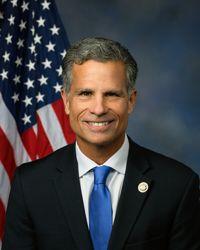
U.S. Representative for Pennsylvania’s 9th district
Republican
119th Congress, two-year term
Missed 5.2% of roll calls. Chamber median 1.9%.
The full voting recordCounts roll calls where most Democrats and most Republicans voted differently, leaving out procedural votes.
How we countFrom FEC filings, Voteview roll calls and Congress.gov.
Republican. In Congress since 2019, 4 terms in total.
Following saves Meuser to your list, which Chamber & Street keeps on its server, linked to a cookie on this browser and not to your name or email. Email alerts will come with constituent verification.
Bills and resolutions Meuser signed on to as a cosponsor. An original cosponsor signed on the day the bill was introduced. Source: govinfo bill status files, last updated Nov 6, 2026.
Nancy Gardner Sewell Medicare Multi-Cancer Early Detection Screening Coverage Act
Sponsor Jodey Arrington (R). Joined Jul 10, 2025. 338 cosponsors. H.R. 842 on Congress.gov
Introduced
Nancy Gardner Sewell Medicare Multi-Cancer Early Detection Screening Coverage Act
This bill allows, beginning in 2028, for Medicare coverage and payment for multi-cancer early detection screening tests that are approved by the Food and Drug Administration and that are used to screen for cancer across many cancer types, if the Centers for Medicare & Medicaid Services determines such coverage is appropriate. Coverage is limited to those under a certain age (age 68 in 2028, increased by one year every year thereafter) and to one test every 11 months.
To amend the Internal Revenue Code of 1986 to treat distributions from health savings accounts for funeral expenses of the account beneficiary as qualified distributions.
Sponsor Kevin Hern (R). Joined Jul 10, 2025. 11 cosponsors. H.R. 2436 on Congress.gov(opens in a new tab)
Introduced
REDI Act
Sponsor Brian Babin (R). Joined Jul 10, 2025. 133 cosponsors. H.R. 2028 on Congress.gov(opens in a new tab)
Introduced
Resident Education Deferred Interest Act or the REDI Act
This bill allows borrowers in medical or dental internships or residency programs to defer student loan payments until the completion of their programs.
Reliable Power Act
Sponsor Troy Balderson (R). Joined Jul 2, 2025. 20 cosponsors. H.R. 3616 on Congress.gov(opens in a new tab)
Passed the House
Reliable Power Act
This bill directs the electric reliability organization (i.e., the North American Electric Reliability Corporation) to conduct annual long-term assessments of the reliability of electric power in the bulk-power system. It also establishes a process for the Federal Energy Regulatory Commission (FERC) to review federal regulations before they are finalized if the electric reliability organization finds that the system is at risk of not having sufficient electric generation to maintain reliability.
If the electric reliability organization finds that the system does not have sufficient generation to maintain reliability, it must notify FERC that the bulk-power system is in a state of generation inadequacy. FERC must then notify the Department of Energy, the Environmental Protection Agency, and any other appropriate federal agencies of the generation inadequacy. Upon receiving the notice, the federal agency must provide proposed regulations that affect any generation resource in the bulk-power system to FERC for review and comment. If applicable, FERC must provide recommendations to modify the regulations. Federal agencies may not finalize such a regulation until FERC finds that it will not be likely to have a significant negative impact on the ability of the bulk-power system to supply sufficient electric energy necessary to maintain an adequate level of reliability.
Proposing an amendment to the Constitution of the United States to limit the number of terms that a Member of Congress may serve.
Sponsor Ralph Norman (R). Joined Jul 2, 2025. 116 cosponsors. H.J.Res. 12 on Congress.gov(opens in a new tab)
Introduced
This joint resolution proposes an amendment to the Constitution establishing term limits for individuals serving in the Senate and the House of Representatives.
The proposed amendment makes an individual who has served two terms in the Senate ineligible for appointment or election to the Senate and an individual who has served three terms as a Member of the House of Representatives ineligible for election to the House of Representatives.
The joint resolution provides that the amendment shall be valid when ratified by the legislatures of three-fourths of the states within seven years after the date of its submission for ratification.
Under Article V of the Constitution, both chambers of Congress may propose an amendment by a vote of two-thirds of all Members present for such vote. A proposed amendment must be ratified by the states as prescribed in Article V and as specified by Congress.
Expanding Access to Lending Options Act
Sponsor Scott Fitzgerald (R). Original cosponsor. 47 cosponsors. H.R. 4167 on Congress.gov(opens in a new tab)
Introduced
Civil Investigative Demand Reform Act of 2025
Sponsor Andy Barr (R). Joined Jun 26, 2025. 6 cosponsors. H.R. 1653 on Congress.gov(opens in a new tab)
Passed committee
Civil Investigative Demand Reform Act of 2025
This bill revises the Consumer Financial Protection Bureau’s (CFPB’s) civil investigative demand process. The demand process is used to gather information relevant to a violation of consumer financial law before formal proceedings.
Under the bill, such demands must be issued and served no later than six years after the date of the violation. The demand must also provide specific reference to particular facts regarding the violation.
The bill establishes a process that allows an advising attorney to submit questions on behalf of a person compelled by a demand to appear for oral testimony.
The bill also allows for judicial review if the CFPB denies a petition to set aside or modify a demand. These petitions must be treated as confidential.
In addition, the bill expands the grounds on which a petitioner may seek relief from such a demand to include a demonstration that the demand (1) is unduly burdensome, expensive, and outside the scope of the inquiry; (2) is unreasonably cumulative or duplicative; or (3) can be obtained from some other source that is more convenient, less burdensome, or less expensive.
Rectifying UDAAP Act
Sponsor Andy Barr (R). Joined Jun 26, 2025. 7 cosponsors. H.R. 1652 on Congress.gov(opens in a new tab)
Introduced
Rectifying Undefined Descriptions of Abusive Acts and Practices Act or the Rectifying UDAAP Act
This bill restricts the Consumer Financial Protection Bureau’s (CFPB’s) authority to deem a financial act or practice abusive for purposes of enforcement activities. Currently, the CFPB may take enforcement action against a financial product or service provider in connection with any transaction with a consumer for a consumer financial product or service that is unfair, deceptive, or abusive.
Specifically, the bill prohibits the CFPB from including discrimination as an abusive practice. Further, the bill revises what an abusive practice is, including by additionally requiring the practice to intentionally interfere with the ability of a consumer to understand a term or condition.
The bill also establishes additional criteria for abusive practices. Particularly, a practice is considered abusive if (1) it causes or is likely to cause substantial injury to consumers that is not reasonably avoidable by consumers, where timely disclosed conduct is presumed to be reasonably avoidable; or (2) the substantial injury is not outweighed by countervailing benefits to consumers or to competition.
The bill also eliminates the CFPB’s ability to seek monetary relief for unfair, deceptive, or abusive practices if the provider establishes a good faith effort to comply with requirements.
The bill establishes rulemaking requirements, including requiring a cost-benefit analysis for a rule relating to unfair, deceptive, or abusive practices.
Finally, the bill establishes the right for providers to cure violations if they self-report and limits the CFPB’s use of alternative claims in court.
RISE Act
Sponsor J. Hill (R). Joined Jun 25, 2025. 5 cosponsors. H.R. 4102 on Congress.gov(opens in a new tab)
Introduced
Digital Asset Market Clarity Act
Sponsor J. Hill (R). Joined Jun 20, 2025. 21 cosponsors. H.R. 3633 on Congress.gov(opens in a new tab)
Passed the House
Digital Asset Market Clarity Act of 2025 or the CLARITY Act of 2025
This bill establishes a regulatory framework for digital commodities, defined by the bill as digital assets that rely upon a blockchain for their value.
The Commodity Futures Trading Commission must generally regulate digital commodities transactions, including digital commodity exchanges, brokers, and dealers. To qualify for trade on an exchange (1) a digital commodity’s blockchain must be mature, or on a blockchain system that has achieved decentralized control as defined by the bill; or (2) the issuer of the digital commodity must file certain reports. The bill establishes requirements for trade monitoring, recordkeeping, and the commingling of customer assets.
The bill exempts digital commodities on mature blockchains (and digital commodities on blockchains expected to mature within certain timeframes) from Securities and Exchange Commission (SEC) registration requirements if annual sales fall under a certain amount and other requirements are met. The bill provides the SEC with jurisdiction over digital commodity activities and transactions engaged in by certain brokers and dealers on alternative trading systems and by national securities exchanges.
Digital commodity exchanges, brokers, and dealers are subject to the Bank Secrecy Act for anti-money laundering and related purposes.
The bill also sets forth requirements for alternative trading systems, previously issued digital commodities, and provisional registration until the bill is implemented.
For more information on this bill, see CRS Insight IN12583, Crypto Legislation: An Overview of H.R. 3633, the CLARITY Act.
CONSTRUCTS Act of 2025
Sponsor Juan Ciscomani (R). Joined Jun 20, 2025. 33 cosponsors. H.R. 1055 on Congress.gov(opens in a new tab)
Introduced
SAFE Cities Act
Sponsor Tony Wied (R). Joined Jun 13, 2025. 17 cosponsors. H.R. 3894 on Congress.gov(opens in a new tab)
Introduced
Condemning the rise in ideologically motivated attacks on Jewish individuals in the United States, including the recent violent assault in Boulder, Colorado, and reaffirming the House of Representatives commitment to combating antisemitism and politically motivated violence.
Sponsor Jefferson Van Drew (R). Original cosponsor. 70 cosponsors. H.Res. 481 on Congress.gov(opens in a new tab)
Passed the House
This resolution condemns the June 1, 2025, targeted act of terror in Boulder, Colorado, as an act of ideologically motivated violence and reaffirms the House of Representatives' commitment to protecting the rights of all Americans to assemble peacefully and practice their faith without fear of violence.
Federal Firearms Licensee Protection Act of 2025
Sponsor John Rutherford (R). Joined Jun 5, 2025. 145 cosponsors. H.R. 1773 on Congress.gov(opens in a new tab)
Introduced
Federal Firearms Licensee Protection Act of 2025
This bill modifies criminal penalties for an offense involving the theft of a firearm from a licensed importer, manufacturer, or dealer, or from their business premises.
Specifically, the bill does the following:
• increases from 10 to 20 years the maximum prison term, and
• creates a 3- or 5-year mandatory minimum prison term for an offense that occurs during the commission of a burglary or robbery.
An attempt to commit an offense is subject to the same penalties as a substantive offense.
Energy Choice Act
Sponsor Nicholas Langworthy (R). Original cosponsor. 157 cosponsors. H.R. 3699 on Congress.gov(opens in a new tab)
Introduced
Energy Choice Act
This bill prohibits a state or local government from banning or limiting the connection, reconnection, modification, installation, transportation, distribution, expansion, or access to an energy service based on the type or source of energy (e.g., natural gas) that is sold.
Housing Supply Frameworks Act
Sponsor Mike Flood (R). Joined Jun 4, 2025. 25 cosponsors. H.R. 2840 on Congress.gov(opens in a new tab)
Introduced
Justice for Victims of Illegal Alien Murders Act
Sponsor Morgan Luttrell (R). Joined Jun 2, 2025. 11 cosponsors. H.R. 3294 on Congress.gov(opens in a new tab)
Introduced
Rural Veterinary Workforce Act
Sponsor Adrian Smith (R). Joined May 29, 2025. 65 cosponsors. H.R. 2398 on Congress.gov(opens in a new tab)
Introduced
Rural Veterinary Workforce Act
This bill excludes from gross income, for federal tax purposes, payments received pursuant to the Veterinary Medicine Loan Repayment Program or any state loan repayment or loan forgiveness program that is intended to provide for increased access to veterinary services. (The Veterinary Medicine Loan Repayment Program is a Department of Agriculture program that repays a portion of the student loans of veterinarians who provide short-term services in designated veterinary shortage areas.)
Improving Seniors’ Timely Access to Care Act of 2025
Sponsor Mike Kelly (R). Original cosponsor. 308 cosponsors. H.R. 3514 on Congress.gov(opens in a new tab)
Passed committee
Improving Seniors' Timely Access to Care Act of 2025
This bill establishes several requirements and standards relating to prior authorization processes under Medicare Advantage (MA) plans.
Specifically, MA plans must (1) establish an electronic prior authorization program that meets specified standards; (2) annually submit to the CMS for publication specified prior authorization information, including the percentage of requests approved and the average response time; and (3) meet other standards, as set by the Centers for Medicare & Medicaid Services (CMS), relating to the quality and timeliness of prior authorization determinations.
The CMS and the Office of the National Coordinator for Health Information Technology must publish on the CMS' website a report that analyzes the information received from MA plans, the feasibility of implementing real-time decision making with respect to prior authorization requests, and the impact of decisions that are made using artificial intelligence on patient access.
FDIC Board Accountability Act
Sponsor Bill Huizenga (R). Original cosponsor. 3 cosponsors. H.R. 3446 on Congress.gov(opens in a new tab)
Introduced
FDIC Board Accountability Act
This bill revises provisions related to the board of directors of the Federal Deposit Insurance Corporation. Specifically, the bill removes the director of the Consumer Financial Protection Bureau from the board as a voting member and instead makes them a non-voting observer. In addition, the bill requires the appointment of one individual with state bank supervisory experience, and another with demonstrated primary experience working in or supervising small depository institutions. Further, the bill limits the term length of a board member to 12 years.
Bureau of Consumer Financial Protection Commission Act
Sponsor Bill Huizenga (R). Original cosponsor. 10 cosponsors. H.R. 3445 on Congress.gov(opens in a new tab)
Introduced
Bureau of Consumer Financial Protection Commission Act
This bill restructures the Consumer Financial Protection Bureau (CFPB) and creates a five-member commission to manage the bureau. Currently, the CFPB is an autonomous bureau within the Federal Reserve System and is led by a director who is appointed by the President with the advice and consent of the Senate.
The bill removes the CFPB from the Federal Reserve System and reestablishes it as an independent agency.
The commission established by this bill is composed of five members appointed by the President with the advice and consent of the Senate, with one member selected by the President to serve as chair of the commission. No more than three commissioners may be members of the same political party. The bill also sets forth provisions regarding terms, quorums, and vacancies. The bill specifies that the President may a remove a commissioner for inefficiency, neglect of duty, or malfeasance in office.
The bill also revises the membership requirements of the Consumer Advisory Board. The board advises and consults with the CFPB regarding relevant consumer financial laws and provides information on emerging practices in the consumer financial products and services industry. Currently, at least six members must be appointed upon recommendation of the regional Federal Reserve Bank presidents. The bill removes this requirement and requires at least half of all members to have private sector experience.
Insurance Data Protection Act
Sponsor Scott Fitzgerald (R). Original cosponsor. 25 cosponsors. H.R. 3437 on Congress.gov(opens in a new tab)
Introduced
Insurance Data Protection Act
This bill limits the ability of federal entities to compel insurance companies to share information.
Specifically, the bill eliminates the subpoena power of the Federal Insurance Office. Under current law, the office has the power to subpoena information from insurers to, among other purposes, identify issues that could contribute to a systemic crisis in the insurance industry or the U.S. financial system.
The bill also eliminates the ability of the Office of Financial Research to subpoena insurance companies.
When seeking to collect insurance company data under specified consumer protection laws, a financial regulator must obtain the data from other regulators or from publicly available sources if possible. Otherwise, the financial regulator may only collect this data directly from the insurance company if the regulator complies with the Paperwork Reduction Act.
Bringing the Discount Window into the 21st Century Act
Sponsor Monica De La Cruz (R). Original cosponsor. 2 cosponsors. H.R. 3390 on Congress.gov(opens in a new tab)
Passed the House
Bringing the Discount Window into the 21st Century Act
This bill requires the Board of Governors of the Federal Reserve System to review and develop a remediation plan for its discount window lending program, which provides loans to depository institutions to support an institution’s security and liquidity.
The review must consider topics such as the sufficiency of the technology infrastructure, the effectiveness of the existing operating hours of the discount window, and how the discount window interacts with other liquidity providers during normal operations and in times of financial distress.
The remediation plan must address any identified deficiencies, establish timelines and milestones for implementation, and be approved by the board.
The bill requires annual reports to Congress regarding the plan.
S-CAP Act of 2025
Sponsor J. Hill (R). Joined May 14, 2025. 19 cosponsors. H.R. 2777 on Congress.gov(opens in a new tab)
Introduced
Made in America Manufacturing Finance Act
Sponsor Roger Williams (R). Joined May 13, 2025. 12 cosponsors. H.R. 3174 on Congress.gov(opens in a new tab)
Passed the House
Made in America Manufacturing Finance Act
This bill increases the maximum loan amounts available to small manufacturers under the Small Business Administration's 7(a) and 504 loan programs.
In particular, the bill generally doubles the maximum loan amount for small manufacturers under the 7(a) program and the bill increases the maximum loan amount for small manufacturers under the 504 program from $5.5 million to $10 million.
Generally, 7(a) loans provide short- and long-term working capital which can be used for expenses such as operational needs. 504 loans provide financing for major fixed assets such as new facilities.