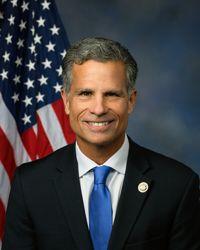
U.S. Representative for Pennsylvania’s 9th district
Republican
119th Congress, two-year term
Missed 5.2% of roll calls. Chamber median 1.9%.
The full voting recordCounts roll calls where most Democrats and most Republicans voted differently, leaving out procedural votes.
How we countFrom FEC filings, Voteview roll calls and Congress.gov.
Republican. In Congress since 2019, 4 terms in total.
Following saves Meuser to your list, which Chamber & Street keeps on its server, linked to a cookie on this browser and not to your name or email. Email alerts will come with constituent verification.
Bills and resolutions Meuser signed on to as a cosponsor. An original cosponsor signed on the day the bill was introduced. Source: govinfo bill status files, last updated Nov 6, 2026.
Offshore Lands Authorities Act of 2025
Sponsor Clay Higgins (R). Original cosponsor. 25 cosponsors. H.R. 513 on Congress.gov
Introduced
Offshore Lands Authorities Act of 2025
This bill limits the withdrawal of unleased lands of the Outer Continental Shelf (OCS) from areas that may be leased for mineral development and nullifies certain past withdrawals. The OCS includes the federally managed ocean area extending from the outer boundaries of state-controlled waters (generally 3 nautical miles [nmi] from shore) to 200 nmi from shore, with some exceptions.
Specifically, the bill limits the President's authority to restrict offshore development of minerals, such as oil and gas, on the OCS. For example, the bill (1) caps the number of acres of OCS lands that a President may withdraw from areas that may be leased; (2) prohibits withdrawals from being made for a period longer than 20 years; (3) prohibits the President from making withdrawals of unleased land that conflict with areas included in lease sales scheduled under approved oil and gas leasing programs; and (4) prohibits the President from withdrawing unleased lands unless the Department of the Interior has completed assessments addressing issues such as mineral resources and the national security, economic, and energy value of the identified mineral deposits.
The President must also obtain congressional approval before withdrawing more than 500,000 acres cumulatively. Further, the bill gives Congress the authority to review and disapprove withdrawals by enacting a joint resolution.
In addition, the bill nullifies certain presidential memoranda and executive orders related to withdrawing unleased land from areas that may be leased for the development of oil, gas, or other minerals on the OCS.
Healthy SNAP Act of 2025
Sponsor Josh Brecheen (R). Original cosponsor. 12 cosponsors. H.R. 479 on Congress.gov(opens in a new tab)
Introduced
Healthy SNAP Act of 2025
This bill amends the Supplemental Nutrition Assistance Program (SNAP) to redefine the foods eligible for purchase with SNAP benefits.
Under the bill, SNAP benefits may not be used for soft drinks, candy, ice cream, or prepared desserts, such as cakes, pies, cookies, or similar products.
Further, the Department of Agriculture (USDA) must designate by regulation foods and food products to include in the SNAP definition of the term food. USDA must consider food and products that (1) based on nutrition research, contain nutrients lacking in the diets of people in the United States; and (2) promote the health of the population served by SNAP, based on relevant nutrition science, public health concerns, and cultural eating patterns. USDA must also, to the maximum extent practicable, ensure that the fat, sugar, and salt content of the food and food products are appropriate. At least every five years, USDA must review and amend the list.
In addition, prepared meals purchased with SNAP benefits must have nutritional values consistent with standards developed by USDA for the list of food and food products.
A state agency may substitute different foods for food USDA designated under this bill, with USDA approval, so long as the foods are nutritionally equivalent; this is permitted to allow for different cultural eating patterns.
Miracle on Ice Congressional Gold Medal Act
Sponsor Pete Stauber (R). Original cosponsor. 299 cosponsors. H.R. 452 on Congress.gov(opens in a new tab)
Became law
Miracle on Ice Congressional Gold Medal Act
This act provides for the award of Congressional Gold Medals to the members of the 1980 U.S. Olympic men's ice hockey team in recognition of the team's achievement at the 1980 Winter Olympic Games.
FIND Act
Sponsor Jack Bergman (R). Joined Jan 15, 2025. 154 cosponsors. H.R. 45 on Congress.gov(opens in a new tab)
Introduced
Firearm Industry Non-Discrimination Act or the FIND Act
This bill prohibits the federal government from entering into contracts with an entity that discriminates against firearm trade associations or businesses that deal in firearms, ammunition, or related products.
Specifically, the bill requires a federal agency to include in each contract for the procurement of goods or services awarded by the agency a clause requiring the prime contractor to certify that it (1) has no policy, practice, guidance, or directive that discriminates against a firearm entity or firearm trade association; and (2) will not adopt a policy, practice, guidance, or directive that discriminates against a firearm entity or firearm trade association during the term of the contract.
The bill establishes (1) a similar requirement with respect to subcontracts, and (2) penalties for violations.
The bill makes such prohibition inapplicable to a contract for the procurement of goods or services that is a sole-source contract.
Border Wall Waste Accountability Act
Sponsor Beth Van Duyne (R). Joined Jan 15, 2025. 7 cosponsors. H.R. 326 on Congress.gov(opens in a new tab)
Introduced
Border Wall Waste Accountability Act
This bill requires the Government Accountability Office to report to Congress on the total cost of unused construction materials that were obtained for construction of a U.S.-Mexico border wall from January 20, 2021, through January 20, 2025.
POLICE Act of 2025
Sponsor Andrew Garbarino (R). Joined Jan 15, 2025. 20 cosponsors. H.R. 31 on Congress.gov(opens in a new tab)
Introduced
Protect Our Law enforcement with Immigration Control and Enforcement Act of 2025 or the POLICE Act of 2025
This bill makes assaulting a law enforcement officer, firefighter, or other first responder a deportable offense.
Specifically, the bill makes deportable any non-U.S. national (alien under federal law) who has been convicted of (or admits to have committed) any act that constitutes the essential elements of any offense involving assault of a law enforcement officer, firefighter, or other first responder.
The Department of Homeland Security must publish annually on its website a report on the number of individuals deported in the previous year pursuant to this bill.
Preventing Violence Against Women by Illegal Aliens Act
Sponsor Nancy Mace (R). Joined Jan 15, 2025. 60 cosponsors. H.R. 30 on Congress.gov(opens in a new tab)
Passed the House
Preventing Violence Against Women by Illegal Aliens Act
This bill establishes certain criminal grounds for making non-U.S. nationals (aliens under federal law) inadmissible and expands the crimes for which a non-U.S. national is deportable.
First, the bill establishes that a non-U.S. national is inadmissible if the individual has admitted to or is convicted of acts constituting the essential elements of stalking, child abuse, child neglect, child abandonment, a sex offense, conspiracy to commit a sex offense, a violation of certain protection orders, or domestic violence (including physical or sexual abuse or a pattern of coercive behavior when it occurs within certain close relationships).
Next, the bill establishes additional grounds for deportation. Under current law, a non-U.S. national is deportable for certain criminal convictions, including domestic violence, stalking, and child abuse. The bill makes any sex offense (including crimes against minors) or conspiracy to commit a sex offense a basis for deportation. The bill also expands the domestic violence crimes that make a non-U.S. national deportable to include physical or sexual abuse or a pattern of coercive behavior when it occurs within certain close relationships.
Fair Milk Pricing for Farmers Act
Sponsor Nicholas Langworthy (R). Joined Jan 15, 2025. 17 cosponsors. H.R. 295 on Congress.gov(opens in a new tab)
Introduced
Fair Milk Pricing for Farmers Act
This bill requires manufacturers to report production cost and product yield information for all dairy products processed in the same facility or facilities to the Department of Agriculture (USDA) Dairy Product Mandatory Reporting Program. Further, USDA must publish a report containing the information obtained under these new requirements and publish a report every two years thereafter.
As background, under the Dairy Product Mandatory Reporting Program, USDA must collect certain dairy product sales information from manufacturers and release the data on a weekly basis.
Born-Alive Abortion Survivors Protection Act
Sponsor Ann Wagner (R). Joined Jan 13, 2025. 163 cosponsors. H.R. 21 on Congress.gov(opens in a new tab)
Passed the House
Born-Alive Abortion Survivors Protection Act
This bill establishes requirements for the degree of care a health care practitioner must provide in the case of a child born alive following an abortion or attempted abortion.
Specifically, a health care practitioner who is present must (1) exercise the same degree of care as would reasonably be provided to any other child born alive at the same gestational age, and (2) ensure the child is immediately admitted to a hospital. Additionally, a health care practitioner or other employee who has knowledge of a failure to comply with the degree-of-care requirements must immediately report such failure to law enforcement.
A health care practitioner who fails to provide the required degree of care, or a health care practitioner or other employee who fails to report such failure, is subject to criminal penalties—a fine, up to five years in prison, or both.
An individual who intentionally kills or attempts to kill a child born alive is subject to prosecution for murder.
The bill bars the criminal prosecution of a mother of a child born alive under this bill and allows her to bring a civil action against a health care practitioner or other employee for violations.
COAL Act of 2025
Sponsor Harriet Hageman (R). Original cosponsor. 4 cosponsors. H.R. 280 on Congress.gov(opens in a new tab)
Introduced
Combating Obstruction Against Leasing Act of 2025 or the COAL Act of 2025
This bill requires the Bureau of Land Management (BLM) to process certain applications to lease coal mineral estates owned by the federal government in order to develop coal.
If the environmental review process under the National Environmental Policy Act of 1969 has commenced for an application, then the BLM must publish a draft environmental assessment and any applicable implementing regulations, finalize the fair market value of the coal tract for which a lease by application is pending, take all intermediate actions necessary to grant the application, and grant the application.
With respect to previously awarded coal leases, the BLM must grant any additional approvals required for mining activities to commence.
Finally, the bill nullifies the Department of the Interior's Secretarial Order 3338, which placed a hold on most new federal coal leases until the BLM completes a comprehensive review of the federal coal program.
To direct the Joint Committee on the Library to procure a statue of Benjamin Franklin for placement in the Capitol.
Sponsor Chrissy Houlahan (D). Original cosponsor. 34 cosponsors. H.R. 250 on Congress.gov(opens in a new tab)
Passed the House
This bill requires the Joint Committee on the Library to contract for and place a statue of Benjamin Franklin in the Capitol.
The committee shall place the statue in a permanent public location where it is accessible during a guided tour provided by the Capitol Visitor Center.
The contract must be executed by December 31, 2025, and the statue must be placed by December 31, 2026.
Federal Employee Return to Work Act
Sponsor Dan Newhouse (R). Original cosponsor. 21 cosponsors. H.R. 236 on Congress.gov(opens in a new tab)
Introduced
Federal Employee Return to Work Act
This bill prohibits providing certain annual or locality-based pay increases to teleworking federal employees.
Currently, federal law mandates annual adjustments to General Schedule (GS) pay rates according to (1) a formula based on the annual percentage change in the Employment Cost Index (a measure of labor costs in the private sector); and (2) the difference between public and private sector pay rates in an employee's locality, if that difference exceeds 5%. For example, in 2025, the default annual rate of pay for a GS-7 (step 1) employee is $49,960; the adjusted annual rate of pay for a GS-7 (step 1) employee in the locality pay area that includes Washington, DC, is $57,164.
The bill makes executive agency employees who telework at least one day each week (or, in the case of an alternative work schedule, 20% or more each week) ineligible for these payments.
The bill is effective on the first day of the fiscal year beginning after the bill's enactment.
HUD Transparency Act of 2025
Sponsor Monica De La Cruz (R). Original cosponsor. 12 cosponsors. H.R. 225 on Congress.gov(opens in a new tab)
Passed the House
HUD Transparency Act of 2025
This bill requires the Office of Inspector General of the Department of Housing and Urban Development (HUD) to annually testify before Congress.
Specifically, the office must testify regarding
• efforts to detect and prevent fraud, waste, and abuse;
• ability to conduct and supervise audits, investigations, and reviews;
• actions to identify opportunities for HUD programs to progress and succeed;
• recommendations to improve overall efficiency and public accountability;
• the extent to which HUD has resources sufficient to carry out its statutory mission; and
• ongoing activities regarding any such additional work.
Disabled Veterans Housing Support Act
Sponsor Monica De La Cruz (R). Original cosponsor. 11 cosponsors. H.R. 224 on Congress.gov(opens in a new tab)
Became law
Disabled Veterans Housing Support Act
This act excludes compensation received for a military service-connected disability from a veteran's income when determining eligibility for assistance under the Community Development Block Grant (CDBG) program.
The CDBG program provides grants to urban communities for development activities focused on revitalizing neighborhoods, economic development, and providing improved community facilities and services.
Additionally, the Government Accountability Office must report on how service-connected disability compensation is treated when determining eligibility for all programs administered by the Department of Housing and Urban Development. This includes identifying instances where the treatment of such compensation is inconsistent with the requirement under this act.
Constitutional Concealed Carry Reciprocity Act of 2025
Sponsor Richard Hudson (R). Original cosponsor. 189 cosponsors. H.R. 38 on Congress.gov(opens in a new tab)
Introduced
Constitutional Concealed Carry Reciprocity Act
This bill establishes a federal statutory framework to regulate the carry or possession of concealed firearms across state lines.
Specifically, an individual who is eligible to carry a concealed firearm in one state may carry or possess a concealed handgun (other than a machine gun or destructive device) in another state that allows its residents to carry concealed firearms.
It sets forth requirements for lawful concealed carry across state lines. The bill preempts most state and local laws related to concealed carry and establishes a private right of action for a person adversely affected by interference with a concealed-carry right established by this bill.
Agent Raul Gonzalez Officer Safety Act
Sponsor Juan Ciscomani (R). Original cosponsor. 32 cosponsors. H.R. 35 on Congress.gov(opens in a new tab)
Passed the House
Agent Raul Gonzalez Officer Safety Act
This bill establishes new federal criminal offenses for operating a motor vehicle within 100 miles of the U.S. border while fleeing from a U.S. Border Patrol agent or a federal, state, or local law enforcement officer who is actively assisting or under the command of the U.S. Border Patrol.
The bill establishes criminal penalties for an offense, including a mandatory minimum prison term for an offense resulting in death or serious bodily injury. Additionally, a non-U.S. national who is convicted of or admits to committing an offense is inadmissible, deportable, and ineligible for immigration relief (including asylum).
Protection of Women and Girls in Sports Act of 2025
Sponsor W. Steube (R). Original cosponsor. 83 cosponsors. H.R. 28 on Congress.gov(opens in a new tab)
Passed the House
Protection of Women and Girls in Sports Act of 2025
This bill generally prohibits school athletic programs from allowing individuals whose biological sex at birth was male to participate in programs that are for women or girls.
Specifically, the bill provides that it is a violation of Title IX of the Education Amendments of 1972 for federally funded education programs or activities to operate, sponsor, or facilitate athletic programs or activities that allow individuals of the male sex to participate in programs or activities that are designated for women or girls. (Title IX prohibits discrimination on the basis of sex in federally funded education programs or activities, including in public elementary and secondary schools and in colleges and universities.) Under the bill, sex is based on an individual's reproductive biology and genetics at birth.
The bill does not prohibit male individuals from training or practicing with programs or activities for women or girls as long as such training or practice does not deprive any female of corresponding opportunities or benefits.
The Government Accountability Office must report on the benefits for women or girls in single-sex sports that would be lost as a result of male participation. In particular, the report must document the negative psychological, developmental, participatory, and sociological effects of male participation on girls.
HALT Fentanyl Act
Sponsor H. Griffith (R). Original cosponsor. 61 cosponsors. H.R. 27 on Congress.gov(opens in a new tab)
Passed the House
Halt All Lethal Trafficking of Fentanyl Act or the HALT Fentanyl Act
This bill permanently places fentanyl-related substances as a class into schedule I of the Controlled Substances Act. A schedule I controlled substance is a drug, substance, or chemical that has a high potential for abuse; has no currently accepted medical value; and is subject to regulatory controls and administrative, civil, and criminal penalties under the Controlled Substances Act.
Under the bill, offenses involving fentanyl-related substances are triggered by the same quantity thresholds and subject to the same penalties as offenses involving fentanyl analogues (e.g., offenses involving 100 grams or more trigger a 10-year mandatory minimum prison term).
Additionally, the bill establishes a new, alternative registration process for certain schedule I research.
The bill also makes several other changes to registration requirements for conducting research with controlled substances, including
• permitting a single registration for related research sites in certain circumstances,
• waiving the requirement for a new inspection in certain situations, and
• allowing a registered researcher to perform certain manufacturing activities with small quantities of a substance without obtaining a manufacturing registration.
Finally, the bill expresses the sense that Congress agrees with the interpretation of Controlled Substances Act in United States v. McCray, a 2018 case decided by the U.S. District Court for the Western District of New York. In that case, the court held that butyryl fentanyl, a controlled substance, can be considered an analogue of fentanyl even though, under the Controlled Substances Act, the term controlled substance analogue specifically excludes a controlled substance.
Family and Small Business Taxpayer Protection Act
Sponsor Adrian Smith (R). Original cosponsor. 36 cosponsors. H.R. 196 on Congress.gov(opens in a new tab)
Introduced
Family and Small Business Taxpayer Protection Act
This bill rescinds unobligated funds that were provided by the Inflation Reduction Act of 2022 to the Internal Revenue Service (IRS) for enforcement activities related to the determination and collection of taxes, for operations support for taxpayer services and enforcement activities, and for a task force to research options for a free, direct electronic filing (e-filing) tax return system.
The bill also rescinds unobligated funds that were provided by the Inflation Reduction Act of 2022 for expenses of the
• Treasury Inspector General for Tax Administration,
• Office of Tax Policy,
• U.S. Tax Court, and
• offices within the Department of the Treasury that provide oversight and support for the IRS.
Finish the Wall Act
Sponsor Clay Higgins (R). Original cosponsor. 29 cosponsors. H.R. 163 on Congress.gov(opens in a new tab)
Introduced
Finish the Wall Act
This bill requires the Department of Homeland Security (DHS) to resume activities related to the construction of a barrier system along the U.S.-Mexico border and addresses other border-related issues.
DHS must resume all such construction activities that were planned or underway prior to January 20, 2021. DHS must also expend all funds appropriated or explicitly obligated since October 1, 2016, for construction of this barrier system. DHS may not cancel contracts for activities related to such construction entered into on or before January 20, 2021.
Furthermore, within 14 days of this bill's enactment, DHS must certify to Congress that U.S. Customs and Border Protection facilities that process adults taken into custody at the border are fully compliant with certain laws related to the collection of DNA. (Among other things, these laws allow for the collection of DNA samples from non-U.S. persons detained under U.S. authority.)
Regulations from the Executive in Need of Scrutiny Act of 2025
Sponsor Kat Cammack (R). Original cosponsor. 93 cosponsors. H.R. 142 on Congress.gov(opens in a new tab)
Introduced
Regulations from the Executive in Need of Scrutiny Act of 2025
This bill revises provisions relating to congressional review of agency rulemaking.
Specifically, the bill establishes a congressional approval process for a major rule. A major rule may only take effect if Congress approves of the rule. A major rule is a rule that has resulted in or is likely to result in (1) an annual effect on the economy of $100 million or more; (2) a major increase in costs or prices for consumers, individual industries, government agencies, or geographic regions; or (3) significant adverse effects on competition, employment, investment, productivity, innovation, or the ability of U.S.-based enterprises to compete with foreign-based enterprises.
The bill generally preserves the current congressional review process for a nonmajor rule.
TCJA Permanency Act
Sponsor Vern Buchanan (R). Original cosponsor. 53 cosponsors. H.R. 137 on Congress.gov(opens in a new tab)
Introduced
TCJA Permanency Act
This bill makes permanent multiple federal tax provisions enacted in 2017 by the Tax Cuts and Jobs Act.
The bill makes permanent the
• individual tax rates of 10%, 12%, 22%, 24%, 32%, 35%, and 37%;
• increased standard deduction;
• personal exemption allowance repeal;
• exclusion from income of student loans discharged due to death or disability;
• qualified business income tax deduction (199A tax deduction);
• allowance of ABLE account contributions in excess of the annual gift tax exclusion amount;
• base estate and gift tax exclusion amount of $10 million (adjusted annually); and
• alternative minimum tax exemption and phaseout amounts for noncorporate taxpayers.
The bill makes permanent the child tax credit amounts of $2,000 per child and $500 for dependents, the $200,000 phaseout threshold ($400,000 for joint filers), and the refundable portion of the tax credit.
The bill expands the expenses eligible for tax-free withdrawals from qualified tuition plans (529 plans) to include additional expenses associated with homeschool and elementary and secondary schools (e.g., instructional materials, tutoring, test and enrollment fees, and educational therapies).
The bill permanently eliminates certain miscellaneous itemized deductions and makes permanent the
• state and local tax deduction limit of $10,000 ($5,000 for married individuals filing separately),
• mortgage interest tax deduction limit of $750,000 ($375,000 for married individuals filing separately),
• limit on the deduction of cash charitable contributions to 60% of a taxpayer’s adjusted gross income, and
• certain limits on casualty loss tax deductions.
The bill also permanently eliminates the exclusion from income for employer-reimbursed bicycle commuting expenses.