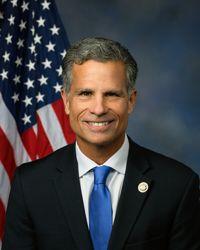
U.S. Representative for Pennsylvania’s 9th district
Republican
119th Congress, two-year term
Missed 5.2% of roll calls. Chamber median 1.9%.
The full voting recordCounts roll calls where most Democrats and most Republicans voted differently, leaving out procedural votes.
How we countFrom FEC filings, Voteview roll calls and Congress.gov.
Republican. In Congress since 2019, 4 terms in total.
Following saves Meuser to your list, which Chamber & Street keeps on its server, linked to a cookie on this browser and not to your name or email. Email alerts will come with constituent verification.
Bills and resolutions Meuser signed on to as a cosponsor. An original cosponsor signed on the day the bill was introduced. Source: govinfo bill status files, last updated Nov 6, 2026.
1071 Repeal to Protect Small Business Lending Act
Sponsor Roger Williams (R). Original cosponsor. 52 cosponsors. H.R. 976 on Congress.gov
Introduced
1071 Repeal to Protect Small Business Lending Act
This bill repeals the statute that requires financial institutions to collect data regarding applications for women-owned, minority-owned, or small business loans. Currently, financial institutions must collect and report to the Consumer Financial Protection Bureau information on (1) how many applications were received; (2) the disposition of each application; (3) the type of loan; (4) the amount applied for; (5) the amount approved; and (6) each applicant’s census tract, revenue, race, sex, and ethnicity.
Small Business Regulatory Reduction Act
Sponsor Beth Van Duyne (R). Original cosponsor. 4 cosponsors. H.R. 974 on Congress.gov(opens in a new tab)
Introduced
Housing Unhoused Disabled Veterans Act
Sponsor Brad Sherman (D). Original cosponsor. 46 cosponsors. H.R. 965 on Congress.gov(opens in a new tab)
Passed the House
Small LENDER Act
Sponsor J. Hill (R). Original cosponsor. 16 cosponsors. H.R. 941 on Congress.gov(opens in a new tab)
Passed committee
Small Lenders Exempt from New Data and Excessive Reporting Act or the Small LENDER Act
This bill modifies the requirements for financial institutions to report certain information about small business credit applications to the Consumer Financial Protection Bureau (CFPB) and extends the timeline for compliance with the CFPB rule with respect to such reporting (i.e., Section 1071 final rule). (For background about the CFPB rule and subsequent litigation see CRS Report R47788.)
Under the bill, the reporting requirements apply only to financial institutions that originate at least 500 credit transactions to small businesses in each of the preceding two years. The bill further defines small businesses as those with gross annual revenue of $1 million or less.
The rule currently establishes a phase-in period that ultimately requires institutions that originate over 100 credit transactions to small businesses to comply with the reporting requirements. The rule also defines small businesses as those with gross annual revenue of $5 million or less.
Further, beginning on the date the final CFPB rule was issued (May 31, 2023), the bill provides three years for applicable financial institutions to comply with the rule followed by a two-year safe harbor period during which such institutions are not subject to any penalties for failure to comply with the rule.
FAIR Exams Act
Sponsor J. Hill (R). Original cosponsor. 10 cosponsors. H.R. 940 on Congress.gov(opens in a new tab)
Introduced
Fair Audits and Inspections for Regulators’ Exams Act or the FAIR Exams Act
This bill establishes new procedures related to the federal examination of financial intuitions. Specifically, the bill establishes the Office of Independent Examination Review within the Federal Financial Institutions Examination Council to adjudicate appeals and investigate complaints from financial institutions concerning examination reports. Under the bill, financial institutions have the right to obtain an independent review of a material supervisory determination contained in a final report of examination. The bill sets forth provisions regarding hearings and final decisions.
The bill also sets deadlines for federal financial regulatory agencies to provide final examination reports and to perform exit interviews of a financial institution. In addition, the agency must list all materials relied upon in support of a material supervisory determination upon the request of the financial institution.
Household Goods Shipping Consumer Protection Act
Sponsor Eleanor Norton (D). Joined Feb 4, 2025. 26 cosponsors. H.R. 880 on Congress.gov(opens in a new tab)
Introduced
Household Goods Shipping Consumer Protection Act
This bill allows the Federal Motor Carrier Safety Administration (FMCSA) to assess civil penalties against motor carriers, brokers, and freight forwarders for violations related to the interstate transportation of household goods and provides states with additional related authorities.
As background, a broker is the “middle person” between a shipper and a motor carrier and arranges for the transportation of household goods. A freight forwarder organizes shipments for individuals or corporations. Unlike a broker, freight forwarders assume responsibility for transportation and may transport the freight itself.
The bill expands the FMCSA registration requirements to require motor carriers, brokers, and freight forwarders to designate a principal place of business (i.e., a single physical location where management officials report to work, a significant portion of the transportation business is conducted, and records are maintained). FMCSA may withhold, suspend, amend, or revoke any part of a registration for failure to designate.
In addition, brokers and freight forwarders must disclose any common ownership, management, control, or familial relationship with any other carrier, freight forwarder, broker, or applicant in the previous three years. Under current law, motor carriers must disclose this information.
Further, states may use certain grant funds to enforce federal household goods statutes and regulations for the interstate transportation of these goods by motor carriers and brokers. This applies to Motor Carrier Safety Assistance Program (MCSAP) grant funds and MCSAP High Priority discretionary grant funds. A state shall retain collected fines that are a result of enforcement.
TABS Act of 2025
Sponsor Andy Barr (R). Joined Feb 4, 2025. 16 cosponsors. H.R. 654 on Congress.gov(opens in a new tab)
Introduced
Taking Account of Bureaucrats' Spending Act of 2025 or the TABS Act of 2025
This bill restructures the Consumer Financial Protection Bureau and renames it as the Consumer Financial Empowerment Agency. The new agency is established as an independent agency outside of the Federal Reserve System.
The bill also changes the funding structure of the agency by prohibiting the transfer of funds to the agency from the Federal Reserve System and by authorizing congressional appropriations for FY2026-FY2027.
PROTECT Jewish Student and Faculty Act
Sponsor Rudy Yakym (R). Joined Feb 4, 2025. 8 cosponsors. H.R. 406 on Congress.gov(opens in a new tab)
Introduced
Promote Restoring Order To End Campus Targeting of Jewish Students and Faculty Act or the PROTECT Jewish Student and Faculty Act
This bill requires institutions of higher education (IHEs) that participate in federal student aid programs to adopt a standard definition of anti-Semitism in their student and employee codes of conduct and prohibit such conduct on campus.
Specifically, the IHE must include in its documents related to student and employee conduct a definition of anti-Semitism which states that (1) anti-Semitism is a certain perception of Jews, which may be expressed as hatred toward Jews; and (2) rhetorical and physical manifestations of anti-Semitism may be directed toward Jewish or non-Jewish individuals, including the property of such individuals, and Jewish community institutions and religious facilities. (This definition is the same as the working definition of anti-Semitism from the International Holocaust Remembrance Alliance.)
Additionally, the IHE must include in such documents a statement that anti-Semitic conduct is prohibited on campus and that such conduct may result in expulsion or termination of employment.
Protecting American Energy Production Act
Sponsor August Pfluger (R). Joined Feb 4, 2025. 18 cosponsors. H.R. 26 on Congress.gov(opens in a new tab)
Passed the House
Protecting American Energy Production Act
This bill prohibits the President from declaring a moratorium on the use of hydraulic fracturing unless Congress authorizes the moratorium. The bill also expresses the sense of Congress that states should maintain primacy (authority) for the regulation of hydraulic fracturing for oil and natural gas production on state and private lands.
Hydraulic fracturing, or fracking, is a process to extract underground resources such as oil or gas from a geologic formation by injecting water, a propping agent (e.g., sand), and chemical additives into a well under enough pressure to fracture the formation.
Sunshine Protection Act of 2025
Sponsor Vern Buchanan (R). Joined Feb 4, 2025. 34 cosponsors. H.R. 139 on Congress.gov(opens in a new tab)
Passed the House
Sunshine Protection Act of 2025
This bill makes daylight saving time the new, permanent standard time.
States with areas exempt from daylight saving time may choose the standard time for those areas.
Jeremy and Angel Seay and Sergeant Brandon Mendoza Protect Our Communities from DUIs Act of 2025
Sponsor Barry Moore (R). Original cosponsor. 23 cosponsors. H.R. 875 on Congress.gov(opens in a new tab)
Passed the House
Jeremy and Angel Seay and Sergeant Brandon Mendoza Protect Our Communities from DUIs Act of 2025
This bill makes driving while intoxicated or impaired a ground for (1) barring a non-U.S. national (alien under federal law) from admission into the United States, or (2) deporting the individual.
The bar to admission shall apply to an individual who has been convicted of the offense or has admitted to having committed the acts which constitute the elements of the offense. As a ground for deportability, the individual must have been convicted of the offense.
Educational Choice for Children Act of 2025
Sponsor Adrian Smith (R). Original cosponsor. 91 cosponsors. H.R. 833 on Congress.gov(opens in a new tab)
Introduced
SAVE Act
Sponsor Chip Roy (R). Joined Jan 31, 2025. 110 cosponsors. H.R. 22 on Congress.gov(opens in a new tab)
Passed the House
Safeguard American Voter Eligibility Act or the SAVE Act
This bill requires individuals to provide documentary proof of U.S. citizenship when registering to vote in federal elections.
Specifically, the bill prohibits states from accepting and processing an application to register to vote in a federal election unless the applicant presents documentary proof of U.S. citizenship. The bill specifies what documents are considered acceptable proof of U.S. citizenship, such as identification that complies with the REAL ID Act of 2005 that indicates U.S. citizenship.
Further, the bill (1) prohibits states from registering an individual to vote in a federal election unless, at the time the individual applies to register to vote, the individual provides documentary proof of U.S. citizenship; and (2) requires states to establish an alternative process under which an applicant may submit other evidence to demonstrate U.S. citizenship.
Each state must take affirmative steps on an ongoing basis to ensure that only U.S. citizens are registered to vote, which shall include establishing a program to identify individuals who are not U.S. citizens using information supplied by certain sources.
Additionally, states must remove noncitizens from their official lists of eligible voters.
The bill allows for a private right of action against an election official who registers an applicant to vote in a federal election who fails to present documentary proof of U.S. citizenship.
The bill establishes criminal penalties for certain offenses, including registering an applicant to vote in a federal election who fails to present documentary proof of U.S. citizenship.
Expressing support for the designation of the week of January 26 through February 1, 2025, as "National School Choice Week".
Sponsor John Moolenaar (R). Original cosponsor. 36 cosponsors. H.Res. 63 on Congress.gov(opens in a new tab)
Introduced
This resolution supports the designation of National School Choice Week.
Recognizing the benefits of natural gas to the United States economy and environment, and recognizing natural gas as an affordable and "green" energy.
Sponsor Troy Balderson (R). Original cosponsor. 8 cosponsors. H.Res. 57 on Congress.gov(opens in a new tab)
Introduced
This resolution recognizes domestically produced natural gas as affordable, green, and necessary for the United States to be energy dominant while asserting that the United States should take a broad approach to meet energy needs. It also supports efforts to increase domestic production of natural gas and natural gas infrastructure, identify and remove barriers to the production of natural gas, and expedite the approval of liquefied natural gas export facilities in the United States.
Main Street Tax Certainty Act
Sponsor Lloyd Smucker (R). Original cosponsor. 192 cosponsors. H.R. 703 on Congress.gov(opens in a new tab)
Introduced
Main Street Tax Certainty Act
This bill makes permanent the qualified business income (QBI) tax deduction.
Under current law, individuals, estates, and trusts may deduct the lower of (1) 20% of QBI from a qualified business, qualified real estate investment trust dividends, and qualified publicly traded partnership income; or (2) 20% of taxable income less net capital gain. (Some limitations apply.)
However, under current law, the QBI tax deduction expires after December 31, 2025.
MERIT Act of 2025
Sponsor Barry Loudermilk (R). Original cosponsor. 24 cosponsors. H.R. 687 on Congress.gov(opens in a new tab)
Introduced
Promoting Domestic Energy Production Act
Sponsor Mike Carey (R). Original cosponsor. 43 cosponsors. H.R. 662 on Congress.gov(opens in a new tab)
Introduced
Promoting Domestic Energy Production Act
This bill allows corporations to reduce their adjusted financial statement income to account for certain intangible costs related to oil, gas, or geothermal well drilling and development for purposes of calculating the corporate alternative minimum tax.
Under current law, a 15% corporate alternative minimum tax is imposed on a corporation with adjusted financial statement income exceeding an average of $1 billion for a consecutive three-year period (or an average of $100 million for a U.S. corporation that is part of a foreign parent multinational group if the adjusted financial statement income of such group exceeds an average of $1 billion for a consecutive three-year period). Adjusted financial statement income generally is the net income or loss reported on the corporation’s applicable financial statement for a tax year, with adjustments for specific items.
This bill expands the reductions that may be made to a corporation’s adjusted financial statement income to include (1) intangible drilling and development costs incurred by an operator of a domestic oil, gas, or geothermal well that are allowed as a deduction in the current tax year when computing regular taxable income; and (2) any depletion expenses related to the intangible oil, gas, or geothermal well drilling and development costs.
Whole Milk for Healthy Kids Act of 2025
Sponsor Glenn Thompson (R). Original cosponsor. 118 cosponsors. H.R. 649 on Congress.gov(opens in a new tab)
Introduced
Whole Milk for Healthy Kids Act of 2025
This bill revises requirements for milk provided by the National School Lunch Program of the Department of Agriculture (USDA).
Currently, schools participating in the program must provide milk that is consistent with the most recent Dietary Guidelines for Americans; USDA regulations require milk to be fat-free or low-fat and allow milk to be flavored or unflavored. The bill modifies these restrictions and instead permits schools to offer students whole, reduced-fat, low-fat, and fat-free flavored and unflavored milk. The milk that is offered may be organic or nonorganic. Further, USDA may not prohibit a participating school from offering students any of these milk choices.
Further, schools currently must provide a substitute for fluid milk, on receipt of a written statement from a licensed physician, for students whose disability restricts their diet. Under the bill, a parent or legal guardian may also provide the written statement.
In addition, schools currently participating in the program must provide meals that meet certain nutrition requirements; USDA regulations require that the average saturated fat content of the meals offered must be less than 10% of the total calories. Under the bill, fluid milk is excluded from the saturated fat content calculation; milk fat included in any fluid milk provided by the program must not be considered saturated fat for the purposes of measuring compliance with USDA regulations.
Finally, the bill prohibits schools participating in the program from purchasing or offering milk produced by Chinese state-owned enterprises.
Strengthening our Servicemembers with Milk Act
Sponsor Derrick Van Orden (R). Original cosponsor. 31 cosponsors. H.R. 648 on Congress.gov(opens in a new tab)
Introduced
Strengthening our Servicemembers with Milk Act
This bill requires the Department of Defense (DOD) to provide varieties of fluid or powdered milk (e.g., unflavored or organic) to members of the Armed Forces at dining facilities on military installations. Under the bill, DOD is prohibited from purchasing such milk from an entity owned or controlled by a foreign adversary.
Sarah’s Law
Sponsor Randy Feenstra (R). Original cosponsor. 53 cosponsors. H.R. 578 on Congress.gov(opens in a new tab)
Introduced
Sarah's Law
This bill requires the Department of Justice or the Department of Homeland Security (DHS) to detain a non-U.S. national (alien under federal law) who is unlawfully present in the United States and has been charged with, arrested for, convicted of, or admits to having committed acts that constitute the essential elements of a crime that resulted in the death or serious bodily injury of another person.
DHS must obtain information about the identity of any victims of the crimes for which the detained individual was charged or convicted. DHS shall provide the victim, or a relative or guardian of a deceased victim, with information about the detained individual, including name, date of birth, nationality, immigration status, criminal history, and a description of any related removal efforts.
Qualified Immunity Act of 2025
Sponsor Virginia Foxx (R). Joined Jan 21, 2025. 24 cosponsors. H.R. 503 on Congress.gov(opens in a new tab)
Introduced
Qualified Immunity Act of 2025
This bill provides statutory authority for qualified immunity for law enforcement officers in civil cases involving constitutional violations.
Current law provides a statutory civil cause of action against state and local government actors (e.g., law enforcement officers) for violations of constitutional rights, also known as Section 1983 lawsuits. The Supreme Court has also found an implied cause of action against federal law enforcement officers in certain situations (e.g., Fourth Amendment violations), also known as Bivens lawsuits. However, under the judicial doctrine of qualified immunity, government officials performing discretionary duties are generally shielded from civil liability, unless their actions violate clearly established rights of which a reasonable person would have known.
The bill provides statutory authority for these principles with respect to law enforcement officers. Specifically, under the bill, law enforcement officers are entitled to qualified immunity if (1) at the time of the alleged violation, the constitutional right at issue was not clearly established or the state of the law was not sufficiently clear that every reasonable officer would have known that the conduct was unconstitutional; or (2) a court has held that the specific conduct at issue is constitutional.
The bill applies to federal, state, and local law enforcement officers. It also specifies that law enforcement agencies and local governments may not be held liable if their officers are entitled to qualified immunity.
Promoting New Bank Formation Act
Sponsor Andy Barr (R). Joined Jan 21, 2025. 24 cosponsors. H.R. 478 on Congress.gov(opens in a new tab)
Introduced
Promoting New Bank Formation Act
This bill eliminates and reduces certain requirements applicable to new depository institutions, certain rural community depository institutions, and federal savings associations.
Federal banking agencies must issue rules allowing a new depository institution or depository institution holding company three years to meet capital requirements. During this period, a depository institution or its depository institution holding company may request to deviate from an approved business plan, and the appropriate agency has 30 days to approve or deny the request.
In addition, the community bank leverage ratio—a way of evaluating debt levels—is reduced for new rural community depository institutions. Specifically, new rural community depository institutions must have a ratio of 8%, with a three-year phase-in of the rate. After this period, the ratio rises to its current level of 9%.
Finally, the bill removes certain restrictions to allow federal savings associations to invest in, sell, or otherwise deal in agricultural loans.
HSA Modernization Act
Sponsor Beth Van Duyne (R). Original cosponsor. 4 cosponsors. H.R. 548 on Congress.gov(opens in a new tab)
Introduced
HSA Modernization Act
This bill increases health savings account (HSA) contribution limits, expands HSA eligibility, and makes other changes to HSAs and high-deductible health plans (HDHP).
The bill increases HSA contribution limits to equal the limits on out-of-pocket expenses under an HDHP (adjusted annually). Under the bill, the maximum annual HSA contribution for 2025 is $8,300 for self-only coverage and $16,600 for family coverage. (Under current law, the maximum annual HSA contribution for 2025 is $4,300 for self-only coverage and $8,550 for family coverage.)
The bill expands eligibility to make tax-deductible HSA contributions to include individuals who
• receive hospital care or medical services from the Department of Veterans Affairs and do not have a service-connected disability,
• receive hospital care or medical services provided by the Indian Health Service or a tribal organization,
• are at least 65 years old and enrolled in Medicare Part A, or
• have a bronze-level or catastrophic health insurance plan through a health insurance exchange.
The bill also allows eligible married individuals to make catch-up contributions to the same HSA.
Under the bill, HSA distributions may be used to pay for qualified medical expenses incurred before the HSA is established if the HSA is established within 60 days from the first day of coverage under an HDHP.
Further, the bill specifies that HSA distributions may be used to pay for expenses for qualified long-term care services.
Finally, the bill allows an HDHP to provide up to $500 of mental health benefits before the annual deductible is met.
CONTAINER Act
Sponsor David Rouzer (R). Original cosponsor. 9 cosponsors. H.R. 534 on Congress.gov(opens in a new tab)
Introduced
Creating Obstructions Necessary to Address Illegal and Nefarious Entry Rapidly Act or CONTAINER Act
This bill requires the Department of the Interior and the Forest Service to allow border states to place temporary, movable structures on federal lands adjacent to the U.S.-Canada and U.S.-Mexico borders without a special use authorization.
Border states may place these structures on such lands for the purpose of securing the northern or southern border for a period of not more than one year. Interior and the Forest Service must approve extension requests in 90-day increments if U.S. Customs and Border Protection determines that operational control of the border area has not been achieved.