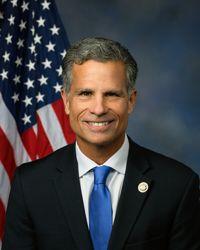
U.S. Representative for Pennsylvania’s 9th district
Republican
119th Congress, two-year term
Missed 5.2% of roll calls. Chamber median 1.9%.
The full voting recordCounts roll calls where most Democrats and most Republicans voted differently, leaving out procedural votes.
How we countFrom FEC filings, Voteview roll calls and Congress.gov.
Republican. In Congress since 2019, 4 terms in total.
Following saves Meuser to your list, which Chamber & Street keeps on its server, linked to a cookie on this browser and not to your name or email. Email alerts will come with constituent verification.
Bills and resolutions Meuser signed on to as a cosponsor. An original cosponsor signed on the day the bill was introduced. Source: govinfo bill status files, last updated Nov 6, 2026.
Crime Victims Fund Stabilization Act of 2025
Sponsor Ann Wagner (R). Joined Feb 13, 2025. 327 cosponsors. H.R. 909 on Congress.gov
Passed the House
Crime Victims Fund Stabilization Act of 2025
This bill adds a new source of revenue for the Crime Victims Fund (CVF). Specifically, the bill requires certain civil monetary penalties collected from settlements and judgments in cases involving fraud and false claims against the federal government to be deposited into the CVF through FY2029.
The CVF supports federal, state, and local programs and activities to compensate and assist victims of crimes. Currently, the CVF is funded by deposits from a variety of sources, including federal criminal fines, penalties, and assessments; forfeited bail bonds; and certain other gifts, donations, and bequests.
FAIR PREP Act of 2025
Sponsor Adrian Smith (R). Joined Feb 13, 2025. 29 cosponsors. H.R. 451 on Congress.gov(opens in a new tab)
Introduced
Fostering Autonomy in Independent Returns by Prohibiting Redundant and Extralegal Programs Act of 2025 or the FAIR PREP Act of 2025
This bill prohibits the Internal Revenue Service (IRS) from preparing federal tax returns or refund claims, with some exceptions. The bill specifically prohibits the preparation of federal income tax returns or refund claims through the IRS’s Direct File program. (The Direct File program currently allows qualified taxpayers in 25 participating states to prepare and electronically file free federal tax returns through a portal on the IRS’s website.)
The bill defines prepare with respect to federal tax returns and refund claims as (1) the completion (in whole or in part) of any form or schedule for the purpose of calculating federal taxes or refunds, and (2) the filing (either electronically or on paper) of such federal tax returns or refund claims.
However, under the bill, federal and state tax returns and refund claims may be prepared through the IRS’s Free File program (a program that allows certain taxpayers to prepare and file free federal and state income tax returns using third-party tax-preparation software) or the Volunteer Income Tax Assistance grant program (through which the IRS partners with local community organizations to help low-income and disabled individuals and persons with limited English proficiency prepare and file free federal and state income tax returns).
Further, the Department of the Treasury may not award grants or enter into contracts or other transactions for the development or operation of an electronic tax preparation service.
Dennis and Lois Krisfalusy Act
Sponsor Guy Reschenthaler (R). Original cosponsor. 9 cosponsors. H.R. 1344 on Congress.gov(opens in a new tab)
Introduced
Dennis and Lois Krisfalusy Act
This bill expands eligibility for a memorial headstone or marker for the spouse, surviving spouse, child, or dependent of a veteran or member of the Armed Forces. Currently, for individuals whose remains are unavailable, such benefit is only available for individuals who died on or after November 11, 1998. The bill makes such individuals eligible regardless of the date they died.
DRILL Now Act
Sponsor Scott Perry (R). Original cosponsor. 6 cosponsors. H.R. 1341 on Congress.gov(opens in a new tab)
Introduced
Smithsonian National Museum of the American Latino Act
Sponsor Nicole Malliotakis (R). Original cosponsor. 130 cosponsors. H.R. 1330 on Congress.gov(opens in a new tab)
Introduced
Smithsonian American Women’s History Museum Act
Sponsor Nicole Malliotakis (R). Original cosponsor. 231 cosponsors. H.R. 1329 on Congress.gov(opens in a new tab)
Introduced
Smithsonian American Women’s History Museum Act
This bill authorizes the Smithsonian American Women's History Museum to be located on a particular site within the Reserve of the National Mall in Washington, DC.
Specifically, the bill designates the South Monument site as the location for the museum; however, the President may designate an alternative site within 180 days of the bill's enactment. (The site is the undeveloped land across the National Mall from the National Museum of African American History and Culture.) Administrative jurisdiction of the site must be transferred to the Smithsonian Institution.
The Board of Regents of the Smithsonian Institution must have the approval of specified federal entities (e.g., the Commission of Fine Arts) to plan, design, and construct a museum building. The bill (1) outlines the criteria for considering site and design proposals, and (2) requires the Smithsonian Institution to reimburse for costs resulting from the building approval process.
The bill directs the museum to be dedicated to preserving, researching, and presenting the history, achievements, and lived experiences of biological women in the United States. Under this bill, the museum may not identify, present, describe, or depict any biological male as a female.
In carrying out its duties, the museum's advisory council must (1) seek and utilize guidance from a broad array of knowledgeable and respected sources reflecting the diversity of the political viewpoints and authentic experiences held by women in the United States, and (2) seek guidance for the creation and substantial revision of exhibits and programs.
Death Tax Repeal Act
Sponsor Randy Feenstra (R). Original cosponsor. 182 cosponsors. H.R. 1301 on Congress.gov(opens in a new tab)
Introduced
Disapproving the rule submitted by the Bureau of Consumer Financial Protection relating to "Overdraft Lending: Very Large Financial Institutions".
Sponsor J. Hill (R). Original cosponsor. 17 cosponsors. H.J.Res. 59 on Congress.gov(opens in a new tab)
Introduced
This joint resolution nullifies the final rule issued by the Consumer Financial Protection Bureau titled Overdraft Lending: Very Large Financial Institutions and published on December 30, 2024. The rule revises provisions regarding charges for insufficient funds in a customer’s bank account (i.e., overdrafts) at very large financial institutions. Under the rule, these institutions must (1) cap overdraft charges at $5; (2) with justification, cap charges at a higher amount; or (3) handle overdrafts as credit and comply with applicable Truth in Lending Act disclosure requirements.
Supporting the Local Radio Freedom Act.
Sponsor Steve Womack (R). Original cosponsor. 233 cosponsors. H.Con.Res. 12 on Congress.gov(opens in a new tab)
Introduced
This concurrent resolution declares that Congress should not impose any new performance fee, tax, royalty, or other charge relating to the public performance of sound recordings on a local radio station for broadcasting sound recordings over the air, or on any business for such public performance of sound recordings.
Rural Obstetrics Readiness Act
Sponsor Robin Kelly (D). Original cosponsor. 50 cosponsors. H.R. 1254 on Congress.gov(opens in a new tab)
Introduced
Rural Obstetrics Readiness Act
This bill creates and expands federal grant programs within the Health Resources and Services Administration (HRSA) to increase capacity to provide emergency obstetric health services in rural areas or areas without practitioners or facilities specializing in obstetric services.
Specifically, HRSA must establish a program for providing grants to certain hospitals or consortiums that include hospitals in rural areas or areas with maternal health care professional shortages for training, developing a workforce, and purchasing equipment relating to obstetric emergencies. In addition, the bill requires HRSA’s Alliance for Innovation on Maternal Health Capacity program to provide grants for training on emergency obstetric services for practitioners in rural health care facilities without dedicated obstetric units. HRSA must also establish a pilot program to provide grants to government entities for developing or improving telehealth access programs to support urgent maternal health care in rural facilities without a dedicated obstetric unit.
Empowering Law Enforcement To Fight Sex Trafficking Demand Act of 2025
Sponsor Morgan Luttrell (R). Joined Feb 10, 2025. 22 cosponsors. H.R. 520 on Congress.gov(opens in a new tab)
Introduced
Empowering Law Enforcement To Fight Sex Trafficking Demand Act of 2025
This bill allows grants under the Edward Byrne Memorial Justice Assistance Grant program to be used for programs to combat human trafficking.
Clock Hour Program Student Protection Act
Sponsor Lloyd Smucker (R). Original cosponsor. 5 cosponsors. H.R. 1176 on Congress.gov(opens in a new tab)
Introduced
Clock Hour Program Student Protection Act
This bill provides statutory authority for the 150% rule, which allows an educational program that prepares students for gainful employment in a recognized occupation to maintain eligibility for federal student aid funding if the program operates within 150% of the state's minimum hours requirement for licensure.
The Department of Education (ED) previously enforced the 150% rule through regulations. ED proposed a new regulation to rescind the 150% rule and instead limit the length of these programs to 100% of the state's minimum required hours. This revised regulation was set to take effect on July 1, 2024; however, a court imposed a temporary injunction to halt the regulation from taking effect.
Decoupling from Foreign Adversarial Battery Dependence Act
Sponsor Carlos Gimenez (R). Original cosponsor. 4 cosponsors. H.R. 1166 on Congress.gov(opens in a new tab)
Passed the House
Decoupling from Foreign Adversarial Battery Dependence Act
This bill prohibits the Department of Homeland Security (DHS) from using appropriated funds to procure a battery produced by certain entities, particularly six specific companies owned and operated in China. This prohibition begins on October 1, 2027.
The bill allows DHS to waive the prohibition if DHS assesses in the affirmative that (1) the batteries to be procured do not pose a risk to U.S. national security, data, or infrastructure; and (2) there is no available alternative to procure batteries that are of similar or better cost and quality and that are produced by an entity not specified in this bill.
DHS may also waive the prohibition upon a determination that the batteries to be procured are for the sole purpose of research, evaluation, training, testing, or analysis.
The bill requires DHS to notify Congress within 15 days after granting a waiver under this bill.
The bill also requires DHS to report to Congress on the anticipated impacts associated with carrying out this bill, including with respect to specified agencies of DHS.
Prove It Act
Sponsor Brad Finstad (R). Original cosponsor. 30 cosponsors. H.R. 1163 on Congress.gov(opens in a new tab)
Introduced
Prove It Act of 2025
This bill expands the requirements for federal agency rulemaking with respect to small businesses, organizations, and governmental jurisdictions.
Specifically, when conducting an initial regulatory flexibility analysis, agencies must include, where feasible, any reasonably foreseeable indirect costs the proposed rule may impose on small entities.
Further, if an agency certifies that an initial regulatory flexibility analysis is not required because the rule will not have a significant economic impact on a substantial number of small entities, the agency must provide such certification within 10 days to the Office of Advocacy of the Small Business Administration. A small entity or group of small entities may petition the Office of Advocacy to review such certification. The petition must include specified information, such as the issues the petitioner believes should be addressed and a proposed solution to the issues raised.
If the Office of Advocacy ultimately determines, upon a full review of the petition, that the proposed rule would have a significant economic impact on a substantial number of small entities, the agency promulgating the rule must perform an initial and final regulatory flexibility analysis for the rule. Additionally, if the agency does not participate or assist in the full review process, the finalized rule shall not apply to small entities.
The bill also requires agencies to publish, and allow for comments on, all guidance documents with respect to any rule an agency determines is likely to have a significant economic impact on a substantial number of small entities.
Marc Fischer Memorial Act
Sponsor Don Bacon (R). Joined Feb 10, 2025. 135 cosponsors. H.R. 1046 on Congress.gov(opens in a new tab)
Introduced
AM Radio for Every Vehicle Act of 2025
Sponsor Gus Bilirakis (R). Joined Feb 7, 2025. 317 cosponsors. H.R. 979 on Congress.gov(opens in a new tab)
Passed the House
AM Radio for Every Vehicle Act of 2025
This bill requires the Department of Transportation (DOT) to issue a rule requiring AM radio capabilities to be standard in all new passenger vehicles. (AM radio is often used to deliver emergency alerts and news and entertainment programming; some newer vehicles do not include AM equipment.)
Specifically, this bill applies to passenger vehicles (1) manufactured in the United States for sale in the United States, imported into the United States, or shipped in interstate commerce; and (2) manufactured after the rule's effective date. The rule must require all such vehicles to have devices that can receive signals and play content transmitted by AM stations or digital audio AM stations installed as standard equipment and made easily accessible to drivers.
Prior to the rule's effective date, manufacturers that do not include devices that can access AM radio as standard equipment (1) must inform purchasers of this fact through clear and conspicuous labeling, and (2) may not charge an additional or separate fee for AM radio access.
DOT may assess civil penalties for any violation of the rule. The Department of Justice may also bring a civil action to enjoin a violation.
The rule, including DOT’s authority to enforce it, must expire 10 years after the bill’s enactment.
Further, the Government Accountability Office must study and report on the dissemination of emergency alerts to the public, including by conducting an assessment of AM radio relative to other Integrated Public Alert and Warning System communication technologies.
Credit Union Board Modernization Act
Sponsor Juan Vargas (D). Joined Feb 7, 2025. 22 cosponsors. H.R. 975 on Congress.gov(opens in a new tab)
Passed the House
Credit Union Board Modernization Act
This bill reduces the required frequency of meetings held by the board of directors of certain credit unions. Under the bill, new credit unions and credit unions with a low soundness rating must meet monthly, as required under current law. All other credit unions must hold at least six meetings annually, with at least one meeting held during each fiscal quarter.
Medicare Patient Access and Practice Stabilization Act of 2025
Sponsor Gregory Murphy (R). Joined Feb 7, 2025. 198 cosponsors. H.R. 879 on Congress.gov(opens in a new tab)
Introduced
Medicare Patient Access and Practice Stabilization Act of 2025
This bill increases certain payment adjustments under the Medicare physician fee schedule for services furnished between April 1, 2025, and January 1, 2026.
Protect Small Businesses from Excessive Paperwork Act of 2025
Sponsor Zachary Nunn (R). Joined Feb 7, 2025. 12 cosponsors. H.R. 736 on Congress.gov(opens in a new tab)
Passed the House
Protect Small Businesses from Excessive Paperwork Act of 2025
This bill extends the deadline for certain companies that are required to file beneficial ownership information with the Financial Crimes Enforcement Network (FinCEN). Specifically, the bill requires companies formed or registered before January 1, 2024, to submit this information to FinCEN by January 1, 2026, instead of by January 1, 2025, as required under current regulations.
Chinese Currency Accountability Act of 2025
Sponsor Warren Davidson (R). Joined Feb 7, 2025. 1 cosponsor. H.R. 386 on Congress.gov(opens in a new tab)
Passed the House
Chinese Currency Accountability Act of 2025
This bill requires the United States to oppose, absent specified conditions, any increase in the weight of Chinese currency (i.e., the renminbi) in the basket of currencies (currently, a set of five currencies, each with different weightings) used to determine the value of Special Drawing Rights. Special Drawing Rights are international reserve assets created by the International Monetary Fund (IMF) to supplement member countries' official foreign exchange reserves.
Specifically, the Department of the Treasury must instruct certain U.S. officials at the IMF to oppose any such increase unless Treasury has certified that China is in compliance with certain standards and international agreements, including that (1) China is in compliance with all general obligations of members of the IMF, (2) China has not been found to have manipulated its currency in the preceding 12 months, and (3) China adheres to the rules and principles of the Paris Club and the Organisation for Economic Co-operation and Development (OECD) Arrangement on Officially Supported Export Credits.
Family Farm and Small Business Exemption Act
Sponsor Tracey Mann (R). Original cosponsor. 89 cosponsors. H.R. 1131 on Congress.gov(opens in a new tab)
Introduced
Family Farm and Small Business Exemption Act
This bill restores an exemption for certain family farms and small businesses on the Free Application for Federal Student Aid (FAFSA) form. The bill applies to the net worth of (1) a family farm on which the family resides, or (2) a small business with not more than 100 full-time or full-time equivalent employees that is owned and controlled by the family.
Prior to recent changes made to the FAFSA, the net worth of these family farms and small businesses were excluded as assets when calculating a student's financial need to determine federal student aid eligibility. Beginning with the 2024-2025 academic year, the net worth of these farms and businesses are treated as an asset and therefore included in the calculation. This bill restores the exemption to exclude such net worth from the calculation.
WARN Act
Sponsor Nicholas Langworthy (R). Original cosponsor. 41 cosponsors. H.R. 1076 on Congress.gov(opens in a new tab)
Introduced
Expressing the sense of Congress that the United States should resume normal diplomatic relations with Taiwan, negotiate a bilateral free trade agreement with Taiwan, and support Taiwans membership in international organizations.
Sponsor Thomas Tiffany (R). Original cosponsor. 38 cosponsors. H.Con.Res. 8 on Congress.gov(opens in a new tab)
Introduced
This concurrent resolution calls on the President to abandon the One China policy in favor of one that recognizes Taiwan as an independent country that is not a part of China. The resolution also urges the President to bolster diplomatic and economic relations between the United States and Taiwan through specified means.
Cost Estimates Improvement Act
Sponsor Michael Cloud (R). Original cosponsor. 20 cosponsors. H.R. 991 on Congress.gov(opens in a new tab)
Introduced
Cost Estimates Improvement Act
This bill requires cost estimates prepared by the Congressional Budget Office or the Joint Committee on Taxation to include the costs of servicing the public debt.
Fair Access to Banking Act
Sponsor Andy Barr (R). Original cosponsor. 151 cosponsors. H.R. 987 on Congress.gov(opens in a new tab)
Introduced
Fair Access to Banking Act
This bill places restrictions on certain banks, credit unions, and payment card networks if they refuse to do business with a person who complies with the law. Restrictions include prohibiting the use of electronic funds transfer systems and lending programs, termination of an institution's depository insurance, and specified civil penalties.
Banks and other specified financial institutions are allowed to deny financial services to a person only if the denial is justified by a documented failure of that person to meet quantitative, impartial, risk-based standards established in advance by the institution. This justification may not be based upon reputational risks to the institution.
The bill establishes the right for a person to bring a civil action for a violation of this bill.