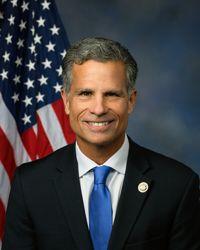
U.S. Representative for Pennsylvania’s 9th district
Republican
119th Congress, two-year term
Missed 5.2% of roll calls. Chamber median 1.9%.
The full voting recordCounts roll calls where most Democrats and most Republicans voted differently, leaving out procedural votes.
How we countFrom FEC filings, Voteview roll calls and Congress.gov.
Republican. In Congress since 2019, 4 terms in total.
Following saves Meuser to your list, which Chamber & Street keeps on its server, linked to a cookie on this browser and not to your name or email. Email alerts will come with constituent verification.
Bills and resolutions Meuser signed on to as a cosponsor. An original cosponsor signed on the day the bill was introduced. Source: govinfo bill status files, last updated Nov 6, 2026.
Protect and Serve Act of 2025
Sponsor John Rutherford (R). Joined Mar 31, 2025. 120 cosponsors. H.R. 1551 on Congress.gov
Introduced
Mikaela Naylon Give Kids a Chance Act
Sponsor Michael McCaul (R). Joined Mar 31, 2025. 313 cosponsors. H.R. 1262 on Congress.gov(opens in a new tab)
Passed the House
Give Kids a Chance Act of 2025
This bill expands the Food and Drug Administration’s (FDA’s) authority with respect to research on rare pediatric diseases, including by permitting the FDA to take enforcement action against drug sponsors that fail to satisfy pediatric study requirements and by reauthorizing programs that support pediatric research.
Specifically, the bill
• modifies requirements relating to molecularly targeted pediatric cancer investigations to permit research on new drugs in combination with active ingredients that have already been approved, provided certain conditions are met;
• permits the FDA to take enforcement action against drug sponsors that fail to comply with pediatric study requirements, if such sponsors demonstrated a lack of due diligence in satisfying the requirement;
• renews the FDA’s authority to award priority review vouchers to sponsors of new products intended to treat rare pediatric diseases through September 30, 2029; and
• reauthorizes through FY2027 certain funding for the National Institutes of Health to support priority pediatric research.
The bill also provides statutory authority for the FDA’s interpretation of the orphan drug exclusivity period. The bill specifies, consistent with FDA regulations, that the seven-year market exclusivity period for drugs for rare diseases or conditions (i.e., orphan drugs) prohibits the approval of the same drug for the same approved use or indication with respect to the disease or condition. (In Catalyst Pharmaceuticals, Inc. v. Becerra, a court rejected the FDA’s interpretation and held that orphan drug exclusivity extends to all uses or indications for the disease or condition.)
Black Vulture Relief Act
Sponsor John Rose (R). Original cosponsor. 26 cosponsors. H.R. 2462 on Congress.gov(opens in a new tab)
Introduced
Black Vulture Relief Act of 2025
This bill allows livestock producers and their employees to take certain actions against black vultures to protect livestock. (Black vultures are protected under the Migratory Bird Treaty Act.)
Specifically, livestock producers and their employees may (1) take (i.e., capture, kill, or disperse, or transport the carcass of) a black vulture that they reasonably believe will cause death, injury, or destruction to livestock; or (2) in the course of taking or attempting to take the black vulture, cause injury to the bird. However, they may not take or attempt to take a black vulture through the use of poison.
Livestock producers and their employees must submit an annual report to the U.S. Fish and Wildlife Service (FWS) on black vultures taken under this bill. The FWS must develop a reporting form and make this reporting form available on its website.
Currently, the FWS has a permit process under the Migratory Bird Treaty Act for the taking of black vultures.
STABLE Act of 2025
Sponsor Bryan Steil (R). Original cosponsor. 17 cosponsors. H.R. 2392 on Congress.gov(opens in a new tab)
Introduced
Stablecoin Transparency and Accountability for a Better Ledger Economy Act of 2025 or the STABLE Act of 2025
This bill establishes a regulatory framework for payment stablecoins (digital assets which an issuer must redeem for a fixed value).
Under the bill, only permitted issuers may issue a payment stablecoin in the United States, subject to certain exceptions. Permitted issuers must be a subsidiary of an insured depository institution, a federal-qualified nonbank payment stablecoin issuer, or a state-qualified payment stablecoin issuer. Permitted issuers must be regulated by the appropriate federal or state regulator. A state regulator must certify that the state regulatory regime meets or exceeds federal requirements as established by the bill.
Permitted issuers must maintain reserves backing the stablecoin on a one-to-one basis using U.S. currency or other similarly liquid assets, as specified. Permitted issuers must also publicly disclose their redemption policy and publish monthly the details of their reserves.
The bill specifies requirements for (1) reusing reserves; (2) providing safekeeping services for stablecoins; and (3) supervisory, examination, and enforcement authority over federal-qualified issuers.
The bill places a two-year moratorium on new endogenously collateralized stablecoins (i.e., stablecoins that rely on the value of another digital asset created or maintained by the same originator to maintain the fixed price).
Under the bill, permitted payment stablecoins are not considered securities under securities law. However, permitted issuers are subject to the Bank Secrecy Act for anti-money laundering and related purposes.
Making the CFPB Accountable to Small Businesses Act of 2025
Sponsor Scott Fitzgerald (R). Joined Mar 26, 2025. 3 cosponsors. H.R. 1606 on Congress.gov(opens in a new tab)
Introduced
Making the CFPB Accountable to Small Businesses Act of 2025
This bill requires the Consumer Financial Protection Bureau (CFPB) to consider the impact of proposed rules on small entities.
In addition, the CFPB, the Environmental Protection Agency, and the Occupational Safety and Health Administration must justify decisions to not adopt certain alternatives to regulations that are applicable to small entities.
SHARE Act of 2026
Sponsor Tracey Mann (R). Original cosponsor. 29 cosponsors. H.R. 2332 on Congress.gov(opens in a new tab)
Introduced
CEMAC Act
Sponsor Bill Huizenga (R). Original cosponsor. 2 cosponsors. H.R. 2325 on Congress.gov(opens in a new tab)
Introduced
DMEPOS Relief Act of 2025
Sponsor Mariannette Miller-Meeks (R). Joined Mar 25, 2025. 25 cosponsors. H.R. 2005 on Congress.gov(opens in a new tab)
Introduced
DMEPOS Relief Act of 2025
This bill extends until December 31, 2025, a higher payment rate (known as the 75/25 blended rate) for durable medical equipment in nonrural or noncontiguous areas under Medicare.
HELPER Act of 2025
Sponsor John Rutherford (R). Joined Mar 24, 2025. 154 cosponsors. H.R. 2094 on Congress.gov(opens in a new tab)
Introduced
Homes for Every Local Protector, Educator, and Responder Act of 2025 or the HELPER Act of 2025
This bill establishes a program administered by the Department of Housing and Urban Development to provide mortgage assistance to law enforcement officers, elementary and secondary school teachers, firefighters, or other first responders. Specifically, these individuals may be eligible for a first-time mortgage on a primary family residence with no down payment. Instead, the mortgage is subject to a one-time, up-front mortgage insurance premium.
NORRA of 2025
Sponsor Darrell Issa (R). Joined Mar 24, 2025. 14 cosponsors. H.R. 1526 on Congress.gov(opens in a new tab)
Passed the House
No Rogue Rulings Act or NORRA
This bill limits the authority of federal district courts to issue injunctions.
Specifically, it prohibits a district court from issuing an injunction unless the injunction applies only to the parties of the particular case before the court.
To designate the facility of the United States Postal Service located at 521 Thorn Street in Sewickley, Pennsylvania, as the "Mary Elizabeth 'Bettie' Cole Post Office Building".
Sponsor Christopher Deluzio (D). Joined Mar 24, 2025. 16 cosponsors. H.R. 1461 on Congress.gov(opens in a new tab)
Passed the House
This bill designates the facility of the United States Postal Service located at 521 Thorn Street in Sewickley, Pennsylvania, as the "Mary Elizabeth 'Bettie' Cole Post Office Building".
Access to Small Business Investor Capital Act
Sponsor Brad Sherman (D). Joined Mar 21, 2025. 25 cosponsors. H.R. 2225 on Congress.gov(opens in a new tab)
Passed the House
Access to Small Business Investor Capital Act
This bill allows a registered investment company to exclude from the calculation of acquired fund fees and expenses those incurred indirectly from investment in a business development company. Acquired fund fees and expenses is a required line item on a fund's fee schedule that provides the operating expenses of the fund.
CATCH Fentanyl Act
Sponsor Clay Higgins (R). Joined Mar 21, 2025. 21 cosponsors. H.R. 1569 on Congress.gov(opens in a new tab)
Introduced
Contraband Awareness Technology Catches Harmful Fentanyl Act or the CATCH Fentanyl Act
This bill establishes a pilot program for improving the inspection of conveyances or modes of transportation at land ports of entry along U.S. borders to detect contraband, illegal drugs, illegal weapons, human smuggling, and threats. Specifically, the U.S. Customs and Border Protection Innovation Team must test technology in at least one of the categories of artificial intelligence, machine learning, high-performance computing, quantum information sciences, or other emerging technologies. The team must also test and collect data regarding at least five types of enhancements to nonintrusive inspection technology (e.g., X-ray machines) able to be deployed at land ports of entry.
Veterans 2nd Amendment Protection Act
Sponsor Mike Bost (R). Joined Mar 21, 2025. 70 cosponsors. H.R. 1041 on Congress.gov(opens in a new tab)
Passed the House
Veterans 2nd Amendment Protection Act
This bill prohibits the Department of Veterans Affairs (VA) from transmitting certain information to the National Instant Criminal Background Check System (NICS) utilized by licensed importers or dealers of firearms.
Specifically, the bill prohibits the VA from transmitting personally identifying information of a veteran or a beneficiary to the NICS solely on the basis that such veteran or beneficiary has an appointed fiduciary to manage their benefits, unless there is an order or finding of a judicial authority that such veteran or beneficiary is a danger to themselves or others.
Student Empowerment Act
Sponsor Kevin Hern (R). Joined Mar 18, 2025. 5 cosponsors. H.R. 939 on Congress.gov(opens in a new tab)
Introduced
Student Empowerment Act
This bill expands the education-related expenses that may be paid for with tax-free distributions from a qualified tuition program (also known as a 529 plan) to include certain expenses related to elementary, secondary, and homeschool education.
Under current law, distributions from a 529 plan are excluded from gross income if they are used to pay for qualified higher education expenses, which includes up to $10,000 (per year and per beneficiary) for tuition at an elementary or secondary public, private, or religious school.
The bill expands the education-related expenses that may be paid for with tax-free distributions from a 529 plan to include tuition related to homeschooling and the following expenses related to elementary, secondary, and homeschool education:
• curriculum and curricular materials,
• books or other instructional materials,
• online educational materials,
• tutoring or educational classes outside the home,
• testing fees,
• fees for dual enrollment in an institution of higher education, and
• educational therapies for students with disabilities.
Air America Act of 2025
Sponsor Glenn Grothman (R). Original cosponsor. 178 cosponsors. H.R. 2192 on Congress.gov(opens in a new tab)
Introduced
FOCA Act of 2025
Sponsor Clay Higgins (R). Original cosponsor. 107 cosponsors. H.R. 2126 on Congress.gov(opens in a new tab)
Introduced
Fair and Open Competition Act of 2025 or the FOCA Act of 2025
This bill requires that federal contracts for construction projects neither require nor prohibit a bidder, offeror, contractor, or subcontractor from entering into agreements with one or more labor organizations with respect to such projects or related projects.
Under the bill, the controlling documents for federal construction contracts (such as bid specifications and project agreements) may not require or prohibit a bidder, offeror, contractor, or subcontractor from entering into or adhering to such labor agreements. Additionally, the controlling documents may not discriminate against or give preference to a bidder, offeror, contractor, or subcontractor who signs or refuses to sign such a labor agreement.
These requirements also apply to any (1) construction manager acting on behalf of the federal government with respect to such contract, (2) recipient of a federal grant or financial assistance for construction projects or construction manager acting on the recipient's behalf, and (3) party to a federal cooperative agreement for construction projects or construction managers acting on the party's behalf.
An agency may exempt a project from this prohibition to avert an imminent threat to public health or safety or to serve the national security.
Major Richard Star Act
Sponsor Gus Bilirakis (R). Original cosponsor. 340 cosponsors. H.R. 2102 on Congress.gov(opens in a new tab)
Introduced
Major Richard Star Act
This bill allows a veteran with a combat-related disability to receive retirement pay, without reduction, concurrently with their disability compensation. This includes veterans with a combat-related disability and fewer than 20 years of creditable service. (Currently, veterans who receive combat-related special compensation and retirement pay are subject to an offset in retirement pay for concurrent receipt of such benefits.)
Choices for Increased Mobility Act of 2026
Sponsor John Joyce (R). Joined Mar 14, 2025. 10 cosponsors. H.R. 1703 on Congress.gov(opens in a new tab)
Passed the House
Choices for Increased Mobility Act of 2025
This bill requires the Centers for Medicare & Medicaid Services (CMS) to establish specific billing codes under Medicare for certain materials used in ultralightweight manual wheelchairs.
Specifically, the CMS must establish at least two billing codes for the base of the wheelchair, with at least one code for a base with titanium or carbon fiber construction material and at least one code for a base without these materials. Suppliers receive the same payment under Medicare for these wheelchairs as would otherwise apply, but may bill beneficiaries for any difference between the payment and the actual charge for the wheelchair. The CMS may require suppliers to inform beneficiaries of their potential financial liability in these cases.
Enhanced Iran Sanctions Act of 2025
Sponsor Michael Lawler (R). Joined Mar 14, 2025. 295 cosponsors. H.R. 1422 on Congress.gov(opens in a new tab)
Passed the House
Enhanced Iran Sanctions Act of 2025
This bill imposes sanctions on certain foreign persons (individuals and entities) that are involved in Iran's petroleum sector as well as certain associated persons. The bill also requires or authorizes actions to facilitate the enforcement of sanctions on Iran.
Specifically, the bill requires the President to impose visa- and property-blocking sanctions on any foreign person that, after the bill's enactment, knowingly engages in any transaction related to the processing, export, or sale of oil, condensates, gas, liquefied natural gas, or other petrochemical products in whole or in part from Iran. The President must also impose sanctions on certain foreign persons associated with a sanctioned individual or entity. For example, the President must sanction the subsidiaries and corporate officers of a sanctioned business.
The bill provides certain exceptions to these sanctions, including specifying that sanctions do not apply to the importation of goods or to conducting or facilitating transactions for humanitarian assistance.
The Department of State must establish an interagency working group that shall seek to establish a multilateral contact group to coordinate international efforts to enforce sanctions on Iran.
The bill expands the State Department rewards program to authorize a reward payment to any individual who furnishes information leading to the identification of a person (1) subject to sanctions under this bill, or (2) that has attempted or is attempting to evade sanctions under this bill.
Recognizing the importance of stepped-up basis under section 1014 of the Internal Revenue Code of 1986 in preserving family-owned farms and small businesses.
Sponsor Tracey Mann (R). Original cosponsor. 29 cosponsors. H.Res. 206 on Congress.gov(opens in a new tab)
Introduced
This resolution supports preserving the stepped-up basis of certain inherited assets (such as land, equipment, or buildings), opposes any efforts to impose new taxes on family farms or small businesses, and recognizes the importance of generational transfers of farm and family-owned businesses.
As background, the basis for federal tax purposes of certain inherited assets is reset (or stepped up) from the original cost basis to the fair market value of the asset on the date of the previous owner’s death. Thus, any gain or loss on the subsequent sale of an inherited asset generally is calculated based on the asset’s stepped-up basis (and not the original cost basis).
American Innovation and R&D Competitiveness Act of 2025
Sponsor Ron Estes (R). Original cosponsor. 81 cosponsors. H.R. 1990 on Congress.gov(opens in a new tab)
Introduced
Tanning Tax Repeal Act of 2025
Sponsor Carol Miller (R). Joined Mar 10, 2025. 26 cosponsors. H.R. 1940 on Congress.gov(opens in a new tab)
Introduced
Tanning Tax Repeal Act of 2025
This bill repeals the 10% excise tax imposed on the amount paid for indoor tanning services.
Anti-CBDC Surveillance State Act
Sponsor Tom Emmer (R). Original cosponsor. 135 cosponsors. H.R. 1919 on Congress.gov(opens in a new tab)
Passed the House
Anti-CBDC Surveillance State Act
This bill prohibits a Federal Reserve bank from offering products or services directly to an individual, maintaining an account on behalf of an individual, or issuing a central bank digital currency (i.e., a digital dollar). Further, the Board of Governors of the Federal Reserve System is prohibited from using a central bank digital currency to implement monetary policy or from testing, studying, creating, or implementing a central bank digital currency, with exceptions as provided by the bill.
Disapproving the rule submitted by the Bureau of Consumer Financial Protection relating to "Prohibition on Creditors and Consumer Reporting Agencies Concerning Medical Information (Regulation V)".
Sponsor Ralph Norman (R). Original cosponsor. 13 cosponsors. H.J.Res. 74 on Congress.gov(opens in a new tab)
Introduced
This joint resolution nullifies the final rule issued by the Consumer Financial Protection Bureau titled Prohibition on Creditors and Consumer Reporting Agencies Concerning Medical Information (Regulation V) and published on January 14, 2025. This rule prohibits the inclusion of medical debt on credit reports and prohibits creditors from considering medical debt when making credit eligibility determinations.