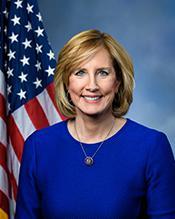
U.S. Representative for New York’s 24th district
Republican
119th Congress, two-year term
Missed 0.7% of roll calls. Chamber median 1.9%.
The full voting recordCounts roll calls where most Democrats and most Republicans voted differently, leaving out procedural votes.
How we countFrom FEC filings, Voteview roll calls and Congress.gov.
Republican. In Congress since 2017, 4 terms in total.
Following saves Tenney to your list, which Chamber & Street keeps on its server, linked to a cookie on this browser and not to your name or email. Email alerts will come with constituent verification.
Bills and resolutions where Tenney is the primary sponsor. Most bills never leave committee; that is normal for every member. Source: Congress.gov, last updated Oct 29, 2026.
34 of 83 have at least one cosponsor from the other party.
To designate the facility of the United States Postal Service located at 80 Prospect Street in Avon, New York, as the "Officer Anthony Mazurkiewicz Memorial Post Office Building".
Introduced Jan 9, 2025. 24 cosponsors, 18 from the other party. H.R. 323 on Congress.gov
Passed the House
This bill designates the facility of the United States Postal Service located at 80 Prospect Street in Avon, New York, as the "Officer Anthony Mazurkiewicz Memorial Post Office Building".
Protect Local Farms Act
Introduced Jan 7, 2025. 3 cosponsors. H.R. 240 on Congress.gov(opens in a new tab)
Introduced
Protect Local Farms Act
This bill provides that the Fair Labor Standards Act (FLSA) preempts any state law that establishes a maximum workweek (i.e., the maximum number of hours an employee is permitted to work without receiving overtime pay) of less than 60 hours for agricultural employees.
Under the FLSA, agricultural employees are generally exempt from federal overtime requirements. However, federal overtime requirements currently do not preempt state laws that provide greater protections to employees.
Commission to Relocate the Federal Bureaucracy Act
Introduced Jan 3, 2025. 0 cosponsors. H.R. 202 on Congress.gov(opens in a new tab)
Introduced
Commission to Relocate the Federal Bureaucracy Act
This bill establishes a commission to study the relocation of nonsecurity-related federal agencies based in the Washington, DC, metropolitan area to other areas throughout the United States. Within one year of the bill's enactment the commission must submit a report to Congress that includes relocation recommendations based on specified considerations.
Federal Freeze Act
Introduced Jan 3, 2025. 0 cosponsors. H.R. 200 on Congress.gov(opens in a new tab)
Introduced
Federal Freeze Act
This bill bars pay raises for federal employees for one year and requires reductions in the number of employees at each federal agency.
The bill prohibits agencies from increasing the basic pay of any employee for one year after enactment. Also in that first year, the bill prohibits each federal agency from increasing the number of its employees beyond the number employed on the date of the bill's enactment, except that the agency may increase such number when making appointments to positions related to law enforcement, public safety, or national security.
Additionally, the bill requires reductions in force such that within three years of the bill's enactment the number of employees at each agency is 5% lower than it was on the date of the bill's enactment.
SERVE Our Communities Act
Introduced Jan 3, 2025. 6 cosponsors. H.R. 198 on Congress.gov(opens in a new tab)
Introduced
Stop Enabling Repeat Violence and Endangering Our Communities Act or the SERVE Our Communities Act
This bill authorizes the Bureau of Justice Assistance to make grants to states and local governments for mentoring, transitional services, and training to help offenders successfully reintegrate back into the community after incarceration. To be eligible for a grant, a state or local government must take steps to prevent repeat offenses by violent offenders and allow a state court or magistrate to consider the danger an individual poses to the community when determining bail or pretrial release conditions.
Red Light Act
Introduced Jan 3, 2025. 4 cosponsors. H.R. 203 on Congress.gov(opens in a new tab)
Introduced
Red Light Act
This bill directs the Department of Transportation to withhold all of a state's share of certain federal highway funds (specifically, funds for the National Highway Performance Program, the Highway Safety Improvement Program, and the Congestion Mitigation and Air Quality Improvement Program) in FY2023 and thereafter if such state has enacted a law to provide driver's licenses or other identification cards to aliens who are unlawfully present in the United States.
Federal Employee Performance and Accountability Act of 2025
Introduced Jan 3, 2025. 0 cosponsors. H.R. 201 on Congress.gov(opens in a new tab)
Introduced
Federal Employee Performance and Accountability Act of 2025
This bill establishes a pilot program making pay increases for certain federal employees contingent on job performance.
Under the bill, each executive agency must identify employees to participate in the five-year pilot program from among employees classified at or above the GS-11 level and holding positions with clearly measurable performance criteria. Each agency must select 1%-10% of these employees to participate in the program. An agency may opt out if participation potentially risks national security or public safety.
The bill provides that a participating agency
• must increase an employee's pay by up to 10% if the employee significantly exceeded established performance metrics during the preceding year,
• may not increase the pay of an employee who met established performance metrics during the preceding year, and
• must reduce by 10% the pay of an employee who rates below expectations for the preceding year.
Participating employees are ineligible for annual or locality-based pay increases authorized under current law during the pilot.
The bill also requires agencies to establish performance plans and evaluation systems for participating employees. Agencies must also provide training and resources to help participating employees understand and meet performance requirements.
Participating agencies must report cost savings, productivity metrics, and other information to the Office of Management and Budget (OMB) every year. OMB and the Government Accountability Office must jointly report on the final outcome of the program.
Implementing DOGE Act
Introduced Jan 3, 2025. 0 cosponsors. H.R. 199 on Congress.gov(opens in a new tab)
Introduced
Implementing Decreases in Overall Government Expenditures Act or the Implementing DOGE Act
This bill requires rescissions of certain nonsecurity (i.e., nondefense) discretionary appropriations.
Beginning in FY2026, the bill requires annual rescissions on a pro rata basis that are equal to the excess growth percent of the nonsecurity discretionary appropriations made available for the fiscal year. Under the bill, the excess growth percent is the percentage in excess of 1% that the total annual appropriations exceeded the previous fiscal year’s annual appropriations.
The rescissions required by the bill are effective on the day after the date on which appropriations are made available through September 30 of the applicable fiscal year for the entire federal government.