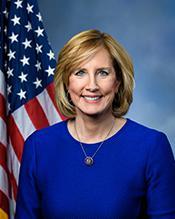
U.S. Representative for New York’s 24th district
Republican
119th Congress, two-year term
Missed 0.7% of roll calls. Chamber median 1.9%.
The full voting recordCounts roll calls where most Democrats and most Republicans voted differently, leaving out procedural votes.
How we countFrom FEC filings, Voteview roll calls and Congress.gov.
Republican. In Congress since 2017, 4 terms in total.
Following saves Tenney to your list, which Chamber & Street keeps on its server, linked to a cookie on this browser and not to your name or email. Email alerts will come with constituent verification.
Bills and resolutions Tenney signed on to as a cosponsor. An original cosponsor signed on the day the bill was introduced. Source: govinfo bill status files, last updated Nov 6, 2026.
Accreditation for College Excellence Act of 2025
Sponsor Burgess Owens (R). Original cosponsor. 12 cosponsors. H.R. 2516 on Congress.gov
Introduced
To codify Executive Order 14248, entitled "Preserving and Protecting the Integrity of American Elections".
Sponsor Abraham Hamadeh (R). Original cosponsor. 4 cosponsors. H.R. 2499 on Congress.gov(opens in a new tab)
Introduced
This bill provides statutory authority for an executive order that restricts voting in federal elections. Executive Order 14248, titled Preserving and Protecting the Integrity of American Elections, was signed by President Donald Trump on March 25, 2025.
Specifically, the order directs the Election Assistance Commission (EAC) to update the national mail voter registration form to require individuals to provide documentary proof of U.S. citizenship when registering to vote in federal elections. The order specifies what documents are considered acceptable proof of U.S. citizenship, such as a U.S. passport or identification that complies with the REAL ID Act of 2005 and indicates U.S. citizenship.
Additionally, the order directs the EAC to (1) revise the most recent version of the Voluntary Voting System Guidelines (which was adopted by the EAC in 2021) to prohibit voting systems that use a barcode or quick-response code in the vote counting process; and (2) review and, if appropriate, recertify voting systems under the new standards established in the order and rescind all previous certifications of voting equipment based on prior standards.
The order directs the Department of Justice (DOJ) to enforce federal election law against states that do not adopt an interpretation requiring mail-in ballots to be received, rather than sent, by Election Day to be counted.
The order addresses additional issues, including state election database access by the federal government, conditions for federal election funding, and additional requirements for DOJ to enforce federal election law.
DMEPOS Relief Act of 2025
Sponsor Mariannette Miller-Meeks (R). Joined Mar 31, 2025. 25 cosponsors. H.R. 2005 on Congress.gov(opens in a new tab)
Introduced
DMEPOS Relief Act of 2025
This bill extends until December 31, 2025, a higher payment rate (known as the 75/25 blended rate) for durable medical equipment in nonrural or noncontiguous areas under Medicare.
Supply Chain Security and Growth Act of 2025
Sponsor Nicole Malliotakis (R). Joined Mar 31, 2025. 12 cosponsors. H.R. 1328 on Congress.gov(opens in a new tab)
Introduced
Supply Chain Security and Growth Act of 2025
This bill establishes a tax credit for qualified investments made in certain facilities that are located in a U.S. possession and manufacture drugs, pharmaceuticals, semiconductors, or certain other items, subject to limitations. The bill also increases the deemed-paid foreign tax credit for taxes paid to a U.S. possession.
Specifically, under the bill, a taxpayer (other than a prohibited foreign entity) is allowed a tax credit for 40% of an investment in certain property that is
• placed into service during the tax year;
• integral to the operation of a critical supply chain facility; and
• constructed, reconstructed, or erected by the taxpayer, or property acquired for original used by the taxpayer.
The bill defines critical supply chain facility as a facility that (1) manufactures active pharmaceutical ingredients, drugs, biologic products, medical countermeasures, medical diagnostic devices, semiconductors, semiconductor manufacturing equipment, aerospace equipment, or artificial nanomaterials; and (2) is located in Puerto Rico, Guam, American Samoa, the Northern Mariana Islands, or the Virgin Islands.
Under the bill, the tax credit is transferable and may be claimed as a direct cash payment (i.e., elective payment). (Limitations apply.)
Finally, the bill increases to 100% (from 80%) the deemed-paid foreign tax credit for income taxes paid or accrued by a controlled foreign corporation (CFC) to a U.S. possession. (Under current law, a U.S. shareholder of a CFC is allowed a tax credit for income taxes paid by a CFC on certain income attributable to the U.S. shareholder.)
Alternatives to PAIN Act
Sponsor Mariannette Miller-Meeks (R). Joined Mar 31, 2025. 116 cosponsors. H.R. 1227 on Congress.gov(opens in a new tab)
Introduced
Alternatives to Prevent Addiction In the Nation Act or the Alternatives to PAIN Act
This bill reduces cost-sharing and prohibits the imposition of certain utilization requirements under the Medicare prescription drug benefit for certain non-opioid pain management drugs.
Specifically, the bill requires such drugs to be covered without a deductible and to be placed on the lowest cost-sharing tier (if any). The bill also prohibits the imposition of prior authorization requirements (i.e., requiring prior approval from a plan) or step therapy requirements (i.e., requiring the use of alternative drugs before a drug is covered under a plan) with respect to such drugs.
Improve and Enhance the Work Opportunity Tax Credit Act
Sponsor Lloyd Smucker (R). Joined Mar 31, 2025. 17 cosponsors. H.R. 1177 on Congress.gov(opens in a new tab)
Introduced
Improve and Enhance the Work Opportunity Tax Credit Act
This bill increases the work opportunity tax credit (WOTC) for wages paid during the first year of employment to certain employees. The bill also eliminates the maximum age limit applicable to Supplemental Nutrition Assistance Program (SNAP) benefit recipients for purposes of the WOTC.
Under current law, an employer generally may claim a WOTC in the amount of 40% of up to $6,000 (or of up to $24,000 for certain veterans, $3,000 for summer youth employees, and $10,000 for long-term family aid recipients) of qualified wages paid during the first year of employment to an employee who is a member of a targeted group. (Exceptions and limitations apply.)
The bill increases the WOTC to (1) 50% of up to $6,000 (or of up to $24,000 for certain veterans) of qualified first-year wages paid to an employee who is a member of a targeted group (other than a summer youth employee or recipient of long-term family aid), and (2) 50% of up to $12,000 (or of up to $48,000 for certain veterans) of qualified wages paid during the first year of employment to such employee if the employee works at least 400 hours during the year.
Finally, the bill eliminates the maximum age limit applicable to SNAP benefit recipients and, thus, allows an employer to claim the WOTC for qualified first-year wages paid to an employee who is at least 18 years old and receiving SNAP benefits for a certain period of time.
Keep Our Girls Safe Act of 2025
Sponsor Mary Miller (R). Original cosponsor. 13 cosponsors. H.R. 2452 on Congress.gov(opens in a new tab)
Introduced
Stop Antisemitism on College Campuses Act
Sponsor Michael Lawler (R). Original cosponsor. 19 cosponsors. H.R. 2446 on Congress.gov(opens in a new tab)
Introduced
Stop Antisemitism on College Campuses Act
This bill prohibits an institution of higher education (IHE) that participates in federal student aid programs from authorizing, facilitating, providing funding for, or otherwise supporting any event that promotes anti-Semitism on the IHE's campus.
Unfair Tax Prevention Act
Sponsor Ron Estes (R). Original cosponsor. 24 cosponsors. H.R. 2423 on Congress.gov(opens in a new tab)
Introduced
Revitalizing Downtowns and Main Streets Act
Sponsor Mike Carey (R). Original cosponsor. 57 cosponsors. H.R. 2410 on Congress.gov(opens in a new tab)
Introduced
Accountability for Terrorist Perpetrators of October 7th Act
Sponsor Brad Sherman (D). Joined Mar 27, 2025. 24 cosponsors. H.R. 2346 on Congress.gov(opens in a new tab)
Introduced
Generating Retirement Ownership through Long-Term Holding
Sponsor Beth Van Duyne (R). Joined Mar 27, 2025. 130 cosponsors. H.R. 2089 on Congress.gov(opens in a new tab)
Introduced
Space National Guard Establishment Act of 2025
Sponsor Jason Crow (D). Joined Mar 27, 2025. 18 cosponsors. H.R. 2042 on Congress.gov(opens in a new tab)
Introduced
Space National Guard Establishment Act of 2025
This bill establishes a Space National Guard as the reserve component of the U.S. Space Force, specifically in Alaska, California, Colorado, Florida, Hawaii, New York, and Ohio. The Space National Guard consists of specified units of the Air National Guard and must use existing facilities, infrastructure, and installations.
Recognizing the 250th anniversary of the United States Marine Corps.
Sponsor Jack Bergman (R). Original cosponsor. 64 cosponsors. H.Res. 254 on Congress.gov(opens in a new tab)
Introduced
Defining Male and Female Act of 2025
Sponsor Mary Miller (R). Original cosponsor. 7 cosponsors. H.R. 2378 on Congress.gov(opens in a new tab)
Introduced
American Genetic Privacy Act of 2025
Sponsor Tim Burchett (R). Joined Mar 26, 2025. 4 cosponsors. H.R. 2286 on Congress.gov(opens in a new tab)
Introduced
Credit for Caring Act of 2025
Sponsor Mike Carey (R). Joined Mar 26, 2025. 145 cosponsors. H.R. 2036 on Congress.gov(opens in a new tab)
Introduced
End Taxpayer Funding of Gender Experimentation Act of 2025
Joined Mar 25, 2025. 23 cosponsors. H.R. 2202 on Congress.gov(opens in a new tab)
Progress not on file
Providing for congressional disapproval under chapter 8 of title 5, United States Code, of the rule submitted by the Office of Energy Efficiency and Renewable Energy, Department of Energy relating to "Energy Conservation Program: Energy Conservation Standards for Commercial Refrigerators, Freezers, and Refrigerator-Freezers".
Sponsor Craig Goldman (R). Joined Mar 25, 2025. 13 cosponsors. H.J.Res. 75 on Congress.gov(opens in a new tab)
Became law
This joint resolution eliminates new, more stringent energy conservation standards for commercial refrigerators, freezers, and refrigerator-freezers. Under the joint resolution, such equipment is no longer required to comply with the new standards.
Specifically, the joint resolution nullifies the rule titled Energy Conservation Program: Energy Conservation Standards for Commercial Refrigerators, Freezers, and Refrigerator-Freezers and published by the Department of Energy's Office of Energy Efficiency and Renewable Energy on January 21, 2025. Under the rule, the office adopted new energy conservation standards for commercial refrigeration equipment to achieve the maximum improvement in energy efficiency that is technologically feasible and economically justified. The rule required the equipment to comply with the those standards by January 22, 2029.
Traveler’s Gun Rights Act
Sponsor Dusty Johnson (R). Joined Mar 24, 2025. 6 cosponsors. H.R. 2060 on Congress.gov(opens in a new tab)
Introduced
Traveler's Gun Rights Act
This bill broadens the scope of allowable firearms transactions involving active duty servicemembers and their spouses and individuals who do not have a residence in any state.
Currently, federal firearms laws generally prohibit a federal firearms licensee (e.g., a gun dealer) from selling or delivering a firearm to an individual whose state of residence is different than the state where the licensee's place of business is located.
This bill defines the term state of residence as the state in which an individual is present with an intention of making a home.
In the case of an individual who does not have a physical residence in any state, the term state of residence means the address of the individual's private mailbox or post office box.
In the case of a member of the Armed Forces on active duty, or his or her spouse, the term state of residence means (1) the state in which the member's permanent duty station is located, and (2) the state where the member maintains a place of abode from which he or she commutes to the permanent duty station.
To amend title XI of the Social Security Act to equalize the negotiation period between small-molecule and biologic candidates under the Drug Price Negotiation Program.
Sponsor Gregory Murphy (R). Joined Mar 24, 2025. 68 cosponsors. H.R. 1492 on Congress.gov(opens in a new tab)
Introduced
This bill lengthens the amount of time for which drug products must have market approval in order for the products to qualify for negotiation under the Medicare Drug Price Negotiation Program.
The Medicare Drug Price Negotiation Program requires the Centers for Medicare & Medicaid Services to negotiate the prices of certain prescription drugs under Medicare beginning in 2026. Among other requirements, drugs must have had market approval for at least 7 years (for drug products) or 11 years (for biologics) to qualify for negotiation.
The bill modifies these provisions so as to require drug products to also have had at least 11 years of market approval in order to qualify for negotiation.
The bill's changes apply retroactively.
BIRD Energy and U.S.-Israel Energy Center Reauthorization Act of 2025
Sponsor Debbie Wasserman Schultz (D). Original cosponsor. 17 cosponsors. H.R. 2280 on Congress.gov(opens in a new tab)
Introduced
NORRA of 2025
Sponsor Darrell Issa (R). Joined Mar 21, 2025. 14 cosponsors. H.R. 1526 on Congress.gov(opens in a new tab)
Passed the House
No Rogue Rulings Act or NORRA
This bill limits the authority of federal district courts to issue injunctions.
Specifically, it prohibits a district court from issuing an injunction unless the injunction applies only to the parties of the particular case before the court.
Federal Retirement Fairness Act
Joined Mar 21, 2025. 158 cosponsors. H.R. 1522 on Congress.gov(opens in a new tab)
Progress not on file
Expressing the sense that Congress and the administration must work together, with urgency, to pursue effective food and agricultural trade policies.
Sponsor Dusty Johnson (R). Original cosponsor. 19 cosponsors. H.Res. 230 on Congress.gov(opens in a new tab)
Introduced
This resolution expresses the sense of Congress that Congress and the Administration must work together to pursue effective food and agricultural trade policies that include specified components. Among others, these components include (1) a renewed commitment to secure market access and maintain global competitiveness for the U.S. food and agriculture industries; and (2) consideration of comprehensive trade agreements, enforcement of existing trade agreements, and elimination of certain nontariff trade barriers.