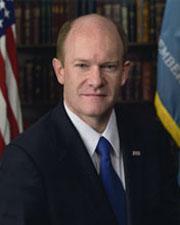
U.S. Senator for Delaware
Democrat
Senate term end not loaded yet
Missed 5.7% of roll calls. Chamber median 2.1%.
The full voting recordCounts roll calls where most Democrats and most Republicans voted differently, leaving out procedural votes.
How we countFrom FEC filings, Voteview roll calls and Congress.gov.
Democrat. In Congress since 2010, 3 terms in total.
Following saves Coons to your list, which Chamber & Street keeps on its server, linked to a cookie on this browser and not to your name or email. Email alerts will come with constituent verification.
Bills and resolutions Coons signed on to as a cosponsor. An original cosponsor signed on the day the bill was introduced. Source: govinfo bill status files, last updated Nov 6, 2026.
Coons also withdrew as a cosponsor from 1 bill, not listed here.
Access to Counsel Act of 2025
Sponsor Alex Padilla (D). Original cosponsor. 18 cosponsors. S. 391 on Congress.gov
Introduced
Access to Counsel Act of 2025
This bill provides various protections for covered individuals subject to secondary or deferred inspections when seeking admission into the United States. Covered individuals include U.S. nationals, lawful permanent residents, non-U.S. nationals (aliens under federal law) in possession of a visa, returning asylees, and refugees.
The Department of Homeland Security must ensure that a covered individual subject to secondary or deferred inspection has a meaningful opportunity to consult with counsel and certain related parties, such as a relative, within an hour of the start of the secondary inspection and as necessary during the inspection process. The counsel and related party must be allowed to advocate on behalf of the covered individual, including by providing evidence and information to the examining immigration officer.
A lawful permanent resident subject to secondary or deferred inspection may not abandon lawful permanent resident status until the individual has had a meaningful opportunity to seek advice from counsel, unless the individual voluntarily and knowingly waives in writing this opportunity to seek counsel's advice.
JOBS Act of 2025
Sponsor Timothy Kaine (D). Original cosponsor. 41 cosponsors. S. 383 on Congress.gov(opens in a new tab)
Introduced
Jumpstart Our Businesses by Supporting Students Act of 2025 or the JOBS Act of 2025
This bill expands student eligibility for Pell Grants by establishing the Job Training Federal Pell Grant program.
Specifically, the bill requires the Department of Education to award a job training Pell Grant to a student who does not have a degree; attends an institution of higher education (IHE); is enrolled in a career and technical education program at an IHE that provides 150 to 600 clock hours of instructional time over a period of 8 to 15 weeks and provides training aligned with high-skill, high-wage, or in-demand industry sectors (i.e., job training programs); and meets all other eligibility requirements for a Pell Grant.
The bill also specifies that any period during which a student receives a job training Pell Grant counts toward that student's Pell Grant eligibility period.
A bill to amend the Internal Revenue Code of 1986 to provide special rules for the taxation of certain residents of Taiwan with income from sources within the United States.
Sponsor Mike Crapo (R). Joined Feb 3, 2025. 48 cosponsors. S. 199 on Congress.gov(opens in a new tab)
Introduced
Charitable Act
Sponsor James Lankford (R). Original cosponsor. 23 cosponsors. S. 317 on Congress.gov(opens in a new tab)
Introduced
Charitable Act
This bill allows an individual taxpayer who does not itemize their tax deductions to claim a tax deduction for charitable contributions and eliminates the tax penalty for overstating charitable contributions. (Some limitations apply).
Under the bill, for tax years beginning in 2026 or 2027, an individual taxpayer who does not itemize their tax deductions may deduct charitable contributions of up to one-third of the standard deduction allowed to such individual. (Under current law, an individual taxpayer generally must itemize their tax deductions to deduct charitable contributions.)
The bill also eliminates the tax penalty for an underpayment of taxes attributable to overstated charitable contributions by taxpayers who do not itemize deductions. (Under current law, taxpayers who claim a deduction under this bill may be assessed a tax penalty in the amount of 50% of the portion of an understatement of tax liability attributable to overstated charitable contributions.)
AM Radio for Every Vehicle Act of 2025
Sponsor Edward Markey (D). Original cosponsor. 60 cosponsors. S. 315 on Congress.gov(opens in a new tab)
Passed committee
AM Radio for Every Vehicle Act of 2025
This bill requires the Department of Transportation (DOT) to issue a rule requiring AM radio capabilities to be standard in all new passenger vehicles. (AM radio is often used to deliver emergency alerts and news and entertainment programming; some newer vehicles do not include AM equipment.)
Specifically, this bill applies to passenger vehicles (1) manufactured in the United States for sale in the United States, imported into the United States, or shipped in interstate commerce; and (2) manufactured after the rule's effective date. The rule must require all such vehicles to have devices that can receive signals and play content transmitted by AM stations or digital audio AM stations installed as standard equipment and made easily accessible to drivers.
Prior to the rule's effective date, manufacturers that do not include devices that can access AM radio as standard equipment (1) must inform purchasers of this fact through clear and conspicuous labeling, and (2) may not charge an additional or separate fee for AM radio access.
DOT may assess civil penalties for any violation of the rule. The Department of Justice may also bring a civil action to enjoin a violation.
DOT’s authority to issue the rule expires 10 years after the bill’s enactment.
Further, the Government Accountability Office must study and report on the dissemination of emergency alerts to the public, including by conducting an assessment of AM broadcast stations relative to other Integrated Public Alert and Warning System communication technologies.
A resolution condemning the pardons for individuals who were found guilty of assaulting Capitol Police Officers.
Sponsor Patty Murray (D). Original cosponsor. 46 cosponsors. S.Res. 42 on Congress.gov(opens in a new tab)
Introduced
This resolution disapproves of pardons for individuals who were found guilty of assaulting U.S. Capitol Police officers.
Harmful Algal Bloom and Hypoxia Research and Control Amendments Act of 2025
Sponsor Dan Sullivan (R). Joined Jan 28, 2025. 15 cosponsors. S. 93 on Congress.gov(opens in a new tab)
Passed the Senate
Harmful Algal Bloom and Hypoxia Research and Control Amendments Act of 2025
This bill extends through FY2030 and modifies the Harmful Algal Bloom and Hypoxia Research and Control Act to address algal blooms and hypoxia (deficiency of oxygen) in U.S. marine, estuarine, and freshwater systems. Harmful algal blooms are high concentrations of algae that may create nuisance or toxic conditions that are harmful to humans, animals, aquatic ecosystems, and the economy.
The bill directs the Inter-Agency Task Force on Harmful Algal Blooms and Hypoxia to submit to Congress an action strategy for harmful algal blooms at least once every five years. The bill also expands the task force's membership to include the Department of Energy.
The bill also expands the duties of the National Oceanic and Atmospheric Administration (NOAA) under the National Harmful Algal Bloom and Hypoxia program. NOAA must also carry out a variety of activities related to monitoring, predicting, preventing, mitigating, and responding to marine, coastal, and Great Lakes harmful algal bloom and hypoxia events. For example, NOAA must establish (1) a national network of observing systems for monitoring, detecting, and forecasting harmful algal blooms; and (2) a national-level incubator program to increase the number of strategies, technologies, and measures available to prevent, mitigate, and control harmful algal blooms.
Additionally, the Environmental Protection Agency must develop and enhance operational freshwater harmful algal bloom monitoring, observing, and forecasting programs in lakes, rivers, and reservoirs and carry out other activities related to researching freshwater harmful algal blooms and hypoxia events.
Global Health, Empowerment and Rights Act
Sponsor Jeanne Shaheen (D). Original cosponsor. 42 cosponsors. S. 280 on Congress.gov(opens in a new tab)
Introduced
A resolution expressing the sense of the Senate that the United States, States, cities, Tribal nations, businesses, institutions of higher education, and other institutions in the United States should work toward achieving the goals of the Paris Agreement.
Sponsor Edward Markey (D). Original cosponsor. 22 cosponsors. S.Res. 36 on Congress.gov(opens in a new tab)
Introduced
Honoring Our Fallen Heroes Act of 2025
Sponsor Amy Klobuchar (D). Original cosponsor. 59 cosponsors. S. 237 on Congress.gov(opens in a new tab)
Passed committee
Honoring Our Fallen Heroes Act of 2025
This bill extends death and disability benefits under the Public Safety Officers' Benefits Program (PSOB) to certain public safety officers who suffer from exposure-related cancer while on duty and their survivors. The PSOB program provides death, disability, and education benefits to public safety officers who are killed or injured in the line of duty and their survivors.
The bill specifies that exposure to a carcinogen shall be presumed to constitute a personal injury in the line of duty if
• the exposure occurred while the officer was in the line of duty;
• the officer began serving as an officer not fewer than 5 years before the date of the diagnosis of an exposure-related cancer and the diagnosis occurred not more than 15 years after the last date of active service; and
• the exposure-related cancer directly and proximately resulted in the death or permanent and total disability of the officer.
The Department of Justice's Bureau of Justice Assistance must periodically review the definition of exposure-related cancer and update the definition if appropriate based on medical evidence and in accordance with the requirements of a petition process.
Commission to Study and Develop Reparation Proposals for African Americans Act
Sponsor Cory Booker (D). Joined Jan 21, 2025. 20 cosponsors. S. 40 on Congress.gov(opens in a new tab)
Introduced
Commission to Study and Develop Reparation Proposals for African Americans Act
This bill establishes the Commission to Study and Develop Reparation Proposals for African Americans.
The commission must (1) compile documentary evidence of slavery in the United States; (2) study the role of the federal and state governments in supporting the institution of slavery; (3) analyze discriminatory laws and policies against formerly enslaved Africans and their descendants; and (4) recommend ways the United States may recognize and remedy the effects of slavery and discrimination on African Americans, including through a formal apology and compensation (i.e., reparations).
The commission consists of individuals from civil society and reparations organizations and individuals appointed by the President and congressional leadership. The commission may hold hearings, subpoena witnesses and records, and contract with other entities to conduct its work.
The commission must submit its final report within one year of its first meeting.
A resolution honoring the service of women in combat roles in the Armed Forces.
Sponsor Patty Murray (D). Original cosponsor. 27 cosponsors. S.Res. 28 on Congress.gov(opens in a new tab)
Introduced
This resolution recognizes the contribution of women serving in combat roles in the Armed Forces.
Recover Fraudulent COVID Funds Act
Sponsor James Lankford (R). Original cosponsor. 17 cosponsors. S. 121 on Congress.gov(opens in a new tab)
Introduced
Recover Fraudulent COVID Funds Act
This bill extends the statute of limitations (i.e., time limit for bringing a legal action) to 10 years for criminal and civil violations involving specified COVID-19 pandemic relief programs, such as violations involving fraudulent activity. Under current law, the statute of limitations is generally five years for violations concerning these pandemic-era programs. The Paycheck Protection Program and the Economic Injury Disaster Loan Program currently have 10-year statutes of limitations relating to program fraud.
Chiropractic Medicare Coverage Modernization Act of 2025
Sponsor Kevin Cramer (R). Original cosponsor. 15 cosponsors. S. 106 on Congress.gov(opens in a new tab)
Introduced
Chiropractic Medicare Coverage Modernization Act of 2025
This bill expands Medicare coverage of chiropractic services to include all services provided by chiropractors, rather than only subluxation corrections through manual manipulation of the spine.
A resolution honoring the life and legacy of President Jimmy Carter and commending President Jimmy Carter for his life-long career of public service, humanitarian leadership, diplomacy, and courageous advocacy.
Sponsor Raphael Warnock (D). Original cosponsor. 98 cosponsors. S.Res. 19 on Congress.gov(opens in a new tab)
Passed the Senate
This resolution (1) mourns the passing of former President Jimmy Carter and extends sympathy to his family; and (2) honors his life, legacy, and contributions to the United States.
Washington, D.C. Admission Act
Sponsor Chris Van Hollen (D). Original cosponsor. 43 cosponsors. S. 51 on Congress.gov(opens in a new tab)
Introduced
Washington, D.C. Admission Act
This bill provides for the establishment of the State of Washington, Douglass Commonwealth, and its admission into the United States.
The state is composed of most of the territory of the District of Columbia (DC), excluding a specified area that encompasses the U.S. Capitol, the White House, the U.S. Supreme Court building, federal monuments, and federal office buildings adjacent to the National Mall and the U.S. Capitol. The excluded territory shall be known as the Capital and serve as the seat of the government of the United States, as provided for in Article I of the Constitution. The state may not impose taxes on federal property except as Congress permits.
The bill provides for the DC Mayor to issue a proclamation for the first elections to Congress of two Senators and one Representative of the state. The bill eliminates the office of Delegate to the House of Representatives.
The bill applies current DC laws to the state. DC judicial proceedings and contractual obligations shall continue under the state’s authority. The bill also provides for specified federal obligations to transfer to the state upon its certification that it has funds and laws in place to assume the obligations. These include maintaining a retirement fund for judges and operating public defender services.
The bill establishes a commission that is generally comprised of members who are appointed by DC and federal government officials to advise on an orderly transition to statehood.
Health Care Affordability Act of 2025
Sponsor Jeanne Shaheen (D). Original cosponsor. 44 cosponsors. S. 46 on Congress.gov(opens in a new tab)
Introduced
Health Care Affordability Act of 2025
This bill makes permanent temporary changes enacted by the American Rescue Plan Act of 2021 (ARPA) and the Inflation Reduction Act of 2022 (IRA) that generally expand eligibility for and increase the amount of the premium tax credit.
Currently, eligible taxpayers may be able to claim the premium tax credit, which applies toward the cost of obtaining health insurance through health insurance exchanges. To be eligible for the premium tax credit, a taxpayer’s household income must meet or exceed 100% of the federal poverty level (FPL) and, after 2025, may not exceed 400% of the FPL (maximum income limit). For 2021-2025, the ARPA and IRA eliminated the maximum income limit, which generally expands eligibility for the premium tax credit.
Further, under current law, the amount of the premium tax credit is (1) generally the plan premium (conditions apply), minus (2) the taxpayer’s household income multiplied by the applicable percentage. The applicable percentage is a specific percentage that varies depending on which of six income ranges (adjusted for inflation after 2025) the taxpayer’s household income falls within. For 2021-2025, the ARPA and IRA lowered the applicable percentages and eliminated the adjustment of the applicable percentages for inflation, which generally increases the amount of the premium tax credit.
The bill makes permanent the elimination of the 400% maximum income limit, the lower applicable percentages, and the elimination of the inflation adjustment for the applicable percentages.