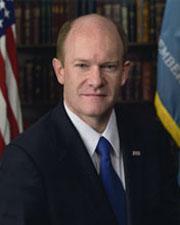
U.S. Senator for Delaware
Democrat
Senate term end not loaded yet
Missed 5.7% of roll calls. Chamber median 2.1%.
The full voting recordCounts roll calls where most Democrats and most Republicans voted differently, leaving out procedural votes.
How we countFrom FEC filings, Voteview roll calls and Congress.gov.
Democrat. In Congress since 2010, 3 terms in total.
Following saves Coons to your list, which Chamber & Street keeps on its server, linked to a cookie on this browser and not to your name or email. Email alerts will come with constituent verification.
Bills and resolutions Coons signed on to as a cosponsor. An original cosponsor signed on the day the bill was introduced. Source: govinfo bill status files, last updated Nov 6, 2026.
Coons also withdrew as a cosponsor from 1 bill, not listed here.
SEMI Investment Act
Sponsor Marsha Blackburn (R). Original cosponsor. 4 cosponsors. S. 1642 on Congress.gov
Introduced
American Innovation and Jobs Act
Sponsor Todd Young (R). Original cosponsor. 35 cosponsors. S. 1639 on Congress.gov(opens in a new tab)
Introduced
A resolution recognizing escalating threats to freedom of the press and freedom of speech worldwide, including increasing harm to journalists reporting in conflict zones and under repressive regimes, reaffirming the vital role that a free and independent press plays in upholding democracy, fostering economic prosperity, and keeping the public informed, and reaffirming freedom of the press as a priority of the United States Government in supporting democracy, human rights, and good governance in commemoration of "World Press Freedom Day" on May 3, 2025.
Sponsor Brian Schatz (D). Joined May 6, 2025. 9 cosponsors. S.Res. 204 on Congress.gov(opens in a new tab)
Introduced
This resolution recognizes the centrality of a free press to free societies and democratic governance and expresses concerns about threats to the exercise of freedom of expression globally.
ACRE Act of 2025
Sponsor Jerry Moran (R). Joined May 6, 2025. 9 cosponsors. S. 838 on Congress.gov(opens in a new tab)
Introduced
Sickle Cell Disease Comprehensive Care Act
Sponsor Cory Booker (D). Joined May 6, 2025. 3 cosponsors. S. 721 on Congress.gov(opens in a new tab)
Introduced
Sickle Cell Disease Comprehensive Care Act
This bill allows state Medicaid programs to establish health homes to provide coordinated care for individuals with sickle-cell disease. (Under current law, state Medicaid programs may establish health homes to provide coordinated care for individuals with specified chronic conditions.) States must ensure that such care includes dental and vision services.
The Centers for Medicare & Medicaid Services must issue best practices for states on how to design and implement such health homes.
Tax Relief for New Businesses Act
Sponsor Jacky Rosen (D). Original cosponsor. 10 cosponsors. S. 1613 on Congress.gov(opens in a new tab)
Introduced
Youth Substance Use Prevention and Awareness Act
Sponsor Mark Kelly (D). Original cosponsor. 2 cosponsors. S. 1611 on Congress.gov(opens in a new tab)
Introduced
A resolution expressing support for the designation of the week of May 4, 2025, through May 10, 2025, as "National Small Business Week" to celebrate the contributions of small businesses and entrepreneurs in every community in the United States.
Sponsor Joni Ernst (R). Original cosponsor. 81 cosponsors. S.Res. 201 on Congress.gov(opens in a new tab)
Passed the Senate
This resolution honors the contributions of small businesses in the United States and supports the designation of National Small Business Week.
Improving Police CARE Act
Sponsor John Cornyn (R). Original cosponsor. 7 cosponsors. S. 1595 on Congress.gov(opens in a new tab)
Passed the Senate
Improving Police Critical Aid for Responding to Emergencies Act or the Improving Police CARE Act
This bill requires the Bureau of Justice Assistance (BJA) within the Department of Justice to develop and publish performance standards for trauma kits that are eligible to be purchased using funds under the Edward Byrne Memorial Justice Assistance Grant program.
Additionally, the BJA must develop and publish best practices for the use, deployment, and maintenance of trauma kits by law enforcement agencies.
Made in America Manufacturing Finance Act of 2025
Sponsor Joni Ernst (R). Original cosponsor. 6 cosponsors. S. 1555 on Congress.gov(opens in a new tab)
Introduced
Living Donor Protection Act of 2025
Sponsor Tom Cotton (R). Original cosponsor. 50 cosponsors. S. 1552 on Congress.gov(opens in a new tab)
Passed committee
Living Donor Protection Act of 2025
This bill prohibits life insurance, disability insurance, and long-term insurance carriers from denying or otherwise restricting coverage for living organ donors.
Specifically, carriers may not deny, cancel, vary premiums, or otherwise impose conditions on policies based on an individual's status as a living organ donor.
The bill also expressly specifies that recovery from organ-donation surgery constitutes a serious health condition that entitles eligible employees to job-protected medical leave.
In addition, the Department of Health and Human Services must update educational materials on living organ donation to include information about the benefits and risks of living organ donation and the impact of donation on insurance access, particularly with respect to the bill's changes.
Patent Eligibility Restoration Act of 2025
Sponsor Thomas Tillis (R). Original cosponsor. 3 cosponsors. S. 1546 on Congress.gov(opens in a new tab)
Introduced
Patent Eligibility Restoration Act of 2025
This bill amends the law relating to patent subject matter eligibility to establish that only specified subject matter (e.g., a natural process wholly independent of human activity) is ineligible for patenting. (Currently, subject matter eligibility is determined by examining whether the claimed invention is directed to certain ineligible categories, and if so, whether there is an inventive concept. Subject matter eligibility is one of several requirements that an invention must satisfy in order to receive patent protection.)
Under this bill, an invention shall be considered to involve patent-ineligible subject matter only if it falls within specified categories, such as (1) a mathematical formula that is not part of a useful process, machine, manufacture, or composition; (2) a mental process that is performed solely in the human mind; or (3) an unmodified human gene as the gene exists in the human body.
Assault Weapons Ban of 2025
Sponsor Adam Schiff (D). Original cosponsor. 42 cosponsors. S. 1531 on Congress.gov(opens in a new tab)
Introduced
Assault Weapons Ban of 2025
This bill makes it a crime to knowingly import, sell, manufacture, transfer, or possess a semiautomatic assault weapon (SAW) or large capacity ammunition feeding device (LCAFD).
The prohibition does not apply to a firearm that is (1) manually operated by bolt, pump, lever, or slide action, except for certain shotguns; (2) permanently inoperable; (3) an antique; (4) only capable of firing rimfire ammunition; or (5) a rifle or shotgun specifically identified by make and model.
The bill also exempts from the prohibition the following, with respect to a SAW or LCAFD:
• importation, sale, manufacture, transfer, or possession related to certain law enforcement efforts, or authorized tests or experiments;
• importation, sale, transfer, or possession related to securing nuclear materials; and
• possession by a retired law enforcement officer.
The bill permits continued possession, sale, or transfer of a grandfathered SAW, which must be securely stored. A licensed gun dealer must conduct a background check prior to the sale or transfer of a grandfathered SAW between private parties.
The bill permits continued possession of, but prohibits sale or transfer of, a grandfathered LCAFD.
Newly manufactured LCAFDs must display serial number identification. Newly manufactured SAWs and LCAFDs must display the date of manufacture.
The bill also allows a state or local government to use Edward Byrne Memorial Justice Assistance Grant Program funds to compensate individuals who surrender a SAW or LCAFD under a buy-back program.
A bill to ensure that Social Security beneficiaries receive regular statements from the Social Security Administration, and for other purposes.
Sponsor Bill Cassidy (R). Original cosponsor. 3 cosponsors. S. 1505 on Congress.gov(opens in a new tab)
Introduced
Claiming Age Clarity Act
Sponsor Bill Cassidy (R). Original cosponsor. 14 cosponsors. S. 1504 on Congress.gov(opens in a new tab)
Introduced
Claiming Age Clarity Act
This bill changes certain terms that are used by the Social Security Administration (SSA) to describe the ages at which a worker may claim Social Security retirement benefits.
First, the SSA must use minimum monthly benefit age instead of early eligibility age. This refers to the earliest age (62 under current law) at which a worker may claim benefits. (Currently, the benefit amount of a worker who claims benefits early is reduced to account for the longer period during which the worker is expected to receive benefits.)
Second, the SSA must use standard monthly benefit age instead of full retirement age and normal retirement age. These terms refer to the age at which a worker may claim benefits without a reduction in the benefit amount. (Currently, this age ranges from 65 to 67, depending on the worker's year of birth.)
Finally, the SSA must use the term maximum monthly benefit age for any reference to age 70 as the maximum age at which a worker may receive delayed retirement credits. The SSA may not use the term delayed retirement credit. These terms refer to the mechanism that increases the benefit amount of a worker who delays claiming benefits after reaching the full retirement age. (Currently, a worker receives a credit for each month between the full retirement age and age 70 that the worker delays claiming benefits. Each credit increases the benefit amount that the worker will receive after claiming benefits by a specified percentage.)
Equality Act
Sponsor Jeff Merkley (D). Original cosponsor. 46 cosponsors. S. 1503 on Congress.gov(opens in a new tab)
Introduced
Equality Act
This bill prohibits discrimination based on sex, sexual orientation, or gender identity with respect to businesses, employment, housing, federally funded programs, and other settings.
Specifically, the bill expands Title II and Title VI of the Civil Rights Act of 1964 to prohibit public accommodations and federally funded programs, respectively, from discriminating based on sex, sexual orientation, or gender identity. It also includes stores, transit services, recreational facilities, and establishments that provide health care, accounting, or legal services as public accommodations under Title II.
The bill also expands Title IV (desegregation of public schools) and Title VII (employment discrimination) to specifically include sexual orientation and gender identity. (The Supreme Court held in Bostock v. Clayton County that Title VII's prohibition of employment discrimination based on sex also prohibits employment discrimination based on sexual orientation or gender identity.)
The bill similarly expands the Fair Housing Act (discrimination in public and private housing) to include sexual orientation and gender identity. It also prohibits discrimination based on sexual orientation or gender identity by creditors and with respect to jury selection.
The bill defines sex for purposes of the aforementioned provisions to include sex stereotypes, pregnancy, childbirth, sexual orientation, gender identity, and sex characteristics.
SAFE Act of 2025
Sponsor Roger Wicker (R). Original cosponsor. 3 cosponsors. S. 1501 on Congress.gov(opens in a new tab)
Introduced
Safe American Food Exports Act of 2025 or the SAFE Act of 2025
This bill provides statutory authority for the Department of Agriculture to preemptively negotiate regional export ban agreements for known animal disease threats that apply only to areas affected by animal disease outbreaks to enable the continuation of exports from areas not affected by an outbreak.
The Animal and Plant Health Inspection Service, the Food Safety and Inspection Service, and the Foreign Agricultural Service, in consultation with the Office of the U.S. Trade Representative, may negotiate the regionalization, zoning, compartmentalization, and other agreements regarding outbreaks of known animal disease threats of trade significance with countries with export markets for livestock animals or animal products from the United States.
The bill also specifies that such a negotiation should take into account accepted global research advances.
A resolution designating the week of April 19 through April 27, 2025, as "National Park Week".
Sponsor Steve Daines (R). Original cosponsor. 59 cosponsors. S.Res. 180 on Congress.gov(opens in a new tab)
Passed the Senate
A resolution supporting the goals and ideals of World Malaria Day.
Sponsor Roger Wicker (R). Original cosponsor. 1 cosponsor. S.Res. 173 on Congress.gov(opens in a new tab)
Introduced
A resolution supporting the designation of the week of April 11 through April 17, 2025, as the eighth annual "Black Maternal Health Week", founded by Black Mamas Matter Alliance, Inc., to bring national attention to the maternal and reproductive health crisis in the United States and the importance of reducing maternal mortality and morbidity among Black women and birthing people.
Sponsor Cory Booker (D). Original cosponsor. 18 cosponsors. S.Res. 172 on Congress.gov(opens in a new tab)
Introduced
Critical Minerals Security Act of 2025
Sponsor John Cornyn (R). Joined Apr 10, 2025. 6 cosponsors. S. 789 on Congress.gov(opens in a new tab)
Passed committee
Critical Minerals Security Act of 2025
This bill establishes requirements for the Department of the Interior related to securing U.S. access to critical minerals and rare earth element (REE) resources. Critical minerals mean any mineral, element, substance, or material designated as critical by the U.S. Geological Survey. REEs mean cerium, dysprosium, erbium, europium, gadolinium, holmium, lanthanum, lutetium, neodymium, praseodymium, promethium, samarium, scandium, terbium, thulium, ytterbium, and yttrium.
First, Interior must report on the critical mineral and REE resources, including recyclable or recycled materials containing those resources, around the world. Among other information, the report must include an assessment of the global ownership and supply of critical mineral and REE resources. Interior must submit the report within a year and every two years thereafter.
Next, Interior must establish a process to assist a U.S. person—a U.S. citizen, a non-U.S. National (alien under federal law) lawfully admitted for permanent residence, or an entity organized under U.S. laws—seeking to divest stock in mining, processing, or recycling operations for critical minerals and REEs in a foreign country with finding a purchaser that is not under the control of North Korea, China, Russia, or Iran.
Finally, Interior must develop (1) a strategy to collaborate with U.S. allies and partners to develop advanced mining, refining, separation, processing, and recycling technologies; and (2) a method for sharing related intellectual property with U.S. allies and partners to enable those countries to license those technologies and develop their resources.
COAST Anti-Drilling Act of 2025
Sponsor Cory Booker (D). Original cosponsor. 16 cosponsors. S. 1486 on Congress.gov(opens in a new tab)
Introduced
Countering Wrongful Detention Act of 2025
Sponsor James Risch (R). Original cosponsor. 2 cosponsors. S. 1478 on Congress.gov(opens in a new tab)
Passed committee
American Family Act
Sponsor Michael Bennet (D). Original cosponsor. 44 cosponsors. S. 1393 on Congress.gov(opens in a new tab)
Introduced
BUMP Act
Sponsor Martin Heinrich (D). Original cosponsor. 30 cosponsors. S. 1374 on Congress.gov(opens in a new tab)
Introduced
Banning Unlawful Machinegun Parts Act or the BUMP Act
This bill generally prohibits the import, sale, manufacture, transfer, receipt, or possession of
• a device that is primarily designed, or redesigned, to increase the rate of fire when attached to a semiautomatic firearm;
• a device, part, or combination of parts that is designed and functions to increase the rate of fire of a firearm; or
• a semiautomatic firearm that has been modified to materially increase the rate of fire or to approximate the action or rate of fire of a machine gun.
Additionally, the bill adds to the list of firearms subject to regulation under the National Firearms Act semiautomatic firearms that have been modified to materially increase the rate of fire or approximate the action or rate of fire of a machine gun.