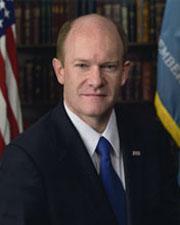
U.S. Senator for Delaware
Democrat
Senate term end not loaded yet
Missed 5.7% of roll calls. Chamber median 2.1%.
The full voting recordCounts roll calls where most Democrats and most Republicans voted differently, leaving out procedural votes.
How we countFrom FEC filings, Voteview roll calls and Congress.gov.
Democrat. In Congress since 2010, 3 terms in total.
Following saves Coons to your list, which Chamber & Street keeps on its server, linked to a cookie on this browser and not to your name or email. Email alerts will come with constituent verification.
Bills and resolutions Coons signed on to as a cosponsor. An original cosponsor signed on the day the bill was introduced. Source: govinfo bill status files, last updated Nov 6, 2026.
Coons also withdrew as a cosponsor from 1 bill, not listed here.
Medicare Audiology Access Improvement Act of 2025
Sponsor Elizabeth Warren (D). Joined Dec 1, 2025. 11 cosponsors. S. 1996 on Congress.gov
Introduced
Medicare Audiology Access Improvement Act of 2025
This bill provides for Medicare coverage of certain audiology services. Specifically, the bill expands coverage to include diagnostic and treatment services that are furnished by audiologists and that would otherwise be covered if provided by a physician, including incidental services, regardless of whether such services are provided pursuant to a referral from, or under the supervision of, a physician or other health care practitioner.
Restoring Food Security for American Families and Farmers Act of 2025
Sponsor Ben Luján (D). Original cosponsor. 46 cosponsors. S. 3281 on Congress.gov(opens in a new tab)
Introduced
John Lewis Every Child Deserves a Family Act
Sponsor Kirsten Gillibrand (D). Original cosponsor. 29 cosponsors. S. 3279 on Congress.gov(opens in a new tab)
Introduced
Humanoid ROBOT Act of 2025
Sponsor Bill Cassidy (R). Original cosponsor. 2 cosponsors. S. 3275 on Congress.gov(opens in a new tab)
Introduced
Liquid Cooling for AI Act of 2025
Sponsor David McCormick (R). Original cosponsor. 3 cosponsors. S. 3269 on Congress.gov(opens in a new tab)
Introduced
Ending Forced Arbitration of Race Discrimination Act of 2025
Sponsor Cory Booker (D). Original cosponsor. 9 cosponsors. S. 3243 on Congress.gov(opens in a new tab)
Introduced
Ending Forced Arbitration of Race Discrimination Act of 2025
This bill prohibits a predispute arbitration agreement or predispute joint-action waiver from being valid or enforceable with respect to a case relating to a race discrimination dispute at the election of the person alleging the discrimination.
Background Check Expansion Act
Sponsor Christopher Murphy (D). Original cosponsor. 46 cosponsors. S. 3214 on Congress.gov(opens in a new tab)
Introduced
Background Check Expansion Act
This bill establishes new background check requirements for firearm transfers between private parties (i.e., unlicensed individuals).
Specifically, it prohibits a firearm transfer between private parties unless a licensed gun dealer, manufacturer, or importer first takes possession of the firearm to conduct a background check.
The prohibition does not apply to certain firearm transfers, such as a gift between spouses.
Protecting Sensitive Locations Act
Sponsor Richard Blumenthal (D). Joined Nov 18, 2025. 33 cosponsors. S. 455 on Congress.gov(opens in a new tab)
Introduced
Protecting Sensitive Locations Act
This bill prohibits immigration enforcement actions within 1,000 feet of a sensitive location except in exigent circumstances, such as the imminent risk of death, violence, or physical harm to any person.
Sensitive locations include
• health care facilities;
• schools and school bus stops;
• places that provide assistance for people such as children, pregnant women, and abuse victims;
• child care facilities;
• places that provide disaster or emergency services;
• places of worship;
• courthouses and lawyers’ offices;
• facilities used as polling places;
• certain labor union facilities; and
• public assistance offices.
The prohibition shall apply to Department of Homeland Security officers and agents, as well as state employees pursuing immigration enforcement actions.
If an enforcement action is carried out in violation of this prohibition (1) no information resulting from the action may be entered into the record in a resulting removal proceeding, and (2) the affected individual may move to immediately terminate such a proceeding.
U.S. Immigration and Customs Enforcement and U.S. Customs and Border Protection shall annually report to Congress about enforcement actions taken at sensitive locations in the preceding year.
Anti-Cash Grab Act
Sponsor Martin Heinrich (D). Original cosponsor. 34 cosponsors. S. 3195 on Congress.gov(opens in a new tab)
Introduced
SNAP BACK Act of 2025
Sponsor Lisa Blunt Rochester (D). Joined Nov 7, 2025. 1 cosponsor. S. 3074 on Congress.gov(opens in a new tab)
Introduced
Supplemental Nutrition Assistance Program Benefits And Compensation for Keep-up Act of 2025 or the SNAP BACK Act of 2025
This bill requires the Department of Agriculture to reimburse states for costs incurred to carry out the Supplemental Nutrition Assistance Program (SNAP) during a lapse in appropriations for SNAP, to the extent that the state carried out SNAP in accordance with federal law (including regulations) during the lapse.
A resolution expressing the sense of the Senate regarding the European Union's actions to diversify from Russian energy sources.
Sponsor Jeanne Shaheen (D). Original cosponsor. 11 cosponsors. S.Res. 488 on Congress.gov(opens in a new tab)
Introduced
GAIN AI Act of 2025
Sponsor Jim Banks (R). Original cosponsor. 5 cosponsors. S. 3150 on Congress.gov(opens in a new tab)
Introduced
Keep Head Start Funded Act of 2025
Sponsor Tammy Baldwin (D). Original cosponsor. 33 cosponsors. S. 3147 on Congress.gov(opens in a new tab)
Introduced
Keep Head Start Funded Act of 2025
This bill provides FY2026 continuing appropriations to carry out Head Start programs without interruption during any period in which interim or full-year appropriations for FY2026 are not in effect (i.e., a government shutdown).
The Head Start programs provide comprehensive early childhood education and development services to low-income children. The programs seek to promote school readiness through the provision of educational, health, nutritional, social, and other services.
This bill provides FY2026 appropriations to continue projects and activities under the programs that were funded in FY2025. The appropriations are available until the earliest of
• the enactment into law of legislation that provides appropriations (including continuing appropriations) for Head Start,
• the enactment into law of legislation that provides regular or continuing appropriations for the Department of Health and Human Services without an appropriation for Head Start, or
• September 30, 2026.
This bill must take effect as if it had been enacted on September 30, 2025.
No Nuclear Testing Without Approval Act
Sponsor Catherine Cortez Masto (D). Joined Nov 6, 2025. 5 cosponsors. S. 3106 on Congress.gov(opens in a new tab)
Introduced
Holocaust Expropriated Art Recovery Act of 2025
Sponsor John Cornyn (R). Joined Nov 6, 2025. 21 cosponsors. S. 1884 on Congress.gov(opens in a new tab)
Became law
Holocaust Expropriated Art Recovery Act of 2025
This act permanently extends and expands judicial authority under the Holocaust Expropriated Art Recovery Act of 2016. The law allows and establishes procedures for civil claims and causes of action to recover artwork and other property lost between 1933 and 1945 because of Nazi persecution.
Among the changes, the act removes the deadline for filing civil claims or causes of action. Currently, the filing deadline is December 31, 2026. (Claims must still be filed within six years of the claimant's discovery of the property in question.)
The act permits courts to exercise jurisdiction over civil claims or causes of action against a foreign state without regard to the nationality or citizenship of the alleged victim. The art or property at issue must still have a connection to the foreign state's commercial activities in the United States.
Additionally, the act authorizes nationwide service of process, which allows courts to exercise personal jurisdiction over defendants in any judicial district where they may be found, reside, have an agent, or transact business.
Finally, the act limits the defenses that may be asserted against civil claims or causes of action, including by prohibiting
• defenses based on the passage of time, including equitable defenses such as laches (i.e., unreasonable delays); and
• discretionary bases for dismissal that are unrelated to the merits of the claim, including international comity (i.e., deference to the laws of other countries).
These changes apply to pending and future civil claims or causes of action.
A resolution honoring the extraordinary life, leadership, and legacy of Dr. Jane Goodall.
Sponsor Peter Welch (D). Original cosponsor. 17 cosponsors. S.Res. 483 on Congress.gov(opens in a new tab)
Passed the Senate
A joint resolution to direct the removal of United States Armed Forces from hostilities within or against Venezuela that have not been authorized by Congress.
Sponsor Timothy Kaine (D). Joined Nov 5, 2025. 18 cosponsors. S.J.Res. 90 on Congress.gov(opens in a new tab)
Introduced
This joint resolution directs the President to terminate the use of U.S. Armed Forces for hostilities within or against Venezuela unless a declaration of war or authorization to use military force for such purpose has been enacted.
The resolution specifies that it shall not be construed to prevent the United States from defending itself from an armed attack or threat of an imminent armed attack.
Chip Security Act
Sponsor Tom Cotton (R). Joined Nov 4, 2025. 21 cosponsors. S. 1705 on Congress.gov(opens in a new tab)
Introduced
Chip Security Act
This bill requires covered integrated circuit products (e.g., advanced computing chips) to incorporate certain security mechanisms.
Specifically, the bill directs the Department of Commerce to require any covered integrated circuit product to have chip security mechanisms that implement location verification before the product is exported, reexported, or in-country transferred to or in a foreign country.
Commerce must require any person that has received a license or other authorization under the Export Control Reform Act of 2018 to export, reexport, or in-country transfer a covered product to promptly report to Commerce's Bureau of Industry and Security if the person obtains credible information that the product has been diverted away from its intended location or has been subjected to tampering.
Commerce must, in coordination with the Department of Defense (DOD), conduct an assessment and report to Congress on whether additional chip security mechanisms should be adopted. If Commerce determines additional security measures are necessary, then Commerce must require any covered product to include the secondary chip security mechanisms before the product is exported, reexported, or in-country transferred to or in a foreign country.
The bill authorizes Commerce to take certain enforcement actions, such as verifying the ownership and location of a covered product that has been exported, reexported, or in-country transferred to or in a foreign country.
Commerce must coordinate with DOD, within two years of the bill's enactment and annually thereafter for three years, to assess new chip security mechanisms and report to Congress.
A resolution expressing the sense of the Senate that the United States Department of Agriculture should use its contingency funds and interchange authority to finance the supplemental nutrition assistance program.
Sponsor Jeff Merkley (D). Original cosponsor. 45 cosponsors. S.Res. 481 on Congress.gov(opens in a new tab)
Introduced
This resolution expresses the sense of the Senate that the Trump Administration is legally obligated to fund the Supplemental Nutrition Assistance Program (SNAP) through the use of the contingency fund, the Administration has the legal authority and the funds to finance SNAP through November 2025, exercising this power is extremely important for the health and wellness of families experiencing hunger, and the Administration should immediately exercise this authority.
Safer Supervision Act of 2025
Sponsor Mike Lee (R). Original cosponsor. 7 cosponsors. S. 3077 on Congress.gov(opens in a new tab)
Introduced
A resolution designating November 1, 2025, as "National Bison Day".
Sponsor John Hoeven (R). Original cosponsor. 25 cosponsors. S.Res. 475 on Congress.gov(opens in a new tab)
Passed the Senate
This resolution designates November 1, 2025, as National Bison Day.
A resolution commemorating the seventh anniversary of the murder of Jamal Khashoggi and calling for accountability.
Sponsor Timothy Kaine (D). Original cosponsor. 20 cosponsors. S.Res. 473 on Congress.gov(opens in a new tab)
Introduced
Keep SNAP and WIC Funded Act of 2025
Sponsor Ben Luján (D). Original cosponsor. 47 cosponsors. S. 3071 on Congress.gov(opens in a new tab)
Introduced
Keep SNAP and WIC Funded Act of 2025
This bill provides FY2026 appropriations for the Department of Agriculture (USDA) to continue operating the Supplemental Nutrition Assistance Program (SNAP); the Special Supplemental Nutrition Program for Women, Infants, and Children (WIC); and a related block grant program if there is a lapse in FY2026 appropriations for USDA.
Specifically, the bill provides appropriations to USDA for any period in which legislation to provide FY2026 interim continuing appropriations or full-year appropriations for USDA has not been enacted. If such a lapse in appropriations occurs, the bill provides the appropriations that are necessary to continue
• providing uninterrupted SNAP benefits,
• providing consolidated block grants to Puerto Rico and American Samoa for nutrition assistance programs, and
• carrying out WIC without interruption.
In addition, the bill provides appropriations to pay any benefits under these programs that were missed on or after September 30, 2025, and before this bill is enacted.
The appropriations for these purposes are available until the earlier of (1) the enactment into law of legislation to provide FY2026 appropriations for USDA (including continuing appropriations), or (2) September 30, 2026.
The bill also requires USDA to use the funds provided by this bill to reimburse state agencies for costs that were incurred to carry out these programs during a lapse in appropriations, to the extent that the programs were carried out in accordance with federal law (including regulations) during the lapse.
A resolution expressing condemnation of the Chinese Communist Party's persecution of religious minority groups, including Christians, Muslims, and Buddhists and the detention of Pastor "Ezra" Jin Mingri and leaders of the Zion Church, and reaffirming the United States' global commitment to promote religious freedom and tolerance.
Sponsor Ted Cruz (R). Original cosponsor. 14 cosponsors. S.Res. 463 on Congress.gov(opens in a new tab)
Passed the Senate
Give Kids a Chance Act of 2025
Joined Oct 23, 2025. 20 cosponsors. S. 932 on Congress.gov(opens in a new tab)
Progress not on file
Give Kids a Chance Act of 2025
This bill authorizes certain targeted clinical trials involving combinations of drugs to treat pediatric cancer, and renews the Food and Drug Administration’s (FDA’s) authority to award priority review vouchers (PRVs) to sponsors of new products for rare pediatric diseases.
Specifically, the bill modifies requirements relating to molecularly targeted pediatric cancer investigations to permit research on new drugs used in combination with active ingredients that have already been approved and that (1) have been determined to be part of the standard of care for treating a pediatric cancer, or (2) have been approved to treat an adult cancer and are directed at molecular targets for pediatric cancer.
The FDA must issue guidance on the implementation of these provisions and report to Congress on its efforts to ensure implementation. The Government Accountability Office (GAO) must report on the effectiveness of the bill's changes with respect to the development of pediatric cancer drugs.
The bill also renews the FDA’s authority to issue PRVs to sponsors of new products intended to treat rare pediatric diseases through September 30, 2029. This is known as the Rare Pediatric Disease PRV program. The program expired in December 2024.
GAO must report on the effectiveness of the Rare Pediatric Disease PRV program, including to what extent PRVs were successful in promoting drug development and expediting patient access to drugs for the treatment or prevention of rare pediatric diseases.