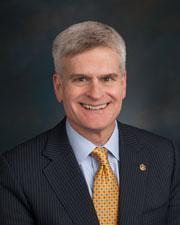
U.S. Senator for Louisiana
Republican
Senate term end not loaded yet
Missed 5.5% of roll calls. Chamber median 2.1%.
The full voting recordCounts roll calls where most Democrats and most Republicans voted differently, leaving out procedural votes.
How we countFrom FEC filings, Voteview roll calls and Congress.gov.
Republican. In Congress since 2009, 5 terms in total.
Following saves Cassidy to your list, which Chamber & Street keeps on its server, linked to a cookie on this browser and not to your name or email. Email alerts will come with constituent verification.
Bills and resolutions Cassidy signed on to as a cosponsor. An original cosponsor signed on the day the bill was introduced. Source: govinfo bill status files, last updated Nov 6, 2026.
CONTAINER Act
Sponsor Marsha Blackburn (R). Original cosponsor. 10 cosponsors. S. 157 on Congress.gov
Introduced
Creating Obstructions Necessary to Address Illegal and Nefarious Entry Rapidly Act or CONTAINER Act
This bill requires the Department of the Interior and the Forest Service to allow border states to place temporary, movable structures on federal lands adjacent to the U.S.-Canada and U.S.-Mexico borders without a special use authorization.
Border states may place these structures on such lands for the purpose of securing the northern or southern border for a period of not more than one year. Interior and the Forest Service must approve extension requests in 90-day increments if U.S. Customs and Border Protection determines that operational control of the border area has not been achieved.
Qualified Immunity Act of 2025
Sponsor Jim Banks (R). Joined Jan 17, 2025. 10 cosponsors. S. 122 on Congress.gov(opens in a new tab)
Introduced
Qualified Immunity Act of 2025
This bill provides statutory authority for qualified immunity for law enforcement officers in civil cases involving constitutional violations.
Current law provides a statutory civil cause of action against state and local government actors (e.g., law enforcement officers) for violations of constitutional rights, also known as Section 1983 lawsuits. The Supreme Court has also found an implied cause of action against federal law enforcement officers in certain situations (e.g., Fourth Amendment violations), also known as Bivens lawsuits. However, under the judicial doctrine of qualified immunity, government officials performing discretionary duties are generally shielded from civil liability, unless their actions violate clearly established rights of which a reasonable person would have known.
The bill provides statutory authority for these principles with respect to law enforcement officers. Specifically, under the bill, law enforcement officers are entitled to qualified immunity if (1) at the time of the alleged violation, the constitutional right at issue was not clearly established or the state of the law was not sufficiently clear that any reasonable officer would have known that the conduct was unconstitutional; or (2) a court has held that the specific conduct at issue is constitutional.
The bill applies to federal, state, and local law enforcement officers. It also specifies that law enforcement agencies and local governments may not be held liable if their officers are entitled to qualified immunity.
TAKE IT DOWN Act
Sponsor Ted Cruz (R). Original cosponsor. 21 cosponsors. S. 146 on Congress.gov(opens in a new tab)
Became law
Tools to Address Known Exploitation by Immobilizing Technological Deepfakes on Websites and Networks Act or the TAKE IT DOWN Act
This act generally prohibits the nonconsensual online publication of intimate visual depictions of individuals, both authentic and computer-generated, and requires certain online platforms (e.g., social media platforms) to promptly remove such depictions upon receiving notice of their existence.
Specifically, the act prohibits the online publication of intimate visual depictions of
• an adult subject where publication is intended to cause or does cause harm to the subject, and where the depiction was published without the subject’s consent or, in the case of an authentic depiction, was created or obtained under circumstances where the adult had a reasonable expectation of privacy; or
• a minor subject where publication is intended to abuse or harass the minor or to arouse or gratify the sexual desire of any person.
Violators are subject to mandatory restitution and criminal penalties, including prison, a fine, or both. Threats to publish intimate visual depictions of a subject are similarly prohibited and subject to criminal penalties.
Separately, covered platforms must establish a process through which subjects of intimate visual depictions may notify the platform of the existence of, and request removal of, an intimate visual depiction including the subject that was published without the subject’s consent. Covered platforms must remove such depictions within 48 hours of notification. Under the act, covered platforms are defined as public websites, online services, or applications that primarily provide a forum for user-generated content.
Dismantle Iran’s Proxy Act of 2025
Sponsor James Risch (R). Original cosponsor. 20 cosponsors. S. 145 on Congress.gov(opens in a new tab)
Introduced
Dismantle Iran’s Proxy Act of 2025
This bill requires the President to take actions against Ansarallah, the Iran-backed movement in Yemen also known as the Houthis.
Specifically, the bill requires the President to designate Ansarallah as a foreign terrorist organization. (Among other things, such a designation allows the Department of the Treasury to require U.S. financial institutions to block transactions involving the organization.)
The President must also (1) impose property blocking sanctions on Ansarallah and any foreign person who is an official, agent, or affiliate of the organization; (2) submit to Congress a determination as to whether three specified individuals are officials, agents, or affiliates of Ansarallah; and (3) submit to Congress a strategy to degrade the offensive capabilities of Ansarallah and to restore freedom of navigation in the Red Sea and nearby waterways.
FIND Act
Sponsor Steve Daines (R). Original cosponsor. 33 cosponsors. S. 137 on Congress.gov(opens in a new tab)
Introduced
Firearm Industry Non-Discrimination Act or the FIND Act
This bill prohibits the federal government from entering into contracts with an entity that discriminates against firearm trade associations or businesses that deal in firearms, ammunition, or related products.
Specifically, the bill requires a federal agency to include in each contract for the procurement of goods or services awarded by the agency a clause requiring the prime contractor to certify that it (1) has no policy, practice, guidance, or directive that discriminates against a firearm entity or firearm trade association; and (2) will not adopt a policy, practice, guidance, or directive that discriminates against a firearm entity or firearm trade association during the term of the contract.
The bill establishes (1) a similar requirement with respect to subcontracts, and (2) penalties for violations.
The bill makes such prohibition inapplicable to a contract for the procurement of goods or services that is a sole-source contract.
Restore VA Accountability Act of 2025
Sponsor Jerry Moran (R). Original cosponsor. 18 cosponsors. S. 124 on Congress.gov(opens in a new tab)
Introduced
Restore Department of Veterans Affairs Accountability Act of 2025 or the Restore VA Accountability Act of 2025
This bill modifies personnel action procedures regarding certain employees and executives of the Department of Veterans Affairs (VA).
The bill authorizes the VA to remove from civil service, demote, or suspend VA employees that are supervisors or managers if the VA determines by substantial evidence that the performance or misconduct of such individual warrants such action. This authority does not apply to certain appointees or individuals in their probationary or trial period.
Supervisors or managers who are subject to a removal, demotion, or suspension under this bill are entitled to (1) advance notice of the action and supporting evidence, (2) representation by an attorney or representative, and (3) grieve the action in accordance with an internal grievance process.
The bill also provides protections from removal, demotion, or suspension for supervisor or managers who are whistleblowers or are seeking corrective action for an alleged prohibited personnel practice such as discrimination.
The bill also modifies the procedures to remove, demote, or suspend VA employees or senior executives based on performance or misconduct, specifically by requiring the VA to determine by substantial evidence that the performance or misconduct of the individual warrants such removal, demotion, or suspension. Such procedures must apply retroactively, beginning on the date of enactment of the Department of Veterans Affairs Accountability and Whistleblower Protection Act of 2017 (June 23, 2017).
Born-Alive Abortion Survivors Protection Act
Sponsor James Lankford (R). Original cosponsor. 50 cosponsors. S. 6 on Congress.gov(opens in a new tab)
Introduced
Born-Alive Abortion Survivors Protection Act
This bill establishes requirements for the degree of care a health care practitioner must provide in the case of a child born alive following an abortion or attempted abortion.
Specifically, a health care practitioner who is present must (1) exercise the same degree of care as would reasonably be provided to any other child born alive at the same gestational age, and (2) ensure the child is immediately admitted to a hospital. Additionally, a health care practitioner or other employee who has knowledge of a failure to comply with the degree-of-care requirements must immediately report such failure to law enforcement.
A health care practitioner who fails to provide the required degree of care, or a health care practitioner or other employee who fails to report such failure, is subject to criminal penalties—a fine, up to five years in prison, or both.
An individual who intentionally kills or attempts to kill a child born alive is subject to prosecution for murder.
The bill bars the criminal prosecution of a mother of a child born alive under this bill and allows her to bring a civil action against a health care practitioner or other employee for violations.
Sporting Firearms Access Act of 2025
Sponsor James Risch (R). Original cosponsor. 14 cosponsors. S. 89 on Congress.gov(opens in a new tab)
Introduced
Sarah's Law
Sponsor Joni Ernst (R). Original cosponsor. 34 cosponsors. S. 84 on Congress.gov(opens in a new tab)
Introduced
Sarah's Law
This bill requires U.S. Immigration and Customs Enforcement (ICE) to detain a non-U.S. national (alien under federal law) who is unlawfully present in the United States and has been charged with a crime that resulted in the death or serious bodily injury of another person.
ICE must make reasonable efforts to obtain information about the identity of any victims of the crimes for which the detained individual was charged or convicted. ICE shall provide the victim, or a relative or guardian of a deceased victim, with information about the detained individual, including name, date of birth, nationality, immigration status, criminal history, and a description of any related removal efforts.
A resolution designating October 10, 2025, as "American Girls in Sports Day".
Sponsor Marsha Blackburn (R). Original cosponsor. 31 cosponsors. S.Res. 21 on Congress.gov(opens in a new tab)
Introduced
This resolution recognizes October 10, 2025, as American Girls in Sports Day. The resolution also calls on sports-governing bodies in the United States and abroad to protect biological women and girls in sports.
Justice for Jocelyn Act
Sponsor Ted Cruz (R). Original cosponsor. 6 cosponsors. S. 72 on Congress.gov(opens in a new tab)
Introduced
Justice for Jocelyn Act
This bill limits Immigration and Customs Enforcement’s (ICE’s) Alternatives to Detention program, which supervises non-U.S. nationals (aliens under federal law) subject to removal who are released from the custody of the Department of Homeland Security (DHS). Specifically, releases under this program are prohibited unless all detention beds are filled and DHS found no alternatives after exercising and exhausting all reasonable options.
The bill requires all individuals on ICE’s nondetained docket to be enrolled in the program and be subject to continuous GPS monitoring and curfew.
Further, the bill requires a non-U.S. national who was arrested and released to be removed in absentia if an immigration officer submits an affidavit to an immigration judge stating that the individual failed to comply with a condition of release.
A resolution honoring the life and legacy of President Jimmy Carter and commending President Jimmy Carter for his life-long career of public service, humanitarian leadership, diplomacy, and courageous advocacy.
Sponsor Raphael Warnock (D). Original cosponsor. 98 cosponsors. S.Res. 19 on Congress.gov(opens in a new tab)
Passed the Senate
This resolution (1) mourns the passing of former President Jimmy Carter and extends sympathy to his family; and (2) honors his life, legacy, and contributions to the United States.
A joint resolution proposing an amendment to the Constitution of the United States relative to limiting the number of terms that a Member of Congress may serve.
Sponsor Ted Cruz (R). Joined Jan 9, 2025. 19 cosponsors. S.J.Res. 1 on Congress.gov(opens in a new tab)
Introduced
This joint resolution proposes an amendment to the Constitution establishing term limits for individuals serving in the Senate and the House of Representatives.
The proposed amendment makes an individual who has served two terms in the Senate ineligible for appointment or election to the Senate and an individual who has served three terms as a Member of the House of Representatives ineligible for election to the House of Representatives.
The joint resolution provides that the amendment shall be valid when ratified by the legislatures of three-fourths of the states within seven years after the date of its submission for ratification.
Under Article V of the Constitution, both chambers of Congress may propose an amendment by a vote of two-thirds of all Members present for such vote. A proposed amendment must be ratified by the states as prescribed in Article V and as specified by Congress.
Constitutional Concealed Carry Reciprocity Act of 2025
Sponsor John Cornyn (R). Original cosponsor. 49 cosponsors. S. 65 on Congress.gov(opens in a new tab)
Introduced
Constitutional Concealed Carry Reciprocity Act of 2025
This bill allows a qualified individual to carry a concealed handgun into or possess a concealed handgun in another state that allows its residents to carry concealed firearms.
A qualified individual must (1) be eligible to possess, transport, or receive a firearm under federal law; (2) carry a valid photo identification document; and (3) carry a valid state-issued concealed carry permit, or be eligible to carry a concealed firearm in his or her state of residence.
PRINTS Act
Sponsor Marsha Blackburn (R). Original cosponsor. 11 cosponsors. S. 53 on Congress.gov(opens in a new tab)
Introduced
Preventing the Recycling of Immigrants is Necessary for Trafficking Suspension Act or the PRINTS Act
This bill addresses migrant minor children entering the United States. Specifically, the bill makes it a crime for a person to knowingly use a minor to gain entry to the United States if the minor is not a close relative or if the person is not the minor’s guardian. In addition, U.S. Customs and Border Protection (CBP) must fingerprint all non-U.S. nationals (aliens under federal law) entering the United States who are younger than 14 years of age if a CBP officer suspects that the child is victim of human trafficking.
The Department of Homeland Security (DHS) must share with the Department of Health and Human Services (HHS) any fingerprints collected under this bill from an unaccompanied child if that child is transferred to HHS custody.
DHS must report to Congress on the number of children fingerprinted annually under this bill. DHS must also publish on a monthly basis the number of individuals apprehended for falsely claiming a child accompanying them into the United States was a close relative.
End Child Trafficking Now Act
Sponsor Marsha Blackburn (R). Original cosponsor. 10 cosponsors. S. 52 on Congress.gov(opens in a new tab)
Introduced
End Child Trafficking Now Act
This bill imposes restrictions related to adult non-U.S. nationals (aliens under federal law) being admitted into the United States with a minor.
Such an adult may not be admitted with a minor unless the adult (1) presents documents and witness testimony proving that the adult is a relative or guardian of the minor, or (2) submits to a DNA test that proves such a relationship. The Department of Homeland Security may request a DNA test only if the required relationship cannot be established by the presented documents and witness testimony. An adult who does not consent to a requested DNA test shall be inadmissible.
If the required relationship cannot be established and the immigration officer believes the adult is guilty of a felony offense, the officer may arrest the adult.
The bill makes it a crime for an adult to knowingly use a minor to whom the adult is not a relative or guardian to enter the United States.
STOP MADURO Act
Sponsor Rick Scott (R). Original cosponsor. 4 cosponsors. S. 39 on Congress.gov(opens in a new tab)
Introduced
Securing Timely Opportunities for Payment and Maximizing Awards for Detaining Unlawful Regime Officials Act of 2025 or the STOP MADURO Act
This bill authorizes the Department of State to pay a reward of up to $100 million for certain information directly leading to the arrest and conviction of Nicolas Maduro Moros.
For example, under the bill, the State Department may pay such a reward to one or more individuals who furnish information directly leading to Maduro's arrest and conviction in any country for specified narcotics-related offenses.
The bill also requires that any such payment come solely from the liquidation of assets that the U.S. President or the Department of the Treasury's Office of Foreign Assets Control has withheld pursuant to specified laws and executive orders from Maduro, officials of the Maduro regime, and their co-conspirators.
Laken Riley Act
Sponsor Katie Britt (R). Joined Jan 8, 2025. 53 cosponsors. S. 5 on Congress.gov(opens in a new tab)
Became law
Laken Riley Act
This act requires the Department of Homeland Security (DHS) to detain certain non-U.S. nationals (aliens under federal law) who have been arrested for burglary, theft, larceny, shoplifting, assault of a law enforcement officer, or any crime that results in death or serious bodily injury to another person. The act also authorizes states to sue the federal government for decisions or alleged failures related to immigration enforcement.
Under this act, DHS must detain an individual who (1) is unlawfully present in the United States or did not possess the necessary documents when applying for admission; and (2) has been charged with, arrested for, convicted of, or admits to having committed acts that constitute the essential elements of the above crimes.
The act also authorizes state governments to sue for injunctive relief over certain immigration-related decisions or alleged failures by the federal government if the decision or failure caused the state or its residents harm, including financial harm of more than $100. Specifically, the state government may sue the federal government over a
• decision to release a non-U.S. national from custody;
• failure to fulfill requirements relating to inspecting individuals seeking admission into the United States, including requirements related to asylum interviews;
• failure to fulfill a requirement to stop issuing visas to nationals of a country that unreasonably denies or delays acceptance of nationals of that country;
• violation of limitations on immigration parole, such as the requirement that parole be granted only on a case-by-case basis; or
• failure to detain an individual who has been ordered removed from the United States.
VALOR Act of 2025
Sponsor James Risch (R). Original cosponsor. 7 cosponsors. S. 37 on Congress.gov(opens in a new tab)
Introduced
Venezuela Advancing Liberty, Opportunity, and Rights Act of 2025 or the VALOR Act of 2025
This bill requires or authorizes various actions, including sanctions, targeting the current government of Venezuela and any nondemocratic successor government. The bill also authorizes certain types of assistance for the people of Venezuela and to support democracy-building efforts.
Under the bill, the President
• must impose property-blocking sanctions on the Venezuelan government and persons supporting the Venezuelan government;
• may deny U.S. nonhumanitarian foreign assistance, arms-related assistance, and debt forgiveness to any country that provides assistance to the Venezuelan government;
• may provide support to individuals and independent nongovernmental organizations to support democracy-building efforts in Venezuela;
• must develop a plan to provide assistance to Venezuela under a democratically elected government, which may include food, medicine, and emergency energy assistance to meet the basic needs of Venezuelans;
• must take steps to terminate sanctions under this bill once the President determines that a democratically elected government is in power (criteria for such a determination include a Venezuelan government that is the result of free and fair elections, is making progress in establishing an independent judiciary and respecting human rights, and has released all political prisoners).
The Department of the Treasury must oppose the seating of Venezuelan representatives at certain international financial institutions such as the International Monetary Fund.
Additionally, the bill prohibits U.S. persons (individuals or entities) from engaging in transactions involving Venezuela's debt or any digital currency issued by Venezuela.