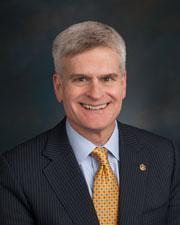
U.S. Senator for Louisiana
Republican
Senate term end not loaded yet
Missed 5.5% of roll calls. Chamber median 2.1%.
The full voting recordCounts roll calls where most Democrats and most Republicans voted differently, leaving out procedural votes.
How we countFrom FEC filings, Voteview roll calls and Congress.gov.
Republican. In Congress since 2009, 5 terms in total.
Following saves Cassidy to your list, which Chamber & Street keeps on its server, linked to a cookie on this browser and not to your name or email. Email alerts will come with constituent verification.
Bills and resolutions Cassidy signed on to as a cosponsor. An original cosponsor signed on the day the bill was introduced. Source: govinfo bill status files, last updated Nov 6, 2026.
Federal Emergency Mobilization Accountability (FEMA) Workforce Planning Act
Sponsor Gary Peters (D). Original cosponsor. 1 cosponsor. S. 444 on Congress.gov
Introduced
Federal Emergency Mobilization Accountability (FEMA) Workforce Planning Act
This bill requires the Federal Emergency Management Agency (FEMA) to develop and submit to Congress every three years a human capital operating plan to shape and improve FEMA’s workforce, and it requires the Government Accountability Office (GAO) to submit a report analyzing the plan.
Specifically, the bill lists contents FEMA must include in the plan, such as performance measures to track staffing and training, strategies for increasing cost-efficiency, and a plan of action to address gaps in critical and emerging skills in FEMA’s workforce. The plan must discuss the membership and training of the Surge Capacity Force, through which federal employees deploy in response to a catastrophic disaster. FEMA must submit the first plan within one year after the bill’s enactment and subsequent plans at least once every three years.
The bill also requires GAO to submit a report analyzing whether FEMA’s plan meets the requirements of the bill, including any recommendations to ensure subsequent plans meet the requirements.
Enhancing Energy Recovery Act
Sponsor John Barrasso (R). Original cosponsor. 6 cosponsors. S. 425 on Congress.gov(opens in a new tab)
Introduced
Retirement Fairness for Charities and Educational Institutions Act of 2025
Sponsor Katie Britt (R). Original cosponsor. 21 cosponsors. S. 424 on Congress.gov(opens in a new tab)
Introduced
Retirement Fairness for Charities and Educational Institutions Act of 2025
This bill allows 403(b) retirement plans (i.e., retirement plans designed for certain employees of public schools, charities, and churches) to invest in collective investment trusts, which are a group of pooled investment assets held by a bank or trust company, and in insurance company separate accounts.
Fair Access to Banking Act
Sponsor Kevin Cramer (R). Original cosponsor. 47 cosponsors. S. 401 on Congress.gov(opens in a new tab)
Introduced
Fair Access to Banking Act
This bill places restrictions on certain banks, credit unions, and payment card networks if they refuse to do business with a person who complies with the law. Restrictions include prohibiting the use of electronic funds transfer systems and lending programs, termination of an institution's depository insurance, and specified civil penalties.
Banks and other specified financial institutions are allowed to deny financial services to a person only if the denial is justified by a documented failure of that person to meet quantitative, impartial, risk-based standards established in advance by the institution. This justification may not be based upon reputational risks to the institution.
The bill establishes the right for a person to bring a civil action for a violation of this bill.
Dismantle DEI Act of 2025
Sponsor Eric Schmitt (R). Original cosponsor. 20 cosponsors. S. 382 on Congress.gov(opens in a new tab)
Introduced
POLICE Act of 2025
Sponsor Ted Budd (R). Joined Feb 4, 2025. 14 cosponsors. S. 212 on Congress.gov(opens in a new tab)
Introduced
Protect Our Law enforcement with Immigration Control and Enforcement Act of 2025 or the POLICE Act of 2025
This bill makes assaulting a law enforcement officer, firefighter, or other first responder a deportable offense.
Specifically, the bill makes deportable any non-U.S. national (alien under federal law) who has been convicted of (or admits to have committed) any act that constitutes the essential elements of any offense involving assault of a law enforcement officer, firefighter, or other first responder.
The Department of Homeland Security must publish annually on its website a report on the number of individuals deported in the previous fiscal year pursuant to this bill.
Hearing Protection Act
Sponsor Mike Crapo (R). Original cosponsor. 39 cosponsors. S. 364 on Congress.gov(opens in a new tab)
Introduced
SHOW UP Act of 2025
Sponsor Marsha Blackburn (R). Original cosponsor. 6 cosponsors. S. 354 on Congress.gov(opens in a new tab)
Introduced
Commission to Relocate the Federal Bureaucracy Act
Sponsor Marsha Blackburn (R). Original cosponsor. 3 cosponsors. S. 353 on Congress.gov(opens in a new tab)
Introduced
VA Home Loan Awareness Act of 2025
Sponsor Tim Sheehy (R). Joined Feb 3, 2025. 26 cosponsors. S. 138 on Congress.gov(opens in a new tab)
Introduced
VA Home Loan Awareness Act of 2025
This bill requires mortgage lenders to include on the Uniform Residential Loan Application (i.e., Fannie Mae Form 1003 or Freddie Mac Form 65) a notification that applicants with military service may qualify for a Department of Veterans Affairs Home Loan.
Not later than 18 months after the enactment of the bill, the Government Accountability Office must study and report on whether at least 80% of lenders using the loan application form have met this requirement.
Knife Owners’ Protection Act of 2025
Sponsor Mike Lee (R). Original cosponsor. 2 cosponsors. S. 346 on Congress.gov(opens in a new tab)
Introduced
Knife Owners’ Protection Act of 2025
This bill permits an individual to transport a knife between two places (e.g., states) where knife possession, carry, or transport is legal. The knife must be transported in compliance with the bill's accessibility and secure storage requirements, unless it is an emergency knife or tool designed to cut seat belts.
An individual who is transporting a knife in compliance with this bill may not be arrested or detained for a knife violation unless there is probable cause to believe the individual failed to comply with the accessibility or secure storage requirements. An individual may assert compliance with this bill as a claim or defense in any civil or criminal proceeding.
Disaster Mitigation and Tax Parity Act of 2025
Sponsor Thomas Tillis (R). Original cosponsor. 12 cosponsors. S. 336 on Congress.gov(opens in a new tab)
Introduced
Disaster Mitigation and Tax Parity Act of 2025
This bill excludes from gross income, for federal income tax purposes, payments received from a state catastrophe loss mitigation program by an individual for the purpose of making improvements to the individual’s property that mitigate the impact of certain disasters.
Under current law, individuals may exclude from gross income, for federal income tax purposes, payments received under the Robert T. Stafford Disaster Relief and Emergency Assistance Act or the National Flood Insurance Act (as in effect on April 15, 2005) for hazard mitigation. (Some exceptions apply.) Further, under current law, such payments do not increase the basis of the property for which the payments are made.
The bill allows a similar exclusion from gross income for certain payments received by an individual from a program established by
• a state (or any political subdivision or instrumentality of the state),
• a joint powers authority, or
• an entity that was established by the state to provide essential or basic property insurance and is regulated by the state.
Under the bill, such payments must be for making improvements to the individual’s property for the sole purpose of reducing damage that would be done to the property by a windstorm, earthquake, flood, or wildfire.
Finally, the bill provides that such payments from a state catastrophe loss mitigation program do not increase the basis of the property for which the payments are made.
A resolution designating the week of January 26 through February 1, 2025, as "National School Choice Week".
Sponsor Tim Scott (R). Original cosponsor. 13 cosponsors. S.Res. 44 on Congress.gov(opens in a new tab)
Introduced
This resolution designates January 26-February 1, 2025, as National School Choice Week.
Stop Funding Global Terrorists Act of 2025
Sponsor Shelley Capito (R). Original cosponsor. 10 cosponsors. S. 313 on Congress.gov(opens in a new tab)
Introduced
Stop Funding Global Terrorists Act of 2025
This bill prohibits the United States from making any voluntary or assessed contributions to the United Nations (UN) for assistance to Afghanistan until the Department of State certifies to Congress that (1) no U.S. funds are used in cash shipments by the UN to Afghanistan, and (2) terrorist organizations do not receive funds as a result of such cash shipments. If the State Department later determines such a certification is inaccurate, it must revoke the certification and notify Congress.
Graduate Opportunity and Affordable Loans Act
Sponsor Tommy Tuberville (R). Original cosponsor. 1 cosponsor. S. 308 on Congress.gov(opens in a new tab)
Introduced
Graduate Opportunity and Affordable Loans Act
This bill limits federal student loan borrowing for graduate and professional students.
Specifically, the bill terminates the ability of a graduate or professional student to receive a Direct PLUS Loan. Institutions of higher education (IHEs) must notify their prospective and enrolled graduate and professional students that Direct PLUS Loans terminate on June 30, 2025.
Additionally, the bill establishes the aggregate loan limit for Direct Unsubsidized Loans as $65,000 for a graduate student (in addition to the amount borrowed for undergraduate education) and $130,000 for a professional student (in addition to the amount borrowed for undergraduate education).
The bill allows IHEs to set lower loan limits.
Harmful Algal Bloom and Hypoxia Research and Control Amendments Act of 2025
Sponsor Dan Sullivan (R). Joined Jan 28, 2025. 15 cosponsors. S. 93 on Congress.gov(opens in a new tab)
Passed the Senate
Harmful Algal Bloom and Hypoxia Research and Control Amendments Act of 2025
This bill extends through FY2030 and modifies the Harmful Algal Bloom and Hypoxia Research and Control Act to address algal blooms and hypoxia (deficiency of oxygen) in U.S. marine, estuarine, and freshwater systems. Harmful algal blooms are high concentrations of algae that may create nuisance or toxic conditions that are harmful to humans, animals, aquatic ecosystems, and the economy.
The bill directs the Inter-Agency Task Force on Harmful Algal Blooms and Hypoxia to submit to Congress an action strategy for harmful algal blooms at least once every five years. The bill also expands the task force's membership to include the Department of Energy.
The bill also expands the duties of the National Oceanic and Atmospheric Administration (NOAA) under the National Harmful Algal Bloom and Hypoxia program. NOAA must also carry out a variety of activities related to monitoring, predicting, preventing, mitigating, and responding to marine, coastal, and Great Lakes harmful algal bloom and hypoxia events. For example, NOAA must establish (1) a national network of observing systems for monitoring, detecting, and forecasting harmful algal blooms; and (2) a national-level incubator program to increase the number of strategies, technologies, and measures available to prevent, mitigate, and control harmful algal blooms.
Additionally, the Environmental Protection Agency must develop and enhance operational freshwater harmful algal bloom monitoring, observing, and forecasting programs in lakes, rivers, and reservoirs and carry out other activities related to researching freshwater harmful algal blooms and hypoxia events.
A joint resolution providing for congressional disapproval under chapter 8 of title 5, United States Code, of the rule submitted by the Department of Energy relating to "Energy Conservation Program: Energy Conservation Standards for Consumer Gas-fired Instantaneous Water Heaters".
Sponsor Ted Cruz (R). Original cosponsor. 14 cosponsors. S.J.Res. 4 on Congress.gov(opens in a new tab)
Passed committee
This joint resolution nullifies the rule titled Energy Conservation Program: Energy Conservation Standards for Consumer Gas-fired Instantaneous Water Heaters and submitted by the Department of Energy (DOE) on December 26, 2024. Under the rule, DOE adopted amended energy conservation standards for gas-fired instantaneous water heaters to achieve the maximum improvement in energy efficiency that DOE determined was technologically feasible and economically justified.
Fair Play for Girls Act
Sponsor Marsha Blackburn (R). Joined Jan 23, 2025. 11 cosponsors. S. 74 on Congress.gov(opens in a new tab)
Introduced
Fair Play for Girls Act
This bill requires the Department of Justice to report to Congress on violence against females in athletics in the United States.
Promoting Domestic Energy Production Act
Sponsor James Lankford (R). Original cosponsor. 18 cosponsors. S. 224 on Congress.gov(opens in a new tab)
Introduced
Promoting Domestic Energy Production Act
This bill allows corporations to reduce their adjusted financial statement income to account for certain intangible costs related to oil, gas, or geothermal well drilling and development for purposes of calculating the corporate alternative minimum tax.
Under current law, a 15% corporate alternative minimum tax is imposed on a corporation with adjusted financial statement income exceeding an average of $1 billion for a consecutive three-year period (or an average of $100 million for a U.S. corporation that is part of a foreign parent multinational group if the adjusted financial statement income of such group exceeds an average of $1 billion for a consecutive three-year period). Adjusted financial statement income generally is the net income or loss reported on the corporation’s applicable financial statement for a tax year, with adjustments for specific items.
This bill expands the reductions that may be made to a corporation’s adjusted financial statement income to include (1) intangible drilling and development costs incurred by an operator of a domestic oil, gas, or geothermal well that are allowed as a deduction in the current tax year when computing regular taxable income; and (2) any depletion expenses related to the intangible oil, gas, or geothermal well drilling and development costs.
Main Street Tax Certainty Act
Sponsor Steve Daines (R). Original cosponsor. 45 cosponsors. S. 213 on Congress.gov(opens in a new tab)
Introduced
Main Street Tax Certainty Act
This bill makes permanent the qualified business income (QBI) tax deduction.
Under current law, individuals, estates, and trusts may deduct the lower of (1) 20% of QBI from a qualified business, qualified real estate investment trust dividends, and qualified publicly traded partnership income; or (2) 20% of taxable income less net capital gain. (Some limitations apply.)
However, under current law, the QBI tax deduction expires after December 31, 2025.
Helping Small Businesses THRIVE Act
Sponsor Jeanne Shaheen (D). Original cosponsor. 1 cosponsor. S. 202 on Congress.gov(opens in a new tab)
Introduced
No Taxpayer Funding for Abortion and Abortion Insurance Full Disclosure Act of 2025
Sponsor Roger Wicker (R). Original cosponsor. 50 cosponsors. S. 186 on Congress.gov(opens in a new tab)
Introduced
No Taxpayer Funding for Abortion and Abortion Insurance Full Disclosure Act of 2025
This bill modifies provisions relating to federal funding for, and health insurance coverage of, abortions.
Specifically, the bill prohibits the use of federal funds for abortions or for health coverage that includes abortions. Such restrictions extend to the use of funds in the budget of the District of Columbia. Additionally, abortions may not be provided in a federal health care facility or by a federal employee.
Historically, language has been included in annual appropriations bills for the Department of Health and Human Services (HHS) that prohibits the use of federal funds for abortions—such language is commonly referred to as the Hyde Amendment. Similar language is also frequently included in appropriations bills for other federal agencies and the District of Columbia. The bill makes these restrictions permanent and extends the restrictions to all federal funds (rather than specific agencies).
The bill's restrictions regarding the use of federal funds do not apply in cases of rape, incest, or where a physical disorder, injury, or illness endangers a woman's life unless an abortion is performed. The Hyde Amendment provides the same exceptions.
The bill also prohibits qualified health plans from including coverage for abortions. Currently, qualified health plans may cover abortion, but the portion of the premium attributable to abortion coverage is not eligible for subsidies.
Justice for Victims of Sanctuary Cities Act of 2025
Sponsor Thomas Tillis (R). Original cosponsor. 11 cosponsors. S. 185 on Congress.gov(opens in a new tab)
Introduced
Justice for Victims of Sanctuary Cities Act of 2025
This bill provides a private right of action against state and local jurisdictions with certain policies that limit cooperation with federal immigration enforcement efforts, and contains additional provisions related to such jurisdictions. Currently, such cooperation is generally not required.
An individual (or certain relatives of such an individual) who is the victim of any felony for which an alien has been arrested, convicted, or sentenced to a prison term of at least one year may sue a state or local jurisdiction if the jurisdiction failed to comply with (1) certain Department of Homeland Security (DHS) requests related to arresting and detaining aliens, and (2) a DHS request to detain the alien in question or provide a notification about the release of the alien. A jurisdiction that accepts certain federal grants may not assert immunity in such a civil action.
A jurisdiction (or employee of a jurisdiction) that complies with certain DHS detainer requests shall be deemed to be acting as an agent of DHS. A complying jurisdiction or employee of the jurisdiction shall not be liable in any lawsuit relating to compliance with such requests. In a lawsuit against an employee of the jurisdiction, the United States shall be substituted in as the defendant, and remedies shall be limited to provisions for bringing tort claims against the federal government.
Protect Funding for Women's Health Care Act
Sponsor Joni Ernst (R). Original cosponsor. 19 cosponsors. S. 177 on Congress.gov(opens in a new tab)
Introduced
Protect Funding for Women's Health Care Act
This bill prohibits federal funding of Planned Parenthood Federation of America or its affiliates, subsidiaries, successors, or clinics.
Standing Against Houthi Aggression Act
Sponsor Steve Daines (R). Original cosponsor. 20 cosponsors. S. 159 on Congress.gov(opens in a new tab)
Introduced
Standing Against Houthi Aggression Act
This bill requires (1) the Department of State to designate Ansarallah, the Iran-backed movement in Yemen also known as the Houthis, as a foreign terrorist organization; and (2) the President to impose property- and visa-blocking sanctions with respect to Ansarallah and any foreign person who is a member, agent, or affiliate of, or owned or controlled by, Ansarallah.