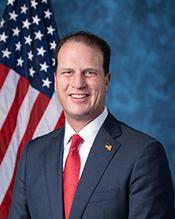
U.S. Representative for Texas’s 11th district
Republican
119th Congress, two-year term
Missed 1.3% of roll calls. Chamber median 1.9%.
The full voting recordCounts roll calls where most Democrats and most Republicans voted differently, leaving out procedural votes.
How we countFrom FEC filings, Voteview roll calls and Congress.gov.
Republican. In Congress since 2021, 3 terms in total.
Following saves Pfluger to your list, which Chamber & Street keeps on its server, linked to a cookie on this browser and not to your name or email. Email alerts will come with constituent verification.
Bills and resolutions where Pfluger is the primary sponsor. Most bills never leave committee; that is normal for every member. Source: Congress.gov, last updated Oct 29, 2026.
27 of 64 have at least one cosponsor from the other party.
A resolution honoring the life and legacy of Dr. Edwin J. Feulner, and commending Dr. Feulner for his life-long commitment to the conservative movement and his distinct contributions to his country.
Introduced Jul 25, 2025. 9 cosponsors. H.Res. 614 on Congress.gov
Introduced
Defending American Property Abroad Act of 2025
Introduced Jul 21, 2025. 39 cosponsors, 7 from the other party. H.R. 4577 on Congress.gov(opens in a new tab)
Introduced
Recognizing the life, achievements, and public service of former First Lady Barbara Pierce Bush on the occasion of her 100th birthday.
Introduced Jun 17, 2025. 10 cosponsors. H.Res. 520 on Congress.gov(opens in a new tab)
Introduced
Terrorist Inadmissibility Codification Act
Introduced Jun 11, 2025. 3 cosponsors. H.R. 3926 on Congress.gov(opens in a new tab)
Introduced
Recognizing the life, achievements, and public service of former First Lady Barbara Pierce Bush on the occasion of her 100th birthday.
Introduced Jun 6, 2025. 9 cosponsors. H.Con.Res. 36 on Congress.gov(opens in a new tab)
Introduced
Small Biotech Innovation Act
Introduced Jun 4, 2025. 4 cosponsors, 1 from the other party. H.R. 3731 on Congress.gov(opens in a new tab)
Introduced
ON TIME Act
Introduced May 29, 2025. 0 cosponsors. H.R. 3653 on Congress.gov(opens in a new tab)
Introduced
COUNTER Act
Introduced May 15, 2025. 40 cosponsors, 11 from the other party. H.R. 3463 on Congress.gov(opens in a new tab)
Introduced
Conscience Protection Act of 2025
Introduced May 14, 2025. 16 cosponsors. H.R. 3411 on Congress.gov(opens in a new tab)
Introduced
No Iranian Energy Act
Introduced Apr 1, 2025. 21 cosponsors. H.R. 2574 on Congress.gov(opens in a new tab)
Introduced
To provide for the rescission of certain waivers and licenses relating to Iran, and for other purposes.
Introduced Apr 1, 2025. 22 cosponsors. H.R. 2575 on Congress.gov(opens in a new tab)
Introduced
LIZARD Act of 2025
Introduced Apr 1, 2025. 1 cosponsor. H.R. 2573 on Congress.gov(opens in a new tab)
Introduced
UPRISERS Act
Introduced Mar 21, 2025. 9 cosponsors. H.R. 2273 on Congress.gov(opens in a new tab)
Introduced
FAFSA Act of 2025
Introduced Mar 21, 2025. 6 cosponsors. H.R. 2272 on Congress.gov(opens in a new tab)
Introduced
Freeze Aid For Student Assaulters Act of 2025 or the FAFSA Act of 2025
This bill prohibits an individual who is convicted of a criminal offense of assault against a police officer or rioting (e.g., inciting a riot or participating in a riot) from receiving student federal financial assistance.
Specifically, an individual who is convicted of such an offense shall not be eligible to receive any grant, loan, or work assistance under Title IV of the Higher Education Act of 1965 (HEA). (Title IV financial assistance is the largest source of federal aid to postsecondary students.)
Additionally, any grant previously awarded to such an individual must be treated as a Federal Direct Unsubsidized Stafford Loan that is subject to repayment. Further, interest shall accrue on the converted loan from the date of the original grant award. Converted loans may not be eligible for any loan forgiveness, cancellation, discharge, or reduction programs under the HEA, any other provision of law, or any administrative action or program.
Early Action and Responsiveness Lifts Youth Minds Act
Introduced Feb 27, 2025. 32 cosponsors, 22 from the other party. H.R. 1735 on Congress.gov(opens in a new tab)
Introduced
Broadband Buildout Accountability Act
Introduced Feb 25, 2025. 5 cosponsors. H.R. 1579 on Congress.gov(opens in a new tab)
Introduced
Broadband Buildout Accountability Act
This bill makes actions or decisions of the National Telecommunications and Information Administration concerning the Broadband Equity, Access, and Deployment Program subject to the Freedom of Information Act, which governs the release of federal documents.
Digital Economy Cybersecurity Advisory Act of 2025
Introduced Feb 21, 2025. 0 cosponsors. H.R. 1495 on Congress.gov(opens in a new tab)
Introduced
Digital Economy Cybersecurity Advisory Act of 2025
This bill establishes a Digital Economy and Cybersecurity Board of Advisors within the National Telecommunications and Information Administration (NTIA).
The board must provide the NTIA with recommendations for (1) technical cybersecurity best practices to drive economic growth while securing information and communications networks; (2) policies to support the development and implementation of cybersecurity practices with respect to the internet and information and communications networks; (3) policies that promote security and resilience to cybersecurity incidents; and (4) policies to remove barriers to trust, security, innovation, and commercialization; among other topics.
The board must be composed of between 5 and 25 members, each of whom must have appropriate cybersecurity expertise. The NTIA must ensure board members provide balanced representation among specified sectors and positions, including chief cybersecurity officers, individuals who operate or maintain communications networks, software and equipment vendors, and individuals who operate or maintain internet applications. Board members must serve without compensation.
The board must terminate four years after the bill’s enactment.
Countering Online Radicalization and Terrorism Act
Introduced Feb 11, 2025. 6 cosponsors, 2 from the other party. H.R. 1212 on Congress.gov(opens in a new tab)
Introduced
Amateur Radio Emergency Preparedness Act
Introduced Feb 6, 2025. 33 cosponsors, 12 from the other party. H.R. 1094 on Congress.gov(opens in a new tab)
Introduced
Amateur Radio Emergency Preparedness Act
This bill limits the adoption and enforcement of private land use restrictions (e.g., rules of a homeowners' association) that prohibit, restrict, or impair the installation, maintenance, or operation of an amateur station antenna on property controlled by an amateur radio operator.
Private land use restrictions are deemed to prohibit, restrict, or impair the installation, maintenance, or operation of an amateur station antenna if they unreasonably delay, prevent, or increase the cost or difficulty of such installation, maintenance, or operation; or if they prevent or degrade the reception or transmission of a signal acceptable to the operator.
However, the bill permits certain private land use restrictions, including restrictions that require amateur station antennas (1) to be maintained in a structurally safe condition; or (2) to be installed in compliance with manufacturer specifications, applicable zoning ordinances, amateur radio tower ordinances, and building codes.
The bill also establishes certain limits on the adoption and enforcement of private land use restrictions that require an amateur radio operator to obtain prior approval before installing an amateur station antenna, and exempts certain categories of amateur station antenna from prior approval requirements altogether.
Finally, the bill sets forth procedures for the enforcement of these provisions and provides a private right of action for individuals harmed by violations of the provisions.
Proposing an amendment to the Constitution of the United States to prohibit persons who are not citizens, nationals, or lawful permanent residents of the United States from voting in elections.
Introduced Jan 31, 2025. 8 cosponsors. H.J.Res. 31 on Congress.gov(opens in a new tab)
Introduced
This joint resolution proposes a constitutional amendment prohibiting persons who are not U.S. citizens, nationals, or lawful permanent residents from voting in elections. Specifically, the joint resolution prohibits such a person from voting in any election for federal, state, tribal, or local office, including offices in the District of Columbia or in any of the territories or possessions of the United States.
No Foreign Persons Administering Our Elections Act
Introduced Jan 31, 2025. 9 cosponsors. H.R. 882 on Congress.gov(opens in a new tab)
Introduced
No Foreign Persons Administering Our Elections Act
This bill prohibits states and local jurisdictions from hiring noncitizens to administer federal elections.
Counter SNIPER Act
Introduced Jan 31, 2025. 3 cosponsors. H.R. 883 on Congress.gov(opens in a new tab)
Introduced
PARTS Act of 2025
Introduced Jan 22, 2025. 27 cosponsors, 1 from the other party. H.R. 631 on Congress.gov(opens in a new tab)
Introduced
RACE Act
Introduced Jan 16, 2025. 2 cosponsors. H.R. 529 on Congress.gov(opens in a new tab)
Introduced
Restoring American Confidence in Elections Act or the RACE Act
This bill establishes deadlines for states to count ballots and certify results in federal elections.
Specifically, the bill requires a state to finish counting the ballots cast in a federal election held in the state not later than 10:00 p.m. on the date of the election. Further, the state must certify the election results not later than 48 hours after the election.
The bill provides exceptions to these deadlines for bona fide emergencies (e.g., major disasters) or technical difficulties (e.g., malfunctioning election equipment or software).
Natural Gas Tax Repeal Act
Introduced Jan 9, 2025. 5 cosponsors. H.R. 313 on Congress.gov(opens in a new tab)
Introduced
Natural Gas Tax Repeal Act
This bill eliminates a program administered by the Environmental Protection Agency that provides support for reducing methane emissions from the oil and gas sector. It also repeals a charge on methane emissions from facilities that contain petroleum and natural gas systems and emit 25,000 metric tons or more of greenhouse gases per year.