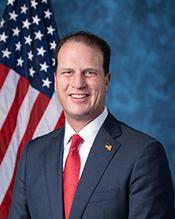
U.S. Representative for Texas’s 11th district
Republican
119th Congress, two-year term
Missed 1.3% of roll calls. Chamber median 1.9%.
The full voting recordCounts roll calls where most Democrats and most Republicans voted differently, leaving out procedural votes.
How we countFrom FEC filings, Voteview roll calls and Congress.gov.
Republican. In Congress since 2021, 3 terms in total.
Following saves Pfluger to your list, which Chamber & Street keeps on its server, linked to a cookie on this browser and not to your name or email. Email alerts will come with constituent verification.
Bills and resolutions Pfluger signed on to as a cosponsor. An original cosponsor signed on the day the bill was introduced. Source: govinfo bill status files, last updated Nov 6, 2026.
SAFE for America Act of 2025
Sponsor Mike Collins (R). Joined Feb 12, 2026. 59 cosponsors. H.R. 1241 on Congress.gov
Introduced
Security And Fairness Enhancement for America Act of 2025 or SAFE for America Act of 2025
This bill eliminates the diversity visa program. This program provides up to 55,000 visas annually to individuals from countries with low rates of immigration to the United States.
Recycled Materials Attribution Act of 2026
Sponsor Nicholas Langworthy (R). Original cosponsor. 13 cosponsors. H.R. 7502 on Congress.gov(opens in a new tab)
Passed committee
Pipeline Cybersecurity Preparedness Act
Sponsor Randy Weber (R). Joined Feb 11, 2026. 5 cosponsors. H.R. 7272 on Congress.gov(opens in a new tab)
Introduced
New Source Review Permitting Improvement Act
Sponsor H. Griffith (R). Joined Feb 11, 2026. 21 cosponsors. H.R. 161 on Congress.gov(opens in a new tab)
Introduced
New Source Review Permitting Improvement Act
This bill modifies terminology for purposes of the New Source Review (NSR) permitting program of the Environmental Protection Agency (EPA).
In order for a change to a stationary source to be a modification (a change to a stationary source that increases the air pollutant emissions or results in new pollutants) for purposes of the NSR permitting program, the maximum hourly emission rate achievable by such source must be higher than the maximum hourly rate achievable by such source during any hour in the 10-year period preceding the change.
A change at a stationary source is not considered to be a modification under the bill if it is designed to (1) reduce the amount of any air pollutant emitted; or (2) restore, maintain, or improve the reliability of operations at, or safety of, the source. However, such changes are not excepted if the EPA determines the increase in the maximum achievable hourly emission rate from such change would cause an adverse effect on human health or the environment.
Construction, in connection with a major emitting facility (a type of stationary source), does not include a change at such a facility that does not result in a significant emissions increase or a significant net emissions increase.
In relation to major emitting facilities in nonattainment areas, the terms modifications and modified do not include changes at such facilities that do not result in a significant emissions increase or a significant net emissions increase.
Stopping Border Surges Act
Sponsor Andy Biggs (R). Joined Feb 11, 2026. 41 cosponsors. H.R. 116 on Congress.gov(opens in a new tab)
Introduced
Stopping Border Surges Act
This bill modifies immigration law provisions relating to unaccompanied alien minors and to asylum seekers.
The bill requires the Department of Homeland Security (DHS) to repatriate certain unaccompanied, inadmissible alien children, generally those not at risk of being trafficking victims nor having a fear of persecution. Currently, only inadmissible unaccompanied aliens from neighboring countries are subject to repatriation, and DHS has discretion whether to repatriate.
When the Department of Health and Human Services releases an unaccompanied child to an individual, it shall provide DHS with certain information about that individual, including Social Security number and immigration status.
The bill requires a stricter standard to find a credible fear of persecution and imposes additional rules on credible fear interviews.
If an alien is granted asylum because of fear of persecution in a country, the alien shall be deemed to have renounced asylum status by returning to that country, if there has been no change in the country's conditions.
The bill also (1) expands the definition of what constitutes a frivolous asylum application, (2) imposes additional limitations on eligibility for asylum, (3) shortens the deadline for applying for asylum, and (4) extends the time period an alien seeking asylum must wait before receiving employment authorization.
Any individual who knowingly and willfully makes materially false statements or uses fraudulent documents in asylum-related proceedings shall be fined or imprisoned up to 10 years, or both.
Dismantle DEI Act of 2025
Sponsor Michael Cloud (R). Joined Feb 9, 2026. 109 cosponsors. H.R. 925 on Congress.gov(opens in a new tab)
Introduced
Department of Homeland Security Intelligence and Analysis Training Act
Sponsor Seth Magaziner (D). Original cosponsor. 3 cosponsors. H.R. 7436 on Congress.gov(opens in a new tab)
Passed the House
Department of Homeland Security Intelligence and Analysis Training Act
This bill requires the Office of Intelligence and Analysis (I&A) of the Department of Homeland Security (DHS) to implement training programs for new I&A employees, including training on federal privacy rights and civil liberties.
Specifically, I&A must implement standard, entry-level training for all new hires, including training on federal privacy rights, civil rights, civil liberties, and information practices.
New hires in analytic positions must also receive training on (1) intelligence community (IC) analytic standards; and (2) I&A’s mission to integrate intelligence operations DHS-wide and to share intelligence with state, local, tribal, territorial, and private sector partners.
New hires in open-source intelligence collection positions must also receive training on (1) principles of open-source intelligence collection and data management, including how to navigate sources and use data in accordance with federal law and policy; and (2) IC open-source intelligence collection standards and related DHS authorities.
Further, I&A must develop specialized training curricula, including raw intelligence release authority training, to improve I&A operations and promote professional development. I&A must periodically provide employees with a list of specialized training offered by other IC elements and the Department of Defense (DOD). I&A must also implement a system to track employee completion of training.
Finally, the Government Accountability Office must submit a report to Congress on the implementation of these provisions, including a comparison of training developed under these provisions and training provided by other IC elements and DOD.
SAVE America Act
Sponsor Chip Roy (R). Joined Feb 9, 2026. 111 cosponsors. H.R. 7296 on Congress.gov(opens in a new tab)
Introduced
Safeguard American Voter Eligibility Act or the SAVE America Act
This bill requires individuals to provide documentary proof of U.S. citizenship when registering to vote, and requires photo identification to vote, in federal elections.
Specifically, the bill prohibits states from accepting and processing an application to register to vote in a federal election unless the applicant presents documentary proof of U.S. citizenship. The bill specifies what documents are considered acceptable proof of U.S. citizenship, such as identification that complies with the REAL ID Act of 2005 that indicates U.S. citizenship.
Further, the bill (1) prohibits states from registering an individual to vote in a federal election unless, at the time the individual applies to register to vote, the individual provides documentary proof of U.S. citizenship; and (2) requires states to establish an alternative process to demonstrate U.S. citizenship.
Each state must take affirmative steps on an ongoing basis to ensure that only U.S. citizens are registered to vote, which shall include establishing a program to identify individuals who are not U.S. citizens using information supplied by certain sources.
Additionally, states must remove noncitizens from their official lists of eligible voters.
The bill (1) provides for a private right of action for certain violations, and (2) establishes criminal penalties for certain offenses.
Individuals voting in federal elections must present an eligible photo identification document. An individual who votes by absentee ballot must submit a copy of their identification document with both the request for, and the submission of, the absentee ballot.
To amend title 18, United States Code, to include rioting in the definition of racketeering activity.
Sponsor Beth Van Duyne (R). Joined Feb 9, 2026. 75 cosponsors. H.R. 4620 on Congress.gov(opens in a new tab)
Introduced
Restoring Equal Opportunity Act
Sponsor Brandon Gill (R). Joined Feb 9, 2026. 61 cosponsors. H.R. 4448 on Congress.gov(opens in a new tab)
Introduced
Fairness for High-Skilled Americans Act of 2025
Sponsor Paul Gosar (R). Joined Feb 9, 2026. 40 cosponsors. H.R. 2315 on Congress.gov(opens in a new tab)
Introduced
Fairness for High-Skilled Americans Act of 2025
This bill eliminates the Optional Practical Training Program or any successor program, unless Congress expressly authorizes such a program. (The program provides an F-1 student visa holder temporary employment authorization before or after completion of the student's studies, or both.)
Duty Status Reform Act
Sponsor Gilbert Cisneros (D). Joined Feb 4, 2026. 44 cosponsors. H.R. 6976 on Congress.gov(opens in a new tab)
Introduced
HIRE Act
Sponsor J. Hill (R). Joined Feb 4, 2026. 8 cosponsors. H.R. 6524 on Congress.gov(opens in a new tab)
Introduced
Protecting Patient Access to Cancer and Complex Therapies Act
Sponsor Gregory Murphy (R). Joined Feb 2, 2026. 57 cosponsors. H.R. 4299 on Congress.gov(opens in a new tab)
Introduced
Make Elections Great Again Act
Sponsor Bryan Steil (R). Original cosponsor. 70 cosponsors. H.R. 7300 on Congress.gov(opens in a new tab)
Introduced
AI for Secure Networks Act
Sponsor Robert Menendez (D). Original cosponsor. 5 cosponsors. H.R. 7294 on Congress.gov(opens in a new tab)
Passed committee
AI for Secure Networks Act
This bill requires the National Telecommunications and Information Administration (NTIA) to study and report to Congress on the impact of artificial intelligence (AI) technology on the security of telecommunications networks.
The report must include an analysis of (1) how AI may be used to improve and increase the security of telecommunications networks, including in connection with Open Radio Access Network or virtualized security technologies; and (2) risks to telecommunications network security posed by AI. The NTIA must seek public comment on the report before finalizing it and submitting it to Congress.
Buying American Cotton Act of 2026
Sponsor Gregory Murphy (R). Original cosponsor. 102 cosponsors. H.R. 7230 on Congress.gov(opens in a new tab)
Introduced
Denouncing Nicolás Maduro's authoritarian, despotic, and murderous regime and commending President Trump for taking decisive action long called for by Members of Congress.
Sponsor Eric Crawford (R). Joined Jan 21, 2026. 9 cosponsors. H.Res. 987 on Congress.gov(opens in a new tab)
Introduced
Promoting Physical Activity for Americans Act
Sponsor Blake Moore (R). Joined Jan 21, 2026. 11 cosponsors. H.R. 6121 on Congress.gov(opens in a new tab)
Introduced
Promoting Physical Activity for Americans Act
This bill requires the Department of Health and Human Services (HHS) to continue issuing at least every 10 years physical-activity guidelines based on the most current scientific and medical knowledge.
HHS must also publish updated reports that detail evidence-based practices and highlight continuing physical-activity issues between iterations of the guidelines.
Deporting Fraudsters Act of 2026
Sponsor David Taylor (R). Joined Jan 21, 2026. 34 cosponsors. H.R. 1958 on Congress.gov(opens in a new tab)
Passed the House
Deporting Fraudsters Act of 2026
This bill makes certain acts related to public benefits fraud grounds for (1) barring a non-U.S. national (alien under federal law) from admission into the United States, or (2) deporting the individual. The bill also makes such an individual ineligible for immigration enforcement relief, including relief for an individual in danger of subjection to torture.
Specifically, this bill applies to individuals who have been convicted of, admit to having committed, or admit to acts which constitute certain offenses. Offenses covered by this bill include (1) fraud involving Supplemental Nutrition Assistance Program (SNAP) benefits, (2) fraud involving Social Security benefits, (3) fraud involving programs that receive federal funds, and (4) the production of fraudulent identification documents.
Birthright Citizenship Act of 2025
Sponsor Brian Babin (R). Joined Jan 20, 2026. 95 cosponsors. H.R. 569 on Congress.gov(opens in a new tab)
Introduced
Birthright Citizenship Act of 2025
This bill limits birthright citizenship by redefining what it means to be subject to the jurisdiction of the United States.
Currently, a person born in the United States and subject to U.S. jurisdiction is entitled to citizenship. Under the bill, a person is subject to U.S. jurisdiction if he or she is born to a parent who is (1) a U.S. citizen or national, (2) a lawful permanent resident residing in the United States, or (3) a non-U.S. national (alien under federal law) with a lawful immigration status who is performing active service in the Armed Forces.
The bill does not affect the citizenship or nationality status of any person born before the bill's enactment date.
Nuclear Family Priority Act
Sponsor Elijah Crane (R). Joined Jan 20, 2026. 48 cosponsors. H.R. 2705 on Congress.gov(opens in a new tab)
Introduced
Nuclear Family Priority Act
This bill imposes limits on various types of family-sponsored immigration visas.
The non-U.S. national (alien under federal law) parents of U.S. citizens shall not qualify for visas for immediate relatives, which are not subject to any direct numerical limits. Currently, the spouses, unmarried children under 21, and parents of citizens are considered immediate relatives.
The bill also creates a nonimmigrant visa for such parents of citizens. Such non-U.S. nationals shall not be eligible for employment or any public benefits.
The bill also reduces the baseline annual cap for family-sponsored visas from 480,000 to 88,000, and revises the methods for calculating the cap. Currently, the 480,000 cap may be adjusted depending on various factors but shall not be less than 226,000.
The bill eliminates preference allocations (visa categories subject to various annual caps) for various family-sponsored visas, including those for the siblings and married children of citizens. The bill provides for a preference allocation for the unmarried children under 21 and spouses of permanent residents, subject to the 88,000 annual cap.
Commending President Trump, his administration, and the brave men and women of the Armed Forces, Intelligence Community, and Justice Department for the remarkable success of "Operation Absolute Resolve".
Sponsor Carlos Gimenez (R). Original cosponsor. 33 cosponsors. H.Res. 998 on Congress.gov(opens in a new tab)
Introduced
Apples to Apples Comparison Act of 2025
Sponsor Aaron Bean (R). Joined Jan 13, 2026. 25 cosponsors. H.R. 4093 on Congress.gov(opens in a new tab)
Passed committee
Apples to Apples Comparison Act of 2025
This bill requires additional reporting and disclosures regarding Medicare enrollment and expenditures.
Specifically, the bill requires the Centers for Medicare & Medicaid Services to annually report on and publish information on its website regarding expenditures for Medicare hospital services and medical services, the Medicare prescription drug benefit, and Medicare Advantage (MA), including for those who are enrolled in one program but not others or have supplemental insurance. This information must be broken down by county and metropolitan statistical area for each month over the prior 10-year period and for each month over the next 5-year period.
In addition, the Medicare Payment Advisory Commission must annually analyze and report on expenditures for Medicare beneficiaries who have an MA plan compared to those who do not have an MA plan. The Boards of Trustees for Medicare must annually report on expenditures for (1) Medicare beneficiaries who have either hospital services or medical services but not both, and (2) Medicare beneficiaries who have both hospital and medical services but do not have an MA plan.
DEFEND Act
Sponsor Elijah Crane (R). Joined Jan 12, 2026. 5 cosponsors. H.R. 6846 on Congress.gov(opens in a new tab)
Introduced