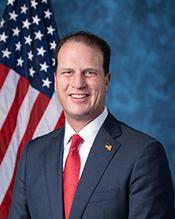
U.S. Representative for Texas’s 11th district
Republican
119th Congress, two-year term
Missed 1.3% of roll calls. Chamber median 1.9%.
The full voting recordCounts roll calls where most Democrats and most Republicans voted differently, leaving out procedural votes.
How we countFrom FEC filings, Voteview roll calls and Congress.gov.
Republican. In Congress since 2021, 3 terms in total.
Following saves Pfluger to your list, which Chamber & Street keeps on its server, linked to a cookie on this browser and not to your name or email. Email alerts will come with constituent verification.
Bills and resolutions Pfluger signed on to as a cosponsor. An original cosponsor signed on the day the bill was introduced. Source: govinfo bill status files, last updated Nov 6, 2026.
CONTAINER Act
Sponsor David Rouzer (R). Original cosponsor. 9 cosponsors. H.R. 534 on Congress.gov
Introduced
Creating Obstructions Necessary to Address Illegal and Nefarious Entry Rapidly Act or CONTAINER Act
This bill requires the Department of the Interior and the Forest Service to allow border states to place temporary, movable structures on federal lands adjacent to the U.S.-Canada and U.S.-Mexico borders without a special use authorization.
Border states may place these structures on such lands for the purpose of securing the northern or southern border for a period of not more than one year. Interior and the Forest Service must approve extension requests in 90-day increments if U.S. Customs and Border Protection determines that operational control of the border area has not been achieved.
Declaration of Energy Independence Act
Sponsor Andrew Ogles (R). Original cosponsor. 8 cosponsors. H.R. 526 on Congress.gov(opens in a new tab)
Introduced
Declaration of Energy Independence Act
This bill reduces certain royalty rates, minimum bids, rental rates, and fees for onshore oil and gas leases on federal lands and modifies related leasing procedures.
Specifically, the bill (1) decreases the royalty rate from 16 2/3% to 12 1/2% for developing oil and gas on federal lands, (2) lowers the minimum bid amount from $10.00 to $2.00 per acre for oil and gas leases on federal lands, and (3) decreases the rental rates from a maximum of $15.00 per acre to $1.50 per acre for the first five years and $2.00 per acre thereafter. The bill also eliminates the fee for expressing interest in a lease.
It also modifies leasing procedures to provide for noncompetitive leasing under certain circumstances.
In addition, the bill modifies the conditions for the reinstatement of leases that have been cancelled or terminated, including by reducing the applicable royalty and rental rates.
Repealing Big Brother Overreach Act
Sponsor Warren Davidson (R). Original cosponsor. 193 cosponsors. H.R. 425 on Congress.gov(opens in a new tab)
Passed committee
Repealing Big Brother Overreach Act
This bill repeals the Corporate Transparency Act. The act requires existing companies and newly created companies to report beneficial ownership information to the Department of the Treasury’s Financial Crimes Enforcement Network for purposes of addressing the financing of terrorism and money laundering.
Hearing Protection Act
Sponsor Ben Cline (R). Original cosponsor. 151 cosponsors. H.R. 404 on Congress.gov(opens in a new tab)
Introduced
Born-Alive Abortion Survivors Protection Act
Sponsor Ann Wagner (R). Joined Jan 13, 2025. 163 cosponsors. H.R. 21 on Congress.gov(opens in a new tab)
Passed the House
Born-Alive Abortion Survivors Protection Act
This bill establishes requirements for the degree of care a health care practitioner must provide in the case of a child born alive following an abortion or attempted abortion.
Specifically, a health care practitioner who is present must (1) exercise the same degree of care as would reasonably be provided to any other child born alive at the same gestational age, and (2) ensure the child is immediately admitted to a hospital. Additionally, a health care practitioner or other employee who has knowledge of a failure to comply with the degree-of-care requirements must immediately report such failure to law enforcement.
A health care practitioner who fails to provide the required degree of care, or a health care practitioner or other employee who fails to report such failure, is subject to criminal penalties—a fine, up to five years in prison, or both.
An individual who intentionally kills or attempts to kill a child born alive is subject to prosecution for murder.
The bill bars the criminal prosecution of a mother of a child born alive under this bill and allows her to bring a civil action against a health care practitioner or other employee for violations.
To designate the facility of the United States Postal Service located at 107 North Hoyne Avenue in Fritch, Texas, as the "Chief Zeb Smith Post Office".
Sponsor Ronny Jackson (R). Original cosponsor. 27 cosponsors. H.R. 282 on Congress.gov(opens in a new tab)
Introduced
This bill designates the facility of the United States Postal Service located at 107 North Hoyne Avenue in Fritch, Texas, as the "Chief Zeb Smith Post Office".
REMAIN in Mexico Act of 2025
Sponsor Brandon Gill (R). Original cosponsor. 110 cosponsors. H.R. 273 on Congress.gov(opens in a new tab)
Introduced
Return Excessive Migrants and Asylees to International Neighbors in Mexico Act of 2025 or the REMAIN in Mexico Act of 2025
This bill requires the Department of Homeland Security (DHS) to implement the Migrant Protection Protocols as outlined in the January 25, 2019, memo titled Policy Guidance for Implementation of the Migrant Protection Protocols.
(The protocols generally required aliens who are not clearly admissible, including those seeking asylum, arriving by land along the U.S.-Mexico border to be returned to Mexico while their immigration proceedings are pending, rather than remain in the United States. On January 21, 2021, DHS stopped applying the protocols to newly-arrived individuals.)
Undersea Cable Protection Act of 2025
Sponsor Earl Carter (R). Original cosponsor. 7 cosponsors. H.R. 261 on Congress.gov(opens in a new tab)
Passed the House
Undersea Cable Protection Act of 2025
This bill prohibits the Department of Commerce from enforcing certain permit requirements for activities related to undersea fiber optic cables in national marine sanctuaries.
Specifically, Commerce may not prohibit or require an authorization for any covered activities related to undersea fiber optic cables if a license, lease, or permit has been issued by a state or federal agency to authorize the covered activity. Covered activities are the installation, continued presence, operation, maintenance, repair, or recovery of undersea fiber optic cables in a national marine sanctuary.
The bill also authorizes Commerce to direct the National Oceanic and Atmospheric Administration to engage in interagency cooperation regarding federal agency actions that are likely to destroy, cause the loss of, or injure a resource in a national marine sanctuary and involve covered activities.
Constitutional Concealed Carry Reciprocity Act of 2025
Sponsor Richard Hudson (R). Original cosponsor. 189 cosponsors. H.R. 38 on Congress.gov(opens in a new tab)
Introduced
Constitutional Concealed Carry Reciprocity Act
This bill establishes a federal statutory framework to regulate the carry or possession of concealed firearms across state lines.
Specifically, an individual who is eligible to carry a concealed firearm in one state may carry or possess a concealed handgun (other than a machine gun or destructive device) in another state that allows its residents to carry concealed firearms.
It sets forth requirements for lawful concealed carry across state lines. The bill preempts most state and local laws related to concealed carry and establishes a private right of action for a person adversely affected by interference with a concealed-carry right established by this bill.
HALT Fentanyl Act
Sponsor H. Griffith (R). Original cosponsor. 61 cosponsors. H.R. 27 on Congress.gov(opens in a new tab)
Passed the House
Halt All Lethal Trafficking of Fentanyl Act or the HALT Fentanyl Act
This bill permanently places fentanyl-related substances as a class into schedule I of the Controlled Substances Act. A schedule I controlled substance is a drug, substance, or chemical that has a high potential for abuse; has no currently accepted medical value; and is subject to regulatory controls and administrative, civil, and criminal penalties under the Controlled Substances Act.
Under the bill, offenses involving fentanyl-related substances are triggered by the same quantity thresholds and subject to the same penalties as offenses involving fentanyl analogues (e.g., offenses involving 100 grams or more trigger a 10-year mandatory minimum prison term).
Additionally, the bill establishes a new, alternative registration process for certain schedule I research.
The bill also makes several other changes to registration requirements for conducting research with controlled substances, including
• permitting a single registration for related research sites in certain circumstances,
• waiving the requirement for a new inspection in certain situations, and
• allowing a registered researcher to perform certain manufacturing activities with small quantities of a substance without obtaining a manufacturing registration.
Finally, the bill expresses the sense that Congress agrees with the interpretation of Controlled Substances Act in United States v. McCray, a 2018 case decided by the U.S. District Court for the Western District of New York. In that case, the court held that butyryl fentanyl, a controlled substance, can be considered an analogue of fentanyl even though, under the Controlled Substances Act, the term controlled substance analogue specifically excludes a controlled substance.
SAVE Act
Sponsor Chip Roy (R). Original cosponsor. 110 cosponsors. H.R. 22 on Congress.gov(opens in a new tab)
Passed the House
Safeguard American Voter Eligibility Act or the SAVE Act
This bill requires individuals to provide documentary proof of U.S. citizenship when registering to vote in federal elections.
Specifically, the bill prohibits states from accepting and processing an application to register to vote in a federal election unless the applicant presents documentary proof of U.S. citizenship. The bill specifies what documents are considered acceptable proof of U.S. citizenship, such as identification that complies with the REAL ID Act of 2005 that indicates U.S. citizenship.
Further, the bill (1) prohibits states from registering an individual to vote in a federal election unless, at the time the individual applies to register to vote, the individual provides documentary proof of U.S. citizenship; and (2) requires states to establish an alternative process under which an applicant may submit other evidence to demonstrate U.S. citizenship.
Each state must take affirmative steps on an ongoing basis to ensure that only U.S. citizens are registered to vote, which shall include establishing a program to identify individuals who are not U.S. citizens using information supplied by certain sources.
Additionally, states must remove noncitizens from their official lists of eligible voters.
The bill allows for a private right of action against an election official who registers an applicant to vote in a federal election who fails to present documentary proof of U.S. citizenship.
The bill establishes criminal penalties for certain offenses, including registering an applicant to vote in a federal election who fails to present documentary proof of U.S. citizenship.
Regulations from the Executive in Need of Scrutiny Act of 2025
Sponsor Kat Cammack (R). Original cosponsor. 93 cosponsors. H.R. 142 on Congress.gov(opens in a new tab)
Introduced
Regulations from the Executive in Need of Scrutiny Act of 2025
This bill revises provisions relating to congressional review of agency rulemaking.
Specifically, the bill establishes a congressional approval process for a major rule. A major rule may only take effect if Congress approves of the rule. A major rule is a rule that has resulted in or is likely to result in (1) an annual effect on the economy of $100 million or more; (2) a major increase in costs or prices for consumers, individual industries, government agencies, or geographic regions; or (3) significant adverse effects on competition, employment, investment, productivity, innovation, or the ability of U.S.-based enterprises to compete with foreign-based enterprises.
The bill generally preserves the current congressional review process for a nonmajor rule.