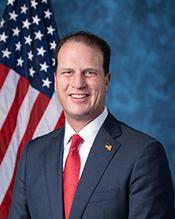
U.S. Representative for Texas’s 11th district
Republican
119th Congress, two-year term
Missed 1.3% of roll calls. Chamber median 1.9%.
The full voting recordCounts roll calls where most Democrats and most Republicans voted differently, leaving out procedural votes.
How we countFrom FEC filings, Voteview roll calls and Congress.gov.
Republican. In Congress since 2021, 3 terms in total.
Following saves Pfluger to your list, which Chamber & Street keeps on its server, linked to a cookie on this browser and not to your name or email. Email alerts will come with constituent verification.
Bills and resolutions Pfluger signed on to as a cosponsor. An original cosponsor signed on the day the bill was introduced. Source: govinfo bill status files, last updated Nov 6, 2026.
Major Richard Star Act
Sponsor Gus Bilirakis (R). Original cosponsor. 340 cosponsors. H.R. 2102 on Congress.gov
Introduced
Major Richard Star Act
This bill allows a veteran with a combat-related disability to receive retirement pay, without reduction, concurrently with their disability compensation. This includes veterans with a combat-related disability and fewer than 20 years of creditable service. (Currently, veterans who receive combat-related special compensation and retirement pay are subject to an offset in retirement pay for concurrent receipt of such benefits.)
250 Years of Service and Sacrifice Commemorative Coin Act
Sponsor Nicole Malliotakis (R). Joined Mar 10, 2025. 14 cosponsors. H.R. 951 on Congress.gov(opens in a new tab)
Introduced
250 Years of Service and Sacrifice Commemorative Coin Act
This bill directs the Department of the Treasury to mint and issue coins in recognition of the United States’ semiquincentennial.
All surcharges received by Treasury from the sale of such coins must be paid to the Stephen Siller Tunnel to Towers Foundation.
To designate the facility of the United States Postal Service located at 620 East Pecan Boulevard in McAllen, Texas, as the "Agent Raul H. Gonzalez Jr. Memorial Post Office Building".
Sponsor Monica De La Cruz (R). Original cosponsor. 27 cosponsors. H.R. 1986 on Congress.gov(opens in a new tab)
Introduced
This bill designates the facility of the United States Postal Service located at 620 East Pecan Boulevard in McAllen, Texas, as the "Agent Raul H. Gonzalez Jr. Memorial Post Office Building".
Protect and Serve Act of 2025
Sponsor John Rutherford (R). Joined Mar 10, 2025. 120 cosponsors. H.R. 1551 on Congress.gov(opens in a new tab)
Introduced
Special Interest Alien Reporting Act of 2025
Joined Mar 6, 2025. 6 cosponsors. H.R. 275 on Congress.gov(opens in a new tab)
Progress not on file
Special Interest Alien Reporting Act of 2024 [sic]
This bill requires the Department of Homeland Security (DHS) to report every month on non-U.S. nationals (aliens under federal law) who attempt to unlawfully enter the United States and who potentially pose a national security risk. DHS must report on (1) the number of individuals, (2) the nationalities or countries of last residence of these individuals, and (3) the location of the encounters.
Censuring Representative Al Green of Texas.
Sponsor Troy Nehls (R). Original cosponsor. 37 cosponsors. H.Res. 197 on Congress.gov(opens in a new tab)
Introduced
This resolution censures Representative Al Green.
SHIELD Against CCP Act
Sponsor Dale Strong (R). Joined Mar 5, 2025. 8 cosponsors. H.R. 708 on Congress.gov(opens in a new tab)
Passed the House
Strategic Homeland Intelligence and Enforcement Legislation to Defend Against the CCP Act or the SHIELD Against CCP Act
This bill requires the Department of Homeland Security (DHS) to form a working group tasked with duties related to countering terrorist, cybersecurity, border and port security, and transportation security threats posed to the United States by the Chinese Communist Party (CCP).
The working group must assess and annually report on current DHS efforts to counter the CCP’s (1) use of the U.S. immigration system, (2) economic and trade practices, and (3) support for illicit financial activity and trafficking controlled substances. The working group must terminate seven years after its establishment.
DHS must additionally carry out research and development on technologies and techniques for enhancing its security and situational awareness to these threats.
The Government Accountability Office must report on the implementation of this bill.
SPEED for BEAD Act
Sponsor Richard Hudson (R). Original cosponsor. 22 cosponsors. H.R. 1870 on Congress.gov(opens in a new tab)
Introduced
Streamlining Program Efficiency and Expanding Deployment for BEAD Act or the SPEED for BEAD Act
This bill makes certain changes to the Broadband, Equity, Access, and Deployment (BEAD) Program, including by expanding the broadband technologies that may qualify for funding and prohibiting states from regulating broadband rates in connection with the program.
(The BEAD Program is administered by the National Telecommunications and Information Administration (NTIA) and provides funding to eligible entities for broadband deployment, connectivity, mapping, and adoption projects. Eligible entities include U.S. states, territories, and the District of Columbia.)
Specifically, the bill establishes that projects using any broadband technology (e.g., satellite, fixed wireless, or fiber) may qualify for funding, provided the technology meets specified performance criteria. (Original BEAD rules established a preference for fiber projects.)
The bill also explicitly prohibits eligible entities from regulating, setting, or otherwise mandating pursuant to the BEAD Program (1) rates charged for broadband service, or (2) methodologies used to calculate such rates. The prohibition includes rate regulation carried out in conjunction with the existing requirement that subgrantees offer at least one low-cost broadband service option to certain subscribers.
Further, the bill prohibits the NTIA and eligible entities from establishing or enforcing conditions, preferences, or other requirements related to collective bargaining and labor agreements; climate change; diversity, equity, and inclusion; and other topics. The bill also modifies the purposes for which the funds may be used and the treatment of unused funds.
Finally, the bill replaces the term Equity in the program’s name with Expansion.
Jobs and Opportunities for Medicaid Act
Sponsor Dan Crenshaw (R). Joined Mar 5, 2025. 3 cosponsors. H.R. 1059 on Congress.gov(opens in a new tab)
Introduced
Jobs and Opportunities for Medicaid Act
This bill establishes work requirements under Medicaid for able-bodied adults.
Specifically, the bill requires individuals who are between the ages of 18 and 65 and who are not otherwise unable to work due to a medical condition, family situation, or other listed reason to work or volunteer at least 20 hours per week, based on a monthly average, in order to qualify for Medicaid.
Miracle on Ice Congressional Gold Medal Act
Sponsor Pete Stauber (R). Joined Mar 4, 2025. 299 cosponsors. H.R. 452 on Congress.gov(opens in a new tab)
Became law
Miracle on Ice Congressional Gold Medal Act
This act provides for the award of Congressional Gold Medals to the members of the 1980 U.S. Olympic men's ice hockey team in recognition of the team's achievement at the 1980 Winter Olympic Games.
To prohibit the use of Federal funds to implement, administer, or enforce a final rule of the Food and Drug Administration relating to "Medical Devices; Laboratory Developed Tests", and for other purposes.
Sponsor Brad Finstad (R). Joined Mar 4, 2025. 7 cosponsors. H.R. 1463 on Congress.gov(opens in a new tab)
Introduced
This bill prohibits the use of federal funds to implement, administer, or enforce the final rule issued by the Food and Drug Administration (FDA) titled Medical Devices; Laboratory Developed Tests and published on May 6, 2024, or any substantially similar rule.
The rule specifies that laboratory developed tests (medical screening tests developed by laboratories rather than medical device manufacturers) are medical devices subject to FDA regulation with limited exceptions. Prior to the rule, the FDA had exercised discretion as to whether to apply regulations for medical devices to laboratory developed tests.
AM Radio for Every Vehicle Act of 2025
Sponsor Gus Bilirakis (R). Joined Mar 3, 2025. 317 cosponsors. H.R. 979 on Congress.gov(opens in a new tab)
Passed the House
AM Radio for Every Vehicle Act of 2025
This bill requires the Department of Transportation (DOT) to issue a rule requiring AM radio capabilities to be standard in all new passenger vehicles. (AM radio is often used to deliver emergency alerts and news and entertainment programming; some newer vehicles do not include AM equipment.)
Specifically, this bill applies to passenger vehicles (1) manufactured in the United States for sale in the United States, imported into the United States, or shipped in interstate commerce; and (2) manufactured after the rule's effective date. The rule must require all such vehicles to have devices that can receive signals and play content transmitted by AM stations or digital audio AM stations installed as standard equipment and made easily accessible to drivers.
Prior to the rule's effective date, manufacturers that do not include devices that can access AM radio as standard equipment (1) must inform purchasers of this fact through clear and conspicuous labeling, and (2) may not charge an additional or separate fee for AM radio access.
DOT may assess civil penalties for any violation of the rule. The Department of Justice may also bring a civil action to enjoin a violation.
The rule, including DOT’s authority to enforce it, must expire 10 years after the bill’s enactment.
Further, the Government Accountability Office must study and report on the dissemination of emergency alerts to the public, including by conducting an assessment of AM radio relative to other Integrated Public Alert and Warning System communication technologies.
Veterans’ ACCESS Act of 2025
Sponsor Mike Bost (R). Joined Mar 3, 2025. 88 cosponsors. H.R. 740 on Congress.gov(opens in a new tab)
Passed committee
Veterans' Assuring Critical Care Expansions to Support Servicemembers Act of 2025 or the Veterans' ACCESS Act of 2025
This bill addresses the administration of the Veterans Community Care Program (VCCP) and other Department of Veterans Affairs (VA) health care matters.
Among other provisions regarding the VCCP, the bill
• establishes in statute access standards that determine when a veteran is eligible to receive non-VA care through the VCCP,
• requires the VA to notify veterans regarding their eligibility for care within two business days after the VA is aware the veteran is seeking care, and
• extends the deadline for the submittal of claims under the VCCP by health care entities and providers.
The VA must address its mental health treatment programs by
• establishing a standardized screening process to determine whether a veteran satisfies criteria for priority or routine admission to a mental health residential rehabilitation treatment program or a program for residential care for mental health and substance abuse disorders,
• tracking the performance of medical facilities and Veterans Integrated Service Networks in meeting the requirements for mental health treatment screenings and timely admission to treatment programs under such screenings, and
• establishing an appeal process for when a veteran is denied admission to a covered treatment program or is accepted into a program but not offered bed placement in a timely manner.
Additionally, the VA must establish an online self-service module for veterans to request and manage appointments, track referrals, and appeal and track decisions related to requests for care.
Second Chances for Rural Hospitals Act
Sponsor Jodey Arrington (R). Original cosponsor. 9 cosponsors. H.R. 1775 on Congress.gov(opens in a new tab)
Introduced
Second Chances for Rural Hospitals Act
This bill allows additional hospitals to qualify as rural emergency hospitals (REHs) under Medicare.
In 2020, Congress established REHs as a new Medicare provider designation for hospitals in rural areas providing emergency department services, observation care, and other outpatient medical and health services for which the annual per patient average length of stay does not exceed 24 hours. These hospitals must have been open as of December 27, 2020, in order to qualify for the new REH designation.
The bill allows hospitals that were open between January 1, 2014, and December 26, 2020, to also qualify for the REH designation, and it provides for a specific payment structure for these hospitals. The bill's changes take effect beginning in 2027.
Simplifying Forms for Veterans Claims Act
Sponsor Robert Bresnahan (R). Joined Mar 3, 2025. 18 cosponsors. H.R. 1286 on Congress.gov(opens in a new tab)
Passed the House
Simplifying Forms for Veterans Claims Act
This bill requires the Department of Veterans Affairs (VA) to seek to enter an agreement with a federally funded research and development center to assess the forms that the VA sends to claimants. The center must submit a written assessment to the VA that includes recommendations on how the VA may make the forms clearer and more organized.
The VA must implement certain recommendations in the assessment within two years after the assessment is received.
Protect Medicaid Act
Sponsor Richard Hudson (R). Joined Mar 3, 2025. 16 cosponsors. H.R. 1195 on Congress.gov(opens in a new tab)
Introduced
Protect Medicaid Act
This bill prohibits federal payment under Medicaid for the administrative costs of providing health benefits to noncitizens who are ineligible for Medicaid based on their immigration status. The Department of Health and Human Services must report on specified information regarding states that provide health benefits to such individuals.
Providing for congressional disapproval under chapter 8 of title 5, United States Code, of the rule submitted by the Environmental Protection Agency relating to "National Emission Standards for Hazardous Air Pollutants: Rubber Tire Manufacturing".
Sponsor H. Griffith (R). Joined Mar 3, 2025. 20 cosponsors. H.J.Res. 61 on Congress.gov(opens in a new tab)
Became law
This joint resolution removes emission regulations on hazardous air pollutants under the rubber tire manufacturing source category, specifically from the rubber processing subcategory. The joint resolution nullifies the Environmental Protection Agency (EPA) rule titled National Emission Standards for Hazardous Air Pollutants: Rubber Tire Manufacturing, which addresses the decision in Louisiana Environmental Action Network v. EPA (D.C. Cir. 2020) that requires the EPA to address unregulated emissions from a major source category when it conducts the 8-year technology review. The rule implemented emissions standards for the rubber processing subcategory.
Forest Service Accountability Act
Sponsor Ryan Zinke (R). Original cosponsor. 11 cosponsors. H.R. 1762 on Congress.gov(opens in a new tab)
Introduced
DHS Intelligence and Analysis Oversight and Transparency Act
Sponsor Laurel Lee (R). Original cosponsor. 2 cosponsors. H.R. 1711 on Congress.gov(opens in a new tab)
Introduced
To nullify the final rule issued by the Environmental Protection Agency relating to "New Source Performance Standards for Greenhouse Gas Emissions From New, Modified, and Reconstructed Fossil Fuel-Fired Electric Generating Units; Emission Guidelines for Greenhouse Gas Emissions From Existing Fossil Fuel-Fired Electric Generating Units; and Repeal of the Affordable Clean Energy Rule".
Sponsor Troy Balderson (R). Original cosponsor. 37 cosponsors. H.R. 1651 on Congress.gov(opens in a new tab)
Introduced
Protecting American Agriculture from Foreign Adversaries Act of 2025
Sponsor Dan Newhouse (R). Original cosponsor. 60 cosponsors. H.R. 1576 on Congress.gov(opens in a new tab)
Introduced
Protecting American Agriculture from Foreign Adversaries Act of 2025
This bill makes changes to the Committee on Foreign Investment in the United States (CFIUS), including by requiring CFIUS to determine whether a national security review is necessary for reportable agricultural land transactions that are referred by the Department of Agriculture (USDA). (CFIUS oversees the national security risks of certain foreign investment in the United States. CFIUS has the authority to review covered transactions, which include mergers, acquisitions, and takeovers that could result in foreign control of a U.S. business; certain investments in businesses involved in critical technologies, critical infrastructure, or sensitive personal data; and certain real estate transactions.)
Specifically, the bill directs CFIUS to, after receiving notification from USDA, determine (1) whether a reportable agricultural land transaction is a covered transaction, and (2) whether CFIUS should initiate a national security review or take another action with respect to the transaction.
Reportable agricultural land transaction means a transaction (1) that USDA has reason to believe is a covered transaction; (2) that involves the acquisition of an interest in agricultural land by a foreign person of China, North Korea, Russia, or Iran; and (3) with respect to which a foreign person is required to submit a report to USDA regarding their agricultural land transactions.
The bill also expands the membership of CFIUS to include the Secretary of Agriculture for covered transactions that involve agricultural land, agricultural biotechnology, or the agriculture industry (e.g., agricultural transportation, storage, and processing).
No American Land for Communist China Act
Sponsor Dan Newhouse (R). Original cosponsor. 60 cosponsors. H.R. 1575 on Congress.gov(opens in a new tab)
Introduced
Fair Access to Banking Act
Sponsor Andy Barr (R). Joined Feb 24, 2025. 151 cosponsors. H.R. 987 on Congress.gov(opens in a new tab)
Introduced
Fair Access to Banking Act
This bill places restrictions on certain banks, credit unions, and payment card networks if they refuse to do business with a person who complies with the law. Restrictions include prohibiting the use of electronic funds transfer systems and lending programs, termination of an institution's depository insurance, and specified civil penalties.
Banks and other specified financial institutions are allowed to deny financial services to a person only if the denial is justified by a documented failure of that person to meet quantitative, impartial, risk-based standards established in advance by the institution. This justification may not be based upon reputational risks to the institution.
The bill establishes the right for a person to bring a civil action for a violation of this bill.
Syria Terrorism Threat Assessment Act
Sponsor Morgan Luttrell (R). Joined Feb 24, 2025. 3 cosponsors. H.R. 1327 on Congress.gov(opens in a new tab)
Passed the House
Syria Terrorism Threat Assessment Act
This bill requires the Department of Homeland Security to provide Congress with an assessment of terrorist threats to the United States posed by individuals in Syria affiliated with either a foreign terrorist organization or a specially designated global terrorist organization.
Cyber PIVOTT Act
Joined Feb 24, 2025. 12 cosponsors. H.R. 1000 on Congress.gov(opens in a new tab)
Progress not on file