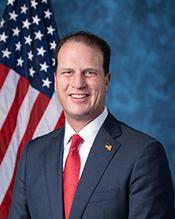
U.S. Representative for Texas’s 11th district
Republican
119th Congress, two-year term
Missed 1.3% of roll calls. Chamber median 1.9%.
The full voting recordCounts roll calls where most Democrats and most Republicans voted differently, leaving out procedural votes.
How we countFrom FEC filings, Voteview roll calls and Congress.gov.
Republican. In Congress since 2021, 3 terms in total.
Following saves Pfluger to your list, which Chamber & Street keeps on its server, linked to a cookie on this browser and not to your name or email. Email alerts will come with constituent verification.
Bills and resolutions Pfluger signed on to as a cosponsor. An original cosponsor signed on the day the bill was introduced. Source: govinfo bill status files, last updated Nov 6, 2026.
Anti-CBDC Surveillance State Act
Sponsor Tom Emmer (R). Joined Apr 8, 2025. 135 cosponsors. H.R. 1919 on Congress.gov
Passed the House
Anti-CBDC Surveillance State Act
This bill prohibits a Federal Reserve bank from offering products or services directly to an individual, maintaining an account on behalf of an individual, or issuing a central bank digital currency (i.e., a digital dollar). Further, the Board of Governors of the Federal Reserve System is prohibited from using a central bank digital currency to implement monetary policy or from testing, studying, creating, or implementing a central bank digital currency, with exceptions as provided by the bill.
Preserving Safe Communities by Ending Swatting Act of 2025
Sponsor David Kustoff (R). Joined Apr 7, 2025. 28 cosponsors. H.R. 286 on Congress.gov(opens in a new tab)
Introduced
Preserving Safe Communities by Ending Swatting Act of 2025
This bill makes it a crime to intentionally convey false or misleading information in circumstances where the information may reasonably be expected to cause an emergency response and the information indicates the occurrence of criminal conduct or a threat to health or safety (commonly referred to as swatting).
To remove certain species from the lists of threatened species and endangered species published pursuant to the Endangered Species Act of 1973.
Sponsor Chip Roy (R). Original cosponsor. 2 cosponsors. H.R. 2608 on Congress.gov(opens in a new tab)
Introduced
SAVES Act
Sponsor Morgan Luttrell (R). Original cosponsor. 76 cosponsors. H.R. 2605 on Congress.gov(opens in a new tab)
Introduced
Maximum Pressure Act
Sponsor Zachary Nunn (R). Original cosponsor. 55 cosponsors. H.R. 2570 on Congress.gov(opens in a new tab)
Introduced
Old Drugs, New Cures Act
Sponsor Donald Davis (D). Original cosponsor. 1 cosponsor. H.R. 2542 on Congress.gov(opens in a new tab)
Introduced
Old Drugs, New Cures Act
This bill exempts manufacturers of certain long-standing drugs from paying specialized rebates under the Medicaid Drug Rebate Program and the Medicare Prescription Drug Inflation Rebate Program. (Under these programs, drug manufacturers pay rebates to state Medicaid programs for certain drugs covered under Medicaid and to the Centers for Medicare & Medicaid Services for certain drugs covered under Medicare.)
Specifically, manufacturers may request that a drug that would otherwise be considered a line extension under the Medicaid and Medicare rebate programs to instead be designated as a priority research drug. (A line extension refers to an oral dose of a new formulation of an existing drug, such as an extended release formulation, that would subject the drug to specialized rebates under the Medicaid and Medicare drug rebate programs.)
Under the bill, a drug qualifies as a priority research drug if (1) at least 10 years have elapsed since the drug was first approved, (2) the manufacturer is investigating a new use of the drug that would address a significant unmet need, and (3) the new use addresses a disease or condition that has a high prevalence among beneficiaries of Medicaid, Medicare, or other federal health care programs.
Guard and Reserve GI Bill Parity Act of 2025
Sponsor Mike Levin (D). Joined Apr 1, 2025. 57 cosponsors. H.R. 1423 on Congress.gov(opens in a new tab)
Introduced
Guard and Reserve GI Bill Parity Act of 2025
This bill expands eligibility for Post-9/11 educational assistance for members of the reserve components of the Armed Forces and members of the National Guard. Specifically, the bill expands the types of activities that count towards Post-9/11 GI Bill eligibility to include active duty, inactive-duty training, annual training duty, and full-time National Guard duty or active duty. (Generally, under current law, only federal active duty counts towards educational assistance eligibility.)
COMPLETE Care Act
Sponsor Nicole Malliotakis (R). Original cosponsor. 32 cosponsors. H.R. 2509 on Congress.gov(opens in a new tab)
Introduced
Connecting Our Medical Providers with Links to Expand Tailored and Effective Care or the COMPLETE Care Act
This bill increases payments and establishes certain requirements to support integrated behavioral health services under Medicare.
Specifically, the bill increases payments for integrated behavioral health services that are provided by physicians under Medicare for 2027-2029, with payments increased by 175% in 2027, 150% in 2028, and 125% in 2029.
The bill provides funds for FY2025-FY2029 for the Centers for Medicare & Medicaid Services to contract with entities to provide technical assistance to primary care practices that want to adopt models for behavioral health integration.
ABC Act
Sponsor Kat Cammack (R). Original cosponsor. 31 cosponsors. H.R. 2491 on Congress.gov(opens in a new tab)
Introduced
Alleviating Barriers for Caregivers Act or the ABC Act
This bill requires federal agencies to review and modify the administrative processes related to Medicare, Medicaid, the Children's Health Insurance Program (CHIP), and Social Security programs in order to streamline these processes for family caregivers.
Specifically, the Centers for Medicare & Medicaid Services (CMS) and the Social Security Administration (SSA) must review processes related to eligibility determinations, applications, forms, and communications for these programs and identify ways to simplify and streamline these processes for family caregivers (e.g., reducing the need for family caregivers to submit the same information for multiple programs). The CMS and SSA must solicit input from family caregivers and state and regional organizations, implement any identified improvements, and report on these efforts to Congress.
In addition, the CMS must issue a letter to state Medicaid and CHIP programs that encourages states to conduct a similar review and that provides potential improvements.
Grown in America Act of 2025
Sponsor David Kustoff (R). Joined Mar 27, 2025. 39 cosponsors. H.R. 1707 on Congress.gov(opens in a new tab)
Introduced
Grown in America Act of 2025
This bill establishes a new tax credit (as part of the general business tax credit) for domestically produced agriculture.
Specifically, the bill allows a tax credit for the lesser of (1) 25% of domestically produced agricultural commodity expenses multiplied by the ratio of such expenses to total agricultural commodity expenses (excluding expenses for agricultural commodities that cannot feasibly be produced domestically), or (1) $100 million. (Conditions apply).
To qualify for the tax credit, a business’s average expenses (over three years) for domestically produced agricultural commodities must exceed a certain percentage of total agricultural commodity expenses (excluding expenses for agricultural commodities that cannot feasibly be produced domestically). The required percentage is 50% for 2026 and increases by 5% each year until it reaches 85% for tax years beginning after 2033.
Under the bill, agricultural commodities include
• horticultural, viticultural, and dairy products;
• livestock and livestock products (excluding live animals);
• poultry and bee raising products; and
• farm-raised fish products.
In addition, the general business tax credit limit based on a business’s tax liability is calculated separately for the domestically produced agriculture tax credit, and the credit is generally limited to 50% of a business’s net regular tax liability.
Finally, domestically produced agriculture tax credit amounts in excess of such limitation may be carried forward for 10 years (rather than the 20 years allowed for other business tax credits).
VA Home Loan Awareness Act of 2025
Sponsor Monica De La Cruz (R). Original cosponsor. 25 cosponsors. H.R. 2362 on Congress.gov(opens in a new tab)
Introduced
To amend title XI of the Social Security Act to equalize the negotiation period between small-molecule and biologic candidates under the Drug Price Negotiation Program.
Sponsor Gregory Murphy (R). Joined Mar 26, 2025. 68 cosponsors. H.R. 1492 on Congress.gov(opens in a new tab)
Introduced
This bill lengthens the amount of time for which drug products must have market approval in order for the products to qualify for negotiation under the Medicare Drug Price Negotiation Program.
The Medicare Drug Price Negotiation Program requires the Centers for Medicare & Medicaid Services to negotiate the prices of certain prescription drugs under Medicare beginning in 2026. Among other requirements, drugs must have had market approval for at least 7 years (for drug products) or 11 years (for biologics) to qualify for negotiation.
The bill modifies these provisions so as to require drug products to also have had at least 11 years of market approval in order to qualify for negotiation.
The bill's changes apply retroactively.
United States Leadership in Immersive Technology Act of 2025
Sponsor Suzan DelBene (D). Original cosponsor. 1 cosponsor. H.R. 2321 on Congress.gov(opens in a new tab)
Introduced
Common Sense Air Regulations Act
Sponsor Earl Carter (R). Original cosponsor. 5 cosponsors. H.R. 2288 on Congress.gov(opens in a new tab)
Introduced
Common Sense Air Regulations Act
This bill nullifies the Environmental Protection Agency (EPA) final rule titled Reconsideration of the National Ambient Air Quality Standards for Particulate Matter (89 Fed. Reg. 16202) and published on March 6, 2024. Among other elements, the rule revised primary (health-based) National Ambient Air Quality Standards (NAAQS) for Particulate Matter under the Clean Air Act. NAAQS are air quality standards set and adjusted by the EPA to protect public health and the environment from certain pollutants.
Protecting Privacy in Purchases Act
Sponsor Riley Moore (R). Joined Mar 21, 2025. 132 cosponsors. H.R. 1181 on Congress.gov(opens in a new tab)
Passed the House
Protecting Privacy in Purchases Act
This bill prohibits payment card networks from using merchant codes that distinguish firearms retailers from general-merchandise retailers or sporting-goods retailers.
The Department of Justice must enforce this bill and report annually on the resulting investigations and cases.
WOLF Act of 2025
Sponsor Greg Stanton (D). Original cosponsor. 6 cosponsors. H.R. 2227 on Congress.gov(opens in a new tab)
Introduced
WOlf and Livestock Fairness Act of 2025 or the WOLF Act of 2025
This bill directs the Department of Agriculture (USDA) to provide emergency relief to producers of livestock with herds adversely affected by Mexican gray wolves.
Specifically, the bill directs the Emergency Assistance for Livestock, Honey Bees, and Farm-Raised Fish Program (ELAP) to provide emergency relief to producers of livestock with herds adversely affected by Mexican gray wolves. USDA must develop a formula to determine the amount of emergency relief to provide to a producer of livestock. Among other factors, the formula must take into consideration the herd size of the producer and the average annual increase in management costs for producers in the state due to Mexican gray wolves.
Additionally, the bill modifies USDA's Livestock Indemnity Program. In the case of attacks on livestock by Mexican gray wolves, the bill increases the payment rate from 75% to 100% of the market value of the affected livestock.
Innovative FEED Act of 2025
Sponsor Nicholas Langworthy (R). Original cosponsor. 53 cosponsors. H.R. 2203 on Congress.gov(opens in a new tab)
Introduced
Innovative Feed Enhancement and Economic Development Act of 2025 or the Innovative FEED Act of 2025
This bill provides for the regulation of zootechnical animal food substances as food additives.
The bill defines zootechnical animal food substance as a substance that is added to the food or drinking water of animals and that affects only the animal's gastrointestinal tract, with the intended purpose of affecting the byproducts of the animal's digestion, reducing foodborne pathogens, or altering the animal's gastrointestinal biome.
The definition does not include substances that are used to treat or prevent diseases in animals, hormones, or active ingredients of animal drugs. Labels for zootechnical animal food substances must include a disclaimer that the substance may not be used to treat or prevent diseases in animals.
Physician Led and Rural Access to Quality Care Act
Sponsor H. Griffith (R). Original cosponsor. 34 cosponsors. H.R. 2191 on Congress.gov(opens in a new tab)
Introduced
Physician Led and Rural Access to Quality Care Act
This bill expands flexibilities for physicians and physician-owned hospitals under the Stark law (i.e., the Physician Self-Referral Law).
The Stark law generally prohibits physicians from referring patients to receive services that are payable under Medicare or Medicaid from entities in which the physician or an immediate family member has a financial relationship. The bill allows physicians or their immediate family members to have financial interests in rural hospitals that are located more than 35 miles (or 15 miles in certain mountainous areas or areas with only secondary roads) from a hospital or critical access hospital.
The Stark law also generally prohibits physician-owned hospitals from expanding the number of operating rooms, procedure rooms, or beds beyond the number in existence as of March 23, 2010, in order to be excepted under the Stark law. The bill removes this restriction.
Strengthening State and Local Efforts to Counter Transnational Repression Act
Sponsor Seth Magaziner (D). Original cosponsor. 6 cosponsors. H.R. 2139 on Congress.gov(opens in a new tab)
Passed committee
Veterans’ Compensation Cost-of-Living Adjustment Act of 2025
Sponsor Morgan Luttrell (R). Original cosponsor. 12 cosponsors. H.R. 2138 on Congress.gov(opens in a new tab)
Introduced
Veterans' Compensation Cost-of-Living Adjustment Act of 2025
This bill requires the Department of Veterans Affairs (VA) to increase the amounts payable for wartime disability compensation, additional compensation for dependents, the clothing allowance for certain disabled veterans, and dependency and indemnity compensation for surviving spouses and children. Specifically, the VA must increase the amounts by the same percentage as the cost-of-living increase in benefits for Social Security recipients that is effective on December 1, 2025. The bill requires the VA to publish the amounts payable, as increased, in the Federal Register.
The VA is authorized to make a similar adjustment to the rates of disability compensation payable to persons who have not received compensation for service-connected disability or death.
Review Every Veterans Claim Act of 2025
Sponsor Morgan Luttrell (R). Original cosponsor. 9 cosponsors. H.R. 2137 on Congress.gov(opens in a new tab)
Introduced
Review Every Veterans Claim Act of 2025
This bill prohibits the Department of Veterans Affairs (VA) from denying a claim for benefits on the sole basis that a veteran failed to appear for a medical examination provided by the VA in conjunction with the claim for benefits.
Reimbursing Border Communities Act of 2025
Sponsor Ronny Jackson (R). Original cosponsor. 11 cosponsors. H.R. 2128 on Congress.gov(opens in a new tab)
Introduced
Reimbursing Border Communities Act of 2025
This bill requires the Department of Homeland Security to make grants to certain border communities for expenses related to security measures along the southern border.
Specifically, the local government of a community is eligible for a grant if it is located within 200 miles of the border and is not a sanctuary jurisdiction as defined by the bill.
Additionally, no grant may be used to reimburse nonprofit organizations, fund legal representation, or provide educational, housing, food, or health care resources to a non-U.S. national (alien under federal law).
FOCA Act of 2025
Sponsor Clay Higgins (R). Original cosponsor. 107 cosponsors. H.R. 2126 on Congress.gov(opens in a new tab)
Introduced
Fair and Open Competition Act of 2025 or the FOCA Act of 2025
This bill requires that federal contracts for construction projects neither require nor prohibit a bidder, offeror, contractor, or subcontractor from entering into agreements with one or more labor organizations with respect to such projects or related projects.
Under the bill, the controlling documents for federal construction contracts (such as bid specifications and project agreements) may not require or prohibit a bidder, offeror, contractor, or subcontractor from entering into or adhering to such labor agreements. Additionally, the controlling documents may not discriminate against or give preference to a bidder, offeror, contractor, or subcontractor who signs or refuses to sign such a labor agreement.
These requirements also apply to any (1) construction manager acting on behalf of the federal government with respect to such contract, (2) recipient of a federal grant or financial assistance for construction projects or construction manager acting on the recipient's behalf, and (3) party to a federal cooperative agreement for construction projects or construction managers acting on the party's behalf.
An agency may exempt a project from this prohibition to avert an imminent threat to public health or safety or to serve the national security.
Law Enforcement Support and Counter Transnational Repression Act
Sponsor Gabe Evans (R). Original cosponsor. 4 cosponsors. H.R. 2116 on Congress.gov(opens in a new tab)
Passed committee
Children’s Hospital GME Support Reauthorization Act of 2025
Sponsor Dan Crenshaw (R). Original cosponsor. 11 cosponsors. H.R. 2107 on Congress.gov(opens in a new tab)
Introduced