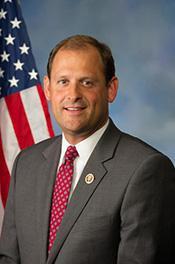
U.S. Representative for Kentucky’s 6th district
Republican
119th Congress, two-year term
Missed 7.1% of roll calls. Chamber median 1.9%.
The full voting recordCounts roll calls where most Democrats and most Republicans voted differently, leaving out procedural votes.
How we countFrom FEC filings, Voteview roll calls and Congress.gov.
Republican. In Congress since 2013, 7 terms in total.
Following saves Barr to your list, which Chamber & Street keeps on its server, linked to a cookie on this browser and not to your name or email. Email alerts will come with constituent verification.
Bills and resolutions Barr signed on to as a cosponsor. An original cosponsor signed on the day the bill was introduced. Source: govinfo bill status files, last updated Nov 6, 2026.
Smithsonian National Museum of the American Latino Act
Sponsor Nicole Malliotakis (R). Original cosponsor. 130 cosponsors. H.R. 1330 on Congress.gov
Introduced
Smithsonian American Women’s History Museum Act
Sponsor Nicole Malliotakis (R). Original cosponsor. 231 cosponsors. H.R. 1329 on Congress.gov(opens in a new tab)
Introduced
Smithsonian American Women’s History Museum Act
This bill authorizes the Smithsonian American Women's History Museum to be located on a particular site within the Reserve of the National Mall in Washington, DC.
Specifically, the bill designates the South Monument site as the location for the museum; however, the President may designate an alternative site within 180 days of the bill's enactment. (The site is the undeveloped land across the National Mall from the National Museum of African American History and Culture.) Administrative jurisdiction of the site must be transferred to the Smithsonian Institution.
The Board of Regents of the Smithsonian Institution must have the approval of specified federal entities (e.g., the Commission of Fine Arts) to plan, design, and construct a museum building. The bill (1) outlines the criteria for considering site and design proposals, and (2) requires the Smithsonian Institution to reimburse for costs resulting from the building approval process.
The bill directs the museum to be dedicated to preserving, researching, and presenting the history, achievements, and lived experiences of biological women in the United States. Under this bill, the museum may not identify, present, describe, or depict any biological male as a female.
In carrying out its duties, the museum's advisory council must (1) seek and utilize guidance from a broad array of knowledgeable and respected sources reflecting the diversity of the political viewpoints and authentic experiences held by women in the United States, and (2) seek guidance for the creation and substantial revision of exhibits and programs.
Death Tax Repeal Act
Sponsor Randy Feenstra (R). Original cosponsor. 182 cosponsors. H.R. 1301 on Congress.gov(opens in a new tab)
Introduced
No DeepSeek on Government Devices Act
Sponsor Josh Gottheimer (D). Joined Feb 13, 2025. 32 cosponsors. H.R. 1121 on Congress.gov(opens in a new tab)
Introduced
No DeepSeek on Government Devices Act
This bill directs the Office of Management and Budget to develop standards and guidance requiring removal of the DeepSeek application from federal agency information technology. Such standards and guidance also apply to any successor application developed or provided by High Flyer or entities owned by High Flyer.
DeepSeek is an artificial intelligence start-up founded in 2023 and based in Hangzhou, China. DeepSeek's chief executive officer also created High Flyer, a hedge fund that is reportedly the sole funder of DeepSeek.
Disapproving the rule submitted by the Bureau of Consumer Financial Protection relating to "Overdraft Lending: Very Large Financial Institutions".
Sponsor J. Hill (R). Original cosponsor. 17 cosponsors. H.J.Res. 59 on Congress.gov(opens in a new tab)
Introduced
This joint resolution nullifies the final rule issued by the Consumer Financial Protection Bureau titled Overdraft Lending: Very Large Financial Institutions and published on December 30, 2024. The rule revises provisions regarding charges for insufficient funds in a customer’s bank account (i.e., overdrafts) at very large financial institutions. Under the rule, these institutions must (1) cap overdraft charges at $5; (2) with justification, cap charges at a higher amount; or (3) handle overdrafts as credit and comply with applicable Truth in Lending Act disclosure requirements.
National Right-to-Work Act
Sponsor Joe Wilson (R). Original cosponsor. 129 cosponsors. H.R. 1232 on Congress.gov(opens in a new tab)
Introduced
PROTECT Our Kids Act
Sponsor Kevin Hern (R). Joined Feb 12, 2025. 2 cosponsors. H.R. 1069 on Congress.gov(opens in a new tab)
Passed the House
Promoting Responsible Oversight To Eliminate Communist Teachings for Our Kids Act or the PROTECT Our Kids Act
This bill prohibits federal education funding for any elementary or secondary school that directly or indirectly receives support from the Chinese government.
Specifically, the bill prohibits such funding for any school that (1) has a partnership in effect with a cultural or language institute funded by the Chinese government, including a Confucius Institute; (2) operates a learning center supported by the Chinese government (commonly referred to as a Confucius Classroom); or (3) receives support from an individual or entity acting on behalf of the Chinese government, including support in the form of teaching materials, personnel, funds, or other resources. However, the Department of Education (ED) may issue a waiver of the prohibition if a school has an existing contract with one of these entities and the school demonstrates that the contract is for the benefit of the school and promotes the security, stability, and economy of the United States.
The bill directs ED to provide notice of the bill's requirements to schools, as well as guidance for achieving compliance with the requirements.
Protecting Privacy in Purchases Act
Sponsor Riley Moore (R). Original cosponsor. 132 cosponsors. H.R. 1181 on Congress.gov(opens in a new tab)
Passed the House
Protecting Privacy in Purchases Act
This bill prohibits payment card networks from using merchant codes that distinguish firearms retailers from general-merchandise retailers or sporting-goods retailers.
The Department of Justice must enforce this bill and report annually on the resulting investigations and cases.
Transparency in Reporting of Adversarial Contributions to Education Act
Sponsor Aaron Bean (R). Joined Feb 11, 2025. 3 cosponsors. H.R. 1049 on Congress.gov(opens in a new tab)
Passed the House
Transparency in Reporting of Adversarial Contributions to Education Act
This bill requires each local educational agency (LEA), as a condition of receiving federal elementary and secondary education funds, to ensure that each elementary and secondary school served by the LEA notifies parents of their rights to request and receive information regarding foreign influence (e.g., influence by China) in schools.
These rights include the right to
• review (and make copies of at no cost) any curricular or professional development material used at the school that was obtained using funds received from a foreign government or a foreign entity of concern;
• know, by written response, how many school personnel are compensated using funds received from a foreign government or a foreign entity of concern; and
• know, by written response, information about funding from or agreements (e.g., contracts) with a foreign country or a foreign entity of concern.
Parents must submit a written request for this information.
Each school must post on a publicly accessible website (or otherwise widely disseminate to the public) a summary notice of parental rights under the bill.
The bill requires the Department of Education to notify state educational agencies (SEAs) about the bill's requirements. Each SEA must, as a condition of receiving federal elementary and secondary education funds, notify LEAs about the bill's requirements.
DETERRENT Act
Sponsor Michael Baumgartner (R). Joined Feb 11, 2025. 21 cosponsors. H.R. 1048 on Congress.gov(opens in a new tab)
Passed the House
Defending Education Transparency and Ending Rogue Regimes Engaging in Nefarious Transactions Act or the DETERRENT Act
This bill expands oversight and disclosure requirements related to foreign sources and institutions of higher education (IHEs).
Specifically, the bill requires an IHE to annually disclose to the Department of Education (ED) any year in which the IHE
• receives a gift from a foreign country of concern (e.g., China or Russia) or foreign entity of concern of any dollar amount;
• receives a gift or contract from a foreign source (other than a foreign country of concern or foreign entity of concern) that is valued at $50,000 or more, considered alone or in combination with all other gifts or contracts within a calendar year (current disclosure threshold is $250,000 or more), or which has an undetermined monetary value;
• enters into a contract with a foreign country of concern or foreign entity of concern after receiving a waiver for such contract; or
• is substantially controlled by a foreign source.
Additionally, the bill
• prohibits IHEs from entering into contracts with a foreign country of concern or with a foreign entity of concern without obtaining a waiver,
• requires certain IHEs to disclose gifts or contracts between covered individuals (e.g., researchers) and foreign sources, and
• requires private IHEs with specified assets or investments to file annual investment disclosure reports.
The bill requires ED to investigate possible violations of this bill and outlines the various penalties for each violation. Penalties may include losing eligibility for federal student financial aid.
Combating the Lies of Authoritarians in School Systems Act
Sponsor David Joyce (R). Joined Feb 11, 2025. 5 cosponsors. H.R. 1005 on Congress.gov(opens in a new tab)
Passed the House
Combating the Lies of Authoritarians in School Systems Act or the CLASS Act
This bill prohibits public elementary and secondary schools, as a condition of receiving federal elementary and secondary education funds, from accepting funds from or entering into a contract with the Chinese government, the Chinese Communist Party (CCP), or any individual or entity acting on behalf of the Chinese government or the CCP. The bill also requires schools to disclose funding from or contracts with a foreign source to the Department of Education.
Respect State Housing Laws Act
Sponsor Barry Loudermilk (R). Original cosponsor. 58 cosponsors. H.R. 1078 on Congress.gov(opens in a new tab)
Introduced
Respect State Housing Laws Act
This bill eliminates a provision that requires a 30-day notice period before a landlord may begin eviction proceedings against a tenant in federally assisted or federally backed housing.
Medicare Patient Access and Practice Stabilization Act of 2025
Sponsor Gregory Murphy (R). Joined Feb 5, 2025. 198 cosponsors. H.R. 879 on Congress.gov(opens in a new tab)
Introduced
Medicare Patient Access and Practice Stabilization Act of 2025
This bill increases certain payment adjustments under the Medicare physician fee schedule for services furnished between April 1, 2025, and January 1, 2026.
Old Glory Only Act
Sponsor William Timmons (R). Joined Feb 5, 2025. 34 cosponsors. H.R. 465 on Congress.gov(opens in a new tab)
Introduced
Old Glory Only Act
This bill prohibits the flying of any flag other than the U.S. flag over U.S. diplomatic and consular posts.
Retirement Fairness for Charities and Educational Institutions Act of 2025
Sponsor Frank Lucas (R). Original cosponsor. 24 cosponsors. H.R. 1013 on Congress.gov(opens in a new tab)
Introduced
Retirement Fairness for Charities and Educational Institutions Act of 2025
This bill allows 403(b) retirement plans (i.e., retirement plans designed for certain employees of public schools, charities, and churches) to invest in collective investment trusts, which are a group of pooled investment assets held by a bank or trust company, and in insurance company separate accounts.
1071 Repeal to Protect Small Business Lending Act
Sponsor Roger Williams (R). Original cosponsor. 52 cosponsors. H.R. 976 on Congress.gov(opens in a new tab)
Introduced
1071 Repeal to Protect Small Business Lending Act
This bill repeals the statute that requires financial institutions to collect data regarding applications for women-owned, minority-owned, or small business loans. Currently, financial institutions must collect and report to the Consumer Financial Protection Bureau information on (1) how many applications were received; (2) the disposition of each application; (3) the type of loan; (4) the amount applied for; (5) the amount approved; and (6) each applicant’s census tract, revenue, race, sex, and ethnicity.
Protect Small Businesses from Excessive Paperwork Act of 2025
Sponsor Zachary Nunn (R). Joined Feb 4, 2025. 12 cosponsors. H.R. 736 on Congress.gov(opens in a new tab)
Passed the House
Protect Small Businesses from Excessive Paperwork Act of 2025
This bill extends the deadline for certain companies that are required to file beneficial ownership information with the Financial Crimes Enforcement Network (FinCEN). Specifically, the bill requires companies formed or registered before January 1, 2024, to submit this information to FinCEN by January 1, 2026, instead of by January 1, 2025, as required under current regulations.
HALT Fentanyl Act
Sponsor H. Griffith (R). Joined Feb 4, 2025. 61 cosponsors. H.R. 27 on Congress.gov(opens in a new tab)
Passed the House
Halt All Lethal Trafficking of Fentanyl Act or the HALT Fentanyl Act
This bill permanently places fentanyl-related substances as a class into schedule I of the Controlled Substances Act. A schedule I controlled substance is a drug, substance, or chemical that has a high potential for abuse; has no currently accepted medical value; and is subject to regulatory controls and administrative, civil, and criminal penalties under the Controlled Substances Act.
Under the bill, offenses involving fentanyl-related substances are triggered by the same quantity thresholds and subject to the same penalties as offenses involving fentanyl analogues (e.g., offenses involving 100 grams or more trigger a 10-year mandatory minimum prison term).
Additionally, the bill establishes a new, alternative registration process for certain schedule I research.
The bill also makes several other changes to registration requirements for conducting research with controlled substances, including
• permitting a single registration for related research sites in certain circumstances,
• waiving the requirement for a new inspection in certain situations, and
• allowing a registered researcher to perform certain manufacturing activities with small quantities of a substance without obtaining a manufacturing registration.
Finally, the bill expresses the sense that Congress agrees with the interpretation of Controlled Substances Act in United States v. McCray, a 2018 case decided by the U.S. District Court for the Western District of New York. In that case, the court held that butyryl fentanyl, a controlled substance, can be considered an analogue of fentanyl even though, under the Controlled Substances Act, the term controlled substance analogue specifically excludes a controlled substance.
Federal Insurance Office Elimination Act
Sponsor Troy Downing (R). Joined Jan 28, 2025. 26 cosponsors. H.R. 643 on Congress.gov(opens in a new tab)
Introduced
Federal Insurance Office Elimination Act
This bill eliminates the Federal Insurance Office (FIO) within the Department of the Treasury. The bill also removes the FIO director as a nonvoting member of the Financial Stability Oversight Council.
Constitutional Concealed Carry Reciprocity Act of 2025
Sponsor Richard Hudson (R). Joined Jan 28, 2025. 189 cosponsors. H.R. 38 on Congress.gov(opens in a new tab)
Introduced
Constitutional Concealed Carry Reciprocity Act
This bill establishes a federal statutory framework to regulate the carry or possession of concealed firearms across state lines.
Specifically, an individual who is eligible to carry a concealed firearm in one state may carry or possess a concealed handgun (other than a machine gun or destructive device) in another state that allows its residents to carry concealed firearms.
It sets forth requirements for lawful concealed carry across state lines. The bill preempts most state and local laws related to concealed carry and establishes a private right of action for a person adversely affected by interference with a concealed-carry right established by this bill.
Expressing the sense of Congress that tax-exempt fraternal benefit societies have historically provided and continue to provide critical benefits to the people and communities of the United States.
Sponsor Darin LaHood (R). Original cosponsor. 122 cosponsors. H.Con.Res. 4 on Congress.gov(opens in a new tab)
Introduced
This concurrent resolution expresses the sense of Congress that tax-exempt fraternal benefit societies serve as a private economic and social support system, providing benefits to their members is necessary to support the charitable and fraternal activities of the volunteer chapters, and their work should continue to be promoted.
CBO Show Your Work Act
Sponsor Warren Davidson (R). Original cosponsor. 35 cosponsors. H.R. 724 on Congress.gov(opens in a new tab)
Introduced
CBO Show Your Work Act
This bill requires the Congressional Budget Office (CBO) to make available to Congress and the public each fiscal model, policy model, and data preparation routine that the CBO uses to estimate the costs and other fiscal, social, or economic effects of legislation.
For each estimate of the costs and other fiscal effects of legislation, the CBO must also disclose, in a manner sufficient to permit replication by individuals not employed by the CBO, the data, programs, models, assumptions, and other details of the computations used to prepare the estimate.
For data that may not be disclosed, the CBO must make available to Congress and the public
• a complete list of all data variables for the data;
• descriptive statistics for all data variables for the data, to the extent that the descriptive statistics do not violate the rule against disclosure;
• a reference to the statute requiring that the data not be disclosed; and
• contact information for the individual or entity who has unrestricted access to the data.
Main Street Tax Certainty Act
Sponsor Lloyd Smucker (R). Original cosponsor. 192 cosponsors. H.R. 703 on Congress.gov(opens in a new tab)
Introduced
Main Street Tax Certainty Act
This bill makes permanent the qualified business income (QBI) tax deduction.
Under current law, individuals, estates, and trusts may deduct the lower of (1) 20% of QBI from a qualified business, qualified real estate investment trust dividends, and qualified publicly traded partnership income; or (2) 20% of taxable income less net capital gain. (Some limitations apply.)
However, under current law, the QBI tax deduction expires after December 31, 2025.
Whole Milk for Healthy Kids Act of 2025
Sponsor Glenn Thompson (R). Original cosponsor. 118 cosponsors. H.R. 649 on Congress.gov(opens in a new tab)
Introduced
Whole Milk for Healthy Kids Act of 2025
This bill revises requirements for milk provided by the National School Lunch Program of the Department of Agriculture (USDA).
Currently, schools participating in the program must provide milk that is consistent with the most recent Dietary Guidelines for Americans; USDA regulations require milk to be fat-free or low-fat and allow milk to be flavored or unflavored. The bill modifies these restrictions and instead permits schools to offer students whole, reduced-fat, low-fat, and fat-free flavored and unflavored milk. The milk that is offered may be organic or nonorganic. Further, USDA may not prohibit a participating school from offering students any of these milk choices.
Further, schools currently must provide a substitute for fluid milk, on receipt of a written statement from a licensed physician, for students whose disability restricts their diet. Under the bill, a parent or legal guardian may also provide the written statement.
In addition, schools currently participating in the program must provide meals that meet certain nutrition requirements; USDA regulations require that the average saturated fat content of the meals offered must be less than 10% of the total calories. Under the bill, fluid milk is excluded from the saturated fat content calculation; milk fat included in any fluid milk provided by the program must not be considered saturated fat for the purposes of measuring compliance with USDA regulations.
Finally, the bill prohibits schools participating in the program from purchasing or offering milk produced by Chinese state-owned enterprises.
Pony Up Act
Sponsor Sam Graves (R). Joined Jan 23, 2025. 10 cosponsors. H.R. 431 on Congress.gov(opens in a new tab)
Introduced
Pony Up Act
This bill requires the U.S. Postal Service (USPS) to pay a citizen for late payment fees or penalties incurred due to late delivery of mail by USPS.
Late delivery of mail means that (1) USPS received a bill or notice of bill at least 12 days prior to the payment due date and delivered such bill or notice of bill less than 6 days prior to the payment due date; or (2) USPS received a payment at least 5 days prior to the payment due date and delivered such payment after the due date.
USPS is not required to pay a citizen for late payment fees or penalties when a bill, notice of bill, or payment is delayed for reasons outside of USPS control (for example, if a major disaster or emergency declared by the President caused the delay).