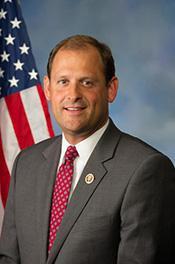
U.S. Representative for Kentucky’s 6th district
Republican
119th Congress, two-year term
Missed 7.1% of roll calls. Chamber median 1.9%.
The full voting recordCounts roll calls where most Democrats and most Republicans voted differently, leaving out procedural votes.
How we countFrom FEC filings, Voteview roll calls and Congress.gov.
Republican. In Congress since 2013, 7 terms in total.
Following saves Barr to your list, which Chamber & Street keeps on its server, linked to a cookie on this browser and not to your name or email. Email alerts will come with constituent verification.
Bills and resolutions Barr signed on to as a cosponsor. An original cosponsor signed on the day the bill was introduced. Source: govinfo bill status files, last updated Nov 6, 2026.
Fix Our Forests Act
Sponsor Bruce Westerman (R). Original cosponsor. 56 cosponsors. H.R. 471 on Congress.gov
Passed the House
Fix Our Forests Act
This bill establishes requirements for managing forests on federal land, including requirements concerning reducing wildfire threats, expediting the review of certain forest management projects, and implementing forest management projects and other activities.
Specifically, the bill (1) designates certain firesheds at high risk for wildfires as fireshed management areas; (2) directs the U.S. Forest Service and U.S. Geological Survey to jointly establish an interagency Fireshed Center that is responsible for duties related to assessing and predicting fire, including maintaining a fireshed registry on a publicly accessible website that provides interactive geospatial data on individual firesheds; and (3) makes other requirements related to reducing wildfire.
Next, the bill expedites the review of certain forest management projects under the National Environmental Policy Act (NEPA) of 1969 and exempts certain activities from NEPA review. It also establishes intra-agency strike teams to accelerate the review and any interagency consultation processes under NEPA, the Endangered Species Act of 1973, and the National Historic Preservation Act. It also limits consultation requirements concerning threatened and endangered species under the Forest and Rangeland Renewable Resources Planning Act of 1974 and the Federal Land Management and Policy Act of 1976. Finally, it limits litigation involving fireshed management projects and limits remedies that courts may provide.
Additionally, the bill supports reducing community wildfire risks, carrying out forest restoration and stewardship activities (including watershed protection and restoration), conducting biochar demonstration projects, advancing technologies to address forest wildfires, and assisting wildland firefighters and their families.
Miracle on Ice Congressional Gold Medal Act
Sponsor Pete Stauber (R). Original cosponsor. 299 cosponsors. H.R. 452 on Congress.gov(opens in a new tab)
Became law
Miracle on Ice Congressional Gold Medal Act
This act provides for the award of Congressional Gold Medals to the members of the 1980 U.S. Olympic men's ice hockey team in recognition of the team's achievement at the 1980 Winter Olympic Games.
To amend the Internal Revenue Code of 1986 to provide special rules for the taxation of certain residents of Taiwan with income from sources within the United States.
Sponsor Jason Smith (R). Joined Jan 13, 2025. 46 cosponsors. H.R. 33 on Congress.gov(opens in a new tab)
Passed the House
Preventing Violence Against Women by Illegal Aliens Act
Sponsor Nancy Mace (R). Joined Jan 13, 2025. 60 cosponsors. H.R. 30 on Congress.gov(opens in a new tab)
Passed the House
Preventing Violence Against Women by Illegal Aliens Act
This bill establishes certain criminal grounds for making non-U.S. nationals (aliens under federal law) inadmissible and expands the crimes for which a non-U.S. national is deportable.
First, the bill establishes that a non-U.S. national is inadmissible if the individual has admitted to or is convicted of acts constituting the essential elements of stalking, child abuse, child neglect, child abandonment, a sex offense, conspiracy to commit a sex offense, a violation of certain protection orders, or domestic violence (including physical or sexual abuse or a pattern of coercive behavior when it occurs within certain close relationships).
Next, the bill establishes additional grounds for deportation. Under current law, a non-U.S. national is deportable for certain criminal convictions, including domestic violence, stalking, and child abuse. The bill makes any sex offense (including crimes against minors) or conspiracy to commit a sex offense a basis for deportation. The bill also expands the domestic violence crimes that make a non-U.S. national deportable to include physical or sexual abuse or a pattern of coercive behavior when it occurs within certain close relationships.
Protection of Women and Girls in Sports Act of 2025
Sponsor W. Steube (R). Joined Jan 13, 2025. 83 cosponsors. H.R. 28 on Congress.gov(opens in a new tab)
Passed the House
Protection of Women and Girls in Sports Act of 2025
This bill generally prohibits school athletic programs from allowing individuals whose biological sex at birth was male to participate in programs that are for women or girls.
Specifically, the bill provides that it is a violation of Title IX of the Education Amendments of 1972 for federally funded education programs or activities to operate, sponsor, or facilitate athletic programs or activities that allow individuals of the male sex to participate in programs or activities that are designated for women or girls. (Title IX prohibits discrimination on the basis of sex in federally funded education programs or activities, including in public elementary and secondary schools and in colleges and universities.) Under the bill, sex is based on an individual's reproductive biology and genetics at birth.
The bill does not prohibit male individuals from training or practicing with programs or activities for women or girls as long as such training or practice does not deprive any female of corresponding opportunities or benefits.
The Government Accountability Office must report on the benefits for women or girls in single-sex sports that would be lost as a result of male participation. In particular, the report must document the negative psychological, developmental, participatory, and sociological effects of male participation on girls.
Born-Alive Abortion Survivors Protection Act
Sponsor Ann Wagner (R). Joined Jan 13, 2025. 163 cosponsors. H.R. 21 on Congress.gov(opens in a new tab)
Passed the House
Born-Alive Abortion Survivors Protection Act
This bill establishes requirements for the degree of care a health care practitioner must provide in the case of a child born alive following an abortion or attempted abortion.
Specifically, a health care practitioner who is present must (1) exercise the same degree of care as would reasonably be provided to any other child born alive at the same gestational age, and (2) ensure the child is immediately admitted to a hospital. Additionally, a health care practitioner or other employee who has knowledge of a failure to comply with the degree-of-care requirements must immediately report such failure to law enforcement.
A health care practitioner who fails to provide the required degree of care, or a health care practitioner or other employee who fails to report such failure, is subject to criminal penalties—a fine, up to five years in prison, or both.
An individual who intentionally kills or attempts to kill a child born alive is subject to prosecution for murder.
The bill bars the criminal prosecution of a mother of a child born alive under this bill and allows her to bring a civil action against a health care practitioner or other employee for violations.
Protecting American Energy Production Act
Sponsor August Pfluger (R). Joined Jan 9, 2025. 18 cosponsors. H.R. 26 on Congress.gov(opens in a new tab)
Passed the House
Protecting American Energy Production Act
This bill prohibits the President from declaring a moratorium on the use of hydraulic fracturing unless Congress authorizes the moratorium. The bill also expresses the sense of Congress that states should maintain primacy (authority) for the regulation of hydraulic fracturing for oil and natural gas production on state and private lands.
Hydraulic fracturing, or fracking, is a process to extract underground resources such as oil or gas from a geologic formation by injecting water, a propping agent (e.g., sand), and chemical additives into a well under enough pressure to fracture the formation.
Illegitimate Court Counteraction Act
Sponsor Chip Roy (R). Joined Jan 9, 2025. 38 cosponsors. H.R. 23 on Congress.gov(opens in a new tab)
Passed the House
Illegitimate Court Counteraction Act
This bill imposes sanctions against foreign persons (individuals and entities) who assist the International Criminal Court (ICC) in investigating, arresting, detaining, or prosecuting certain individuals.
The bill categorizes as protected persons (1) any U.S. individual, U.S. entity, or person in the United States, unless the United States is a state party to the Rome Statute of the ICC and provides formal consent to ICC jurisdiction; and (2) any foreign person that is a citizen or lawful resident of a U.S. ally that is not a state party to the Rome Statute or has not consented to ICC jurisdiction.
If the ICC attempts to investigate, arrest, detain or prosecute a protected person, the President must impose visa- and property-blocking sanctions against the foreign persons that engaged in or materially assisted in such actions, as well as against foreign persons owned by, controlled by, or acting on behalf of such foreign persons. The President must also apply visa-blocking sanctions to the immediate family members of those sanctioned.
Upon enactment, the bill rescinds all funds appropriated for the ICC and prohibits the subsequent use of appropriated funds for the ICC.
Laken Riley Act
Sponsor Mike Collins (R). Joined Jan 7, 2025. 54 cosponsors. H.R. 29 on Congress.gov(opens in a new tab)
Passed the House
Laken Riley Act
This bill requires the Department of Homeland Security (DHS) to detain certain non-U.S. nationals (aliens under federal law) who have been arrested for burglary, theft, larceny, or shoplifting. The bill also authorizes states to sue the federal government for decisions or alleged failures related to immigration enforcement.
Under this bill, DHS must detain an individual who (1) is unlawfully present in the United States or did not possess the necessary documents when applying for admission; and (2) has been charged with, arrested for, convicted of, or admits to having committed acts that constitute the essential elements of burglary, theft, larceny, or shoplifting.
The bill also authorizes state governments to sue for injunctive relief over certain immigration-related decisions or alleged failures by the federal government if the decision or failure caused the state or its residents harm, including financial harm of more than $100. Specifically, the state government may sue the federal government over a
• decision to release a non-U.S. national from custody;
• failure to fulfill requirements relating to inspecting individuals seeking admission into the United States, including requirements related to asylum interviews;
• failure to fulfill a requirement to stop issuing visas to nationals of a country that unreasonably denies or delays acceptance of nationals of that country;
• violation of limitations on immigration parole, such as the requirement that parole be granted only on a case-by-case basis; or
• failure to detain an individual who has been ordered removed from the United States.
Regulations from the Executive in Need of Scrutiny Act of 2025
Sponsor Kat Cammack (R). Original cosponsor. 93 cosponsors. H.R. 142 on Congress.gov(opens in a new tab)
Introduced
Regulations from the Executive in Need of Scrutiny Act of 2025
This bill revises provisions relating to congressional review of agency rulemaking.
Specifically, the bill establishes a congressional approval process for a major rule. A major rule may only take effect if Congress approves of the rule. A major rule is a rule that has resulted in or is likely to result in (1) an annual effect on the economy of $100 million or more; (2) a major increase in costs or prices for consumers, individual industries, government agencies, or geographic regions; or (3) significant adverse effects on competition, employment, investment, productivity, innovation, or the ability of U.S.-based enterprises to compete with foreign-based enterprises.
The bill generally preserves the current congressional review process for a nonmajor rule.
TCJA Permanency Act
Sponsor Vern Buchanan (R). Original cosponsor. 53 cosponsors. H.R. 137 on Congress.gov(opens in a new tab)
Introduced
TCJA Permanency Act
This bill makes permanent multiple federal tax provisions enacted in 2017 by the Tax Cuts and Jobs Act.
The bill makes permanent the
• individual tax rates of 10%, 12%, 22%, 24%, 32%, 35%, and 37%;
• increased standard deduction;
• personal exemption allowance repeal;
• exclusion from income of student loans discharged due to death or disability;
• qualified business income tax deduction (199A tax deduction);
• allowance of ABLE account contributions in excess of the annual gift tax exclusion amount;
• base estate and gift tax exclusion amount of $10 million (adjusted annually); and
• alternative minimum tax exemption and phaseout amounts for noncorporate taxpayers.
The bill makes permanent the child tax credit amounts of $2,000 per child and $500 for dependents, the $200,000 phaseout threshold ($400,000 for joint filers), and the refundable portion of the tax credit.
The bill expands the expenses eligible for tax-free withdrawals from qualified tuition plans (529 plans) to include additional expenses associated with homeschool and elementary and secondary schools (e.g., instructional materials, tutoring, test and enrollment fees, and educational therapies).
The bill permanently eliminates certain miscellaneous itemized deductions and makes permanent the
• state and local tax deduction limit of $10,000 ($5,000 for married individuals filing separately),
• mortgage interest tax deduction limit of $750,000 ($375,000 for married individuals filing separately),
• limit on the deduction of cash charitable contributions to 60% of a taxpayer’s adjusted gross income, and
• certain limits on casualty loss tax deductions.
The bill also permanently eliminates the exclusion from income for employer-reimbursed bicycle commuting expenses.