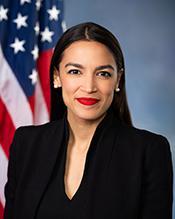
U.S. Representative for New York’s 14th district
Democrat
119th Congress, two-year term
Missed 2.7% of roll calls. Chamber median 1.9%.
The full voting recordCounts roll calls where most Democrats and most Republicans voted differently, leaving out procedural votes.
How we countFrom FEC filings, Voteview roll calls and Congress.gov.
Democrat. In Congress since 2019, 4 terms in total.
Following saves Ocasio-Cortez to your list, which Chamber & Street keeps on its server, linked to a cookie on this browser and not to your name or email. Email alerts will come with constituent verification.
Bills and resolutions Ocasio-Cortez signed on to as a cosponsor. An original cosponsor signed on the day the bill was introduced. Source: govinfo bill status files, last updated Nov 6, 2026.
Original National Domestic Violence Awareness Month Resolution of 2025
Sponsor Al Green (D). Original cosponsor. 148 cosponsors. H.Res. 846 on Congress.gov
Introduced
Original National Domestic Violence Awareness Month Resolution of 2025
This resolution supports the goals and ideals of National Domestic Violence Awareness Month. Further, it expresses the sense that Congress should continue to raise awareness of and support programs to end domestic violence.
CONNECT for Health Act of 2025
Sponsor Mike Thompson (D). Joined Oct 31, 2025. 248 cosponsors. H.R. 4206 on Congress.gov(opens in a new tab)
Introduced
Algorithmic Accountability Act of 2025
Sponsor Yvette Clarke (D). Joined Oct 24, 2025. 32 cosponsors. H.R. 5511 on Congress.gov(opens in a new tab)
Introduced
Break the Cycle of Violence Act
Sponsor Steven Horsford (D). Joined Oct 24, 2025. 121 cosponsors. H.R. 4103 on Congress.gov(opens in a new tab)
Introduced
Break the Cycle of Violence Act
This bill establishes federal grant programs and related entities to support violence intervention initiatives.
Specifically, the bill directs the Department of Health and Human Services (HHS) to award grants for coordinated community violence intervention initiatives in communities disproportionately impacted by homicides and community violence. HHS must also establish several related entities, including
• an Office of Community Violence Intervention to administer programs and activities related to violence intervention;
• the Community Violence Intervention Advisory Committee to advise and assist the office and HHS; and
• the National Community Violence Response Center to provide training and technical assistance, coordinate research, and develop data collection policies.
Additionally, the bill directs the Department of Labor to award grants for job training and workforce programs in communities disproportionately affected by gun violence to connect youth ages 16 to 24 to in-demand occupations.
Keep Air Travel Safe Act
Sponsor Debbie Dingell (D). Joined Oct 21, 2025. 34 cosponsors. H.R. 5732 on Congress.gov(opens in a new tab)
Introduced
Keep Air Travel Safe Act
This bill provides continuing appropriations for the Transportation Security Administration (TSA) during any period in which there is a lapse in appropriations for TSA. It also requires the continuing appropriations to be funded using certain unobligated funds that were provided to U.S. Immigration and Customs Enforcement by the One Big Beautiful Bill Act.
The bill provides the appropriations for TSA to continue all programs, projects, or activities (including the costs of direct loans and loan guarantees) that were funded in the preceding fiscal year.
The appropriations provided by this bill are available from the first day of a lapse in appropriations for TSA until the earlier of
• the date on which the applicable regular appropriations bill for the fiscal year becomes law or a joint resolution making continuing appropriations becomes law, or
• the date that is 180 days after the first day of a lapse in appropriations.
A joint resolution to direct the removal of United States Armed Forces from hostilities that have not been authorized by Congress.
Sponsor Jason Crow (D). Joined Oct 21, 2025. 55 cosponsors. H.J.Res. 126 on Congress.gov(opens in a new tab)
Introduced
This joint resolution directs the President to remove U.S. Armed Forces from hostilities against any organization designated on or after February 20, 2025, as a foreign terrorist organization or specially designated global terrorist, any states in which such entities operate, or any non-state organization engaged in illegal drug trafficking unless a declaration of war or authorization to use military force for such purpose has been enacted.
The resolution specifies that it shall not be construed to prevent the United States from defending itself from an armed attack or the threat of an imminent armed attack or from using the U.S. Armed Forces in support of civil authorities as part of authorized counternarcotics operations.
Recognizing the importance of Spanish-language media in the United States.
Sponsor Nanette Barragán (D). Original cosponsor. 28 cosponsors. H.Res. 804 on Congress.gov(opens in a new tab)
Introduced
New York-New Jersey Watershed Protection Act of 2025
Sponsor Paul Tonko (D). Original cosponsor. 27 cosponsors. H.R. 5762 on Congress.gov(opens in a new tab)
Introduced
New York-New Jersey Watershed Protection Act of 2025
This bill establishes programs to restore and protect the New York-New Jersey Watershed. The watershed is composed of all land area the surface water of which drains into the New York-New Jersey Harbor, the waters contained within that land area, and associated estuaries.
Specifically, the bill requires the U.S. Fish and Wildlife Service to establish the New York-New Jersey Watershed Restoration Program, a nonregulatory program, to coordinate restoration and protection activities among government entities and conservation partners throughout the watershed.
The bill also establishes the New York-New Jersey Watershed Restoration Grant Program, a voluntary grant and technical assistance program, to provide competitive matching grants to certain entities to implement restoration and protection activities for the watershed. The federal government may not maintain ownership of any land acquired under the bill except for the purpose of promptly transferring ownership to grant recipients.
The bill ceases to have force or effect on October 1, 2031.
WIC Benefits Protection Act
Sponsor Robert Scott (D). Original cosponsor. 99 cosponsors. H.R. 5740 on Congress.gov(opens in a new tab)
Introduced
Federal Worker Childcare Protection Act of 2025
Sponsor Ilhan Omar (D). Original cosponsor. 33 cosponsors. H.R. 5720 on Congress.gov(opens in a new tab)
Introduced
Federal Worker Childcare Protection Act of 2025
This bill authorizes certain federal employees to be reimbursed for childcare expenses paid during the government shutdown that began on October 1, 2025.
Under the bill, any federal employee who was furloughed or worked without receiving a paycheck during the lapse in appropriations (i.e., government shutdown) that began on October 1, 2025, and paid for childcare during the lapse is eligible to be reimbursed for the childcare expenses if (1) appropriations are provided for this purpose, and (2) the employee submits a receipt from a childcare provider to the General Services Administration.
SHINE for Autumn Act of 2025
Sponsor Young Kim (R). Joined Oct 8, 2025. 109 cosponsors. H.R. 5469 on Congress.gov(opens in a new tab)
Introduced
Aviation Funding Stability Act of 2025
Sponsor Steve Cohen (D). Joined Oct 8, 2025. 75 cosponsors. H.R. 5451 on Congress.gov(opens in a new tab)
Introduced
Aviation Funding Stability Act of 2025
This bill provides continuing appropriations to the Federal Aviation Administration (FAA) if (1) an appropriations bill for the FAA has not been enacted before a fiscal year begins, or (2) a joint resolution making continuing appropriations for the FAA is not in effect.
Specifically, the bill provides appropriations from the Airport and Airway Trust Fund at the rate of operations that was provided for the prior fiscal year to continue programs, projects, and activities that were funded in the preceding fiscal year.
The bill provides the appropriations until the earlier of (1) the date on which the applicable regular appropriations bill for the fiscal year or a joint resolution making continuing appropriations becomes law, or (2) the date that is 30 days after the first day of a lapse in appropriations.
Protecting Free Vaccines Act
Sponsor Frank Pallone (D). Joined Oct 6, 2025. 83 cosponsors. H.R. 5448 on Congress.gov(opens in a new tab)
Introduced
Protecting Free Vaccines Act
This bill requires Medicare, Medicaid, the Children's Health Insurance Program (CHIP), and private health insurers to cover, without cost-sharing, vaccines that were recommended by the Centers for Disease Control and Prevention's Advisory Committee on Immunization Practices as of October 25, 2024. The requirement ends on January 1, 2030.
Living Wage for Musicians Act of 2025
Sponsor Rashida Tlaib (D). Original cosponsor. 7 cosponsors. H.R. 5664 on Congress.gov(opens in a new tab)
Introduced
Fair Pay for Federal Contractors Act of 2025
Sponsor Ayanna Pressley (D). Original cosponsor. 138 cosponsors. H.R. 5657 on Congress.gov(opens in a new tab)
Introduced
Fair Pay for Federal Contractors Act of 2025
This bill provides back pay to employees of federal contractors who lost pay due to a lapse in appropriations (i.e., government shutdown) in FY2026.
Specifically, the bill provides appropriations for federal agencies that are subject to a lapse in appropriations in FY2026 to adjust the price of contracts to compensate federal contractors for providing back pay to employees who were affected by the lapse in appropriations.
The agencies must adjust the price of any contract for which the contractor stopped, suspended, delayed, or interrupted all or part of the work under the contract due to the lapse in appropriations. The price adjustment must compensate the contractor for reasonable costs incurred to (1) compensate employees who were furloughed or laid off, were not working, or experienced a reduction of hours or compensation due to the lapse in appropriations; or (2) restore paid leave taken by employees during the lapse in appropriations if the contractor required or permitted employees to use paid leave as a result of the lapse in appropriations.
The maximum amount of weekly compensation of an employee for which an adjustment may be made under this bill may not exceed the lesser of (1) the employee's actual weekly compensation, or (2) $1,442 (or a lesser amount pro-rated for an employee who works less than 40 hours per week).
The bill also requires the Office of Federal Procurement Policy to submit a report to Congress on the adjustments made under this bill.
No Shame at School Act of 2025
Sponsor Ilhan Omar (D). Original cosponsor. 45 cosponsors. H.R. 5655 on Congress.gov(opens in a new tab)
Introduced
Veterans Healthcare Equality Act of 2025
Sponsor Timothy Kennedy (D). Original cosponsor. 28 cosponsors. H.R. 5635 on Congress.gov(opens in a new tab)
Introduced
To direct the removal of United States Armed Forces from hostilities that have not been authorized by Congress.
Sponsor Ilhan Omar (D). Joined Sep 30, 2025. 23 cosponsors. H.Con.Res. 51 on Congress.gov(opens in a new tab)
Introduced
To prohibit the removal of Federal employees during any lapse in discretionary appropriations, and for other purposes.
Sponsor Johnny Olszewski (D). Original cosponsor. 73 cosponsors. H.R. 5599 on Congress.gov(opens in a new tab)
Introduced
This bill prohibits the removal of federal employees from the civil service during a government shutdown due to a lapse in discretionary appropriations. If an employee is removed from the civil service in violation of this bill, the employee may elect to be reinstated with back pay on the date on which the lapse in appropriations ends.
Protecting Americans’ Social Security Data Act
Sponsor John Larson (D). Joined Sep 26, 2025. 152 cosponsors. H.R. 1877 on Congress.gov(opens in a new tab)
Introduced
Protecting Americans’ Social Security Data Act
This bill prohibits political appointees and special government employees from accessing Social Security data systems that contain personally identifiable information about Social Security beneficiaries.
Specifically, political appointees and special government employees may not access systems maintained by the Social Security Administration (SSA) that issue or record Social Security account numbers, that are used to determine eligibility for or to pay Social Security benefits, or that otherwise contain personally identifiable information about individuals receiving or applying for benefits.
The bill also establishes a civil right of action for an individual whose information was negligently accessed or disclosed in violation of these provisions. The individual may bring suit against the United States if the violator was a U.S. employee or officer, or against the violator if they were not a U.S. employee or officer. Such a claim must be brought within two years of the affected individual’s discovery of the violation. Upon a finding of liability, defendants are liable for specified monetary damages.
If an individual is criminally charged or subject to proposed disciplinary or adverse action by a federal or state agency for having accessed or disclosed information in violation of these provisions, SSA must notify the individual whose information was accessed or disclosed of the violation as soon as practicable.
Finally, the bill requires the SSA Office of the Inspector General to investigate and report to Congress on any unauthorized access to or disclosure of information in a beneficiary data system.
Condemning attempts to use Federal regulatory power or litigation to suppress lawful speech, particularly speech critical of a political party or the President of the United States, and warning against the rise of authoritarianism.
Sponsor Yassamin Ansari (D). Original cosponsor. 124 cosponsors. H.Res. 748 on Congress.gov(opens in a new tab)
Introduced
Expressing the sense of the House of Representatives condemning all forms of political violence and rejecting rhetoric that dehumanizes or demonizes political opponents.
Sponsor Marc Veasey (D). Original cosponsor. 167 cosponsors. H.Res. 746 on Congress.gov(opens in a new tab)
Introduced
Tyler Clementi Higher Education Anti-Harassment Act of 2025
Sponsor Mark Pocan (D). Original cosponsor. 174 cosponsors. H.R. 5486 on Congress.gov(opens in a new tab)
Introduced
Restoring Essential Healthcare Act
Sponsor Laura Friedman (D). Joined Sep 18, 2025. 155 cosponsors. H.R. 4796 on Congress.gov(opens in a new tab)
Introduced
Health Care Affordability Act of 2025
Sponsor Lauren Underwood (D). Joined Sep 18, 2025. 165 cosponsors. H.R. 247 on Congress.gov(opens in a new tab)
Introduced
Health Care Affordability Act of 2025
This bill makes permanent temporary changes enacted by the American Rescue Plan Act of 2021 (ARPA) and the Inflation Reduction Act of 2022 (IRA) that generally expand eligibility for and increase the amount of the premium tax credit.
Currently, eligible taxpayers may be able to claim the premium tax credit, which applies toward the cost of obtaining health insurance through health insurance exchanges. To be eligible for the premium tax credit, a taxpayer’s household income must meet or exceed 100% of the federal poverty level (FPL) and, after 2025, may not exceed 400% of the FPL (maximum income limit). For 2021-2025, the ARPA and IRA eliminated the maximum income limit, which generally expands eligibility for the premium tax credit.
Further, under current law, the amount of the premium tax credit is (1) generally the plan premium (conditions apply), minus (2) the taxpayer’s household income multiplied by the applicable percentage. The applicable percentage is a specific percentage that varies depending on which of six income ranges (adjusted for inflation after 2025) the taxpayer’s household income falls within. For 2021-2025, the ARPA and IRA lowered the applicable percentages and eliminated the adjustment of the applicable percentages for inflation, which generally increases the amount of the premium tax credit.
The bill makes permanent the elimination of the 400% maximum income limit, the lower applicable percentages, and the elimination of the inflation adjustment for the applicable percentages.