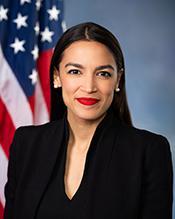
U.S. Representative for New York’s 14th district
Democrat
119th Congress, two-year term
Missed 2.7% of roll calls. Chamber median 1.9%.
The full voting recordCounts roll calls where most Democrats and most Republicans voted differently, leaving out procedural votes.
How we countFrom FEC filings, Voteview roll calls and Congress.gov.
Democrat. In Congress since 2019, 4 terms in total.
Following saves Ocasio-Cortez to your list, which Chamber & Street keeps on its server, linked to a cookie on this browser and not to your name or email. Email alerts will come with constituent verification.
Bills and resolutions Ocasio-Cortez signed on to as a cosponsor. An original cosponsor signed on the day the bill was introduced. Source: govinfo bill status files, last updated Nov 6, 2026.
Artificial Intelligence Civil Rights Act of 2025
Sponsor Yvette Clarke (D). Original cosponsor. 29 cosponsors. H.R. 6356 on Congress.gov
Introduced
No GOUGE Act
Sponsor Rosa DeLauro (D). Original cosponsor. 24 cosponsors. H.R. 6318 on Congress.gov(opens in a new tab)
Introduced
To amend title XVIII of the Social Security Act to require the Secretary of Health and Human Services to maintain a website for Medicare beneficiaries to search for providers participating in MA plans and traditional Medicare.
Sponsor Mark Pocan (D). Original cosponsor. 15 cosponsors. H.R. 6115 on Congress.gov(opens in a new tab)
Introduced
To prohibit funds made available to the Department of Health and Human Services by previous Appropriations Acts from being used for any activity that makes Medicare Advantage the default under the Medicare program.
Sponsor Mark Pocan (D). Original cosponsor. 16 cosponsors. H.R. 6114 on Congress.gov(opens in a new tab)
Introduced
To amend title XVIII of the Social Security Act to impose limitations on contracts with Medicare Advantage organizations offering multiple Medicare Advantage plans under the Medicare program.
Sponsor Mark Pocan (D). Original cosponsor. 15 cosponsors. H.R. 6113 on Congress.gov(opens in a new tab)
Introduced
To amend title XVIII of the Social Security Act to establish certain requirements with respect to the average monthly cost to provide coverage to an enrollee under Medicare Advantage plans.
Sponsor Mark Pocan (D). Original cosponsor. 15 cosponsors. H.R. 6112 on Congress.gov(opens in a new tab)
Introduced
To amend title XVIII of the Social Security Act to require any advertisement of a Medicare Advantage plan to include information related to the rates of prior authorization denials under such plan.
Sponsor Mark Pocan (D). Original cosponsor. 17 cosponsors. H.R. 6111 on Congress.gov(opens in a new tab)
Introduced
To amend title XVIII of the Social Security Act to require Medicare Advantage plans to automatically reconsider determinations denying coverage.
Sponsor Mark Pocan (D). Original cosponsor. 17 cosponsors. H.R. 6110 on Congress.gov(opens in a new tab)
Introduced
To amend title XVIII of the Social Security Act to establish certain requirements with respect to rates of reversed prior authorization coverage determinations under Medicare Advantage plans.
Sponsor Mark Pocan (D). Original cosponsor. 18 cosponsors. H.R. 6109 on Congress.gov(opens in a new tab)
Introduced
To amend title XI of the Social Security Act to require the Secretary to exclude certain individuals and entities who commit fraud from participation in any Federal health care program.
Sponsor Mark Pocan (D). Original cosponsor. 17 cosponsors. H.R. 6108 on Congress.gov(opens in a new tab)
Introduced
To designate the facility of the United States Postal Service located at 2200 South Salina Street in Syracuse, New York, as the "Wallie Howard Jr. Post Office Building".
Sponsor John Mannion (D). Original cosponsor. 20 cosponsors. H.R. 6099 on Congress.gov(opens in a new tab)
Passed committee
This bill designates the facility of the United States Postal Service located at 2200 South Salina Street in Syracuse, New York, as the "Wallie Howard Jr. Post Office Building".
Restoring Food Security for American Families and Farmers Act of 2025
Sponsor Jahana Hayes (D). Original cosponsor. 206 cosponsors. H.R. 6088 on Congress.gov(opens in a new tab)
Introduced
IDEA Full Funding Act
Sponsor Jared Huffman (D). Joined Nov 18, 2025. 175 cosponsors. H.R. 2598 on Congress.gov(opens in a new tab)
Introduced
Recognizing the genocide of the Palestinian people in Gaza.
Sponsor Rashida Tlaib (D). Original cosponsor. 21 cosponsors. H.Res. 876 on Congress.gov(opens in a new tab)
Introduced
VA Care and Benefits Accountability Act
Sponsor Delia Ramirez (D). Original cosponsor. 43 cosponsors. H.R. 6015 on Congress.gov(opens in a new tab)
Introduced
Keep SNAP and WIC Funded Act of 2025
Sponsor Jahana Hayes (D). Original cosponsor. 101 cosponsors. H.R. 5950 on Congress.gov(opens in a new tab)
Introduced
Keep SNAP and WIC Funded Act of 2025
This bill provides FY2026 appropriations for the Department of Agriculture (USDA) to continue operating the Supplemental Nutrition Assistance Program (SNAP); the Special Supplemental Nutrition Program for Women, Infants, and Children (WIC); and a related block grant program if there is a lapse in FY2026 appropriations for USDA.
Specifically, the bill provides appropriations to USDA for any period in which legislation to provide FY2026 interim continuing appropriations or full-year appropriations for USDA has not been enacted. If such a lapse in appropriations occurs, the bill provides the appropriations that are necessary to continue
• providing uninterrupted SNAP benefits,
• providing consolidated block grants to Puerto Rico and American Samoa for nutrition assistance programs, and
• carrying out WIC without interruption.
In addition, the bill provides appropriations to pay any benefits under these programs that were missed on or after September 30, 2025, and before this bill is enacted.
The appropriations for these purposes are available until the earlier of (1) the enactment into law of legislation to provide FY2026 appropriations for USDA (including continuing appropriations), or (2) September 30, 2026.
The bill also requires USDA to use the funds provided by this bill to reimburse state agencies for costs that were incurred to carry out these programs during a lapse in appropriations, to the extent that the programs were carried out in accordance with federal law (including regulations) during the lapse.
Improving Training for School Food Service Workers Act of 2025
Sponsor Mark Pocan (D). Joined Nov 7, 2025. 32 cosponsors. H.R. 3367 on Congress.gov(opens in a new tab)
Introduced
Improving Training for School Food Service Workers Act of 2025
This bill adds requirements regarding the availability of training that the Department of Agriculture provides under current law for local food service personnel in schools.
The training must be scheduled during regular, paid working hours; provided at no cost to food service personnel; offered in-person whenever appropriate; and incorporate experiential learning.
If the training is scheduled outside of working hours, food service personnel must be informed about the necessity of scheduling the program, consulted to schedule the program, and compensated for attending the program. Personnel may not be penalized for failing to attend a program outside of working hours.
Secure Rural Schools Reauthorization Act of 2025
Joined Nov 7, 2025. 93 cosponsors. H.R. 1383 on Congress.gov(opens in a new tab)
Progress not on file
Secure Rural Schools Reauthorization Act of 2025
This bill extends and modifies the Secure Rural Schools and Community Self-Determination Act of 2000, including by
• extending payments made to states and counties containing federal land through FY2026,
• providing for payments for FY2024 and FY2025,
• extending the authority of counties to initiate projects using such funds through FY2028, and
• extending the authority to initiate projects proposed by resource advisory committees through FY2028.
Expressing the sense of the House of Representatives that paraprofessionals and education support staff should have fair compensation, benefits, and working conditions.
Sponsor Jahana Hayes (D). Joined Nov 4, 2025. 58 cosponsors. H.Res. 297 on Congress.gov(opens in a new tab)
Introduced
Keep Our PACT Act
Sponsor Susie Lee (D). Joined Nov 4, 2025. 27 cosponsors. H.R. 869 on Congress.gov(opens in a new tab)
Introduced
Keep Our Promise to America's Children and Teachers Act or the Keep Our PACT Act
This bill provides funding through FY2035 for grant programs operated by local educational agencies to provide supplementary educational and related services to low-achieving students and other students who attend elementary and secondary schools with relatively high concentrations of students from low-income families. Additionally, the bill permanently reauthorizes the grant program to assist states and outlying areas in providing special education and related services to children with disabilities.
The amounts provided by the bill are designated as an emergency requirement for the purposes of Pay-As-You-Go (PAYGO) rules and other budget enforcement procedures.
ESP, Paraprofessional, and Education Support Staff Family Leave Act
Sponsor Sean Casten (D). Joined Nov 4, 2025. 74 cosponsors. H.R. 5222 on Congress.gov(opens in a new tab)
Introduced
Expanding Access to Mental Health Services in Schools Act of 2025
Sponsor Rosa DeLauro (D). Joined Nov 4, 2025. 130 cosponsors. H.R. 4253 on Congress.gov(opens in a new tab)
Introduced
PSLF Payment Completion Fairness Act
Sponsor Chrissy Houlahan (D). Joined Nov 4, 2025. 30 cosponsors. H.R. 3267 on Congress.gov(opens in a new tab)
Introduced
Expanding Access to School Meals Act of 2025
Sponsor Josh Gottheimer (D). Joined Nov 4, 2025. 48 cosponsors. H.R. 2680 on Congress.gov(opens in a new tab)
Introduced
Expanding Access to School Meals Act of 2025
This bill increases student access to free school lunches and breakfasts under the National School Lunch Program and School Breakfast Program of the Department of Agriculture (USDA).
Specifically, the bill expands program eligibility to include students in households with income at or below 224% of the federal poverty level. (Currently, students in households with income at or below 130% are eligible.) The bill also eliminates the reduced price school lunch and breakfast programs and prohibits USDA from providing reimbursements for reduced price programs.
States may use Medicaid participation data to directly certify students for free school meals. (Direct certification allows schools to approve meals without the need for a separate application for children who receive assistance under other programs.) Under current law, states may apply to participate in a USDA demonstration project to directly certify children for free and reduced price meals based on household income data acquired through Medicaid.
Further, the bill increases the number of free meals a school in a high-poverty area may be reimbursed for at the free-meal rate under the Community Eligibility Provision. (This provision allows eligible schools, groups of schools, and school districts to offer free meals at no cost to all enrolled students without collecting separate applications.) Specifically, the bill increases from 1.6% to 2.5% the reimbursement multiplier, which is used to calculate how many meals USDA will reimburse the school for at the free meal rate.
Educators Expense Deduction Modernization Act of 2025
Sponsor Sean Casten (D). Joined Nov 4, 2025. 19 cosponsors. H.R. 1054 on Congress.gov(opens in a new tab)
Introduced
Educators Expense Deduction Modernization Act of 2025
This bill increases the above-the-line tax deduction for unreimbursed expenses incurred by an eligible educator for classroom supplies and certain professional development courses. (Above-the-line deductions are subtracted from gross income to calculate adjusted gross income.)
Under current law, an eligible educator may deduct up to $300 in 2025 (adjusted annually for inflation) for unreimbursed expenses for classroom supplies and certain professional development courses. An eligible educator is defined as a kindergarten through grade 12 teacher, instructor, counselor, principal, or aide who works at least 900 hours during a school year in a school that provides elementary or secondary education.
Under the bill, an eligible educator may deduct up to $1,000 in 2026 for unreimbursed expenses for classroom supplies and certain professional development. For tax years after 2026, the $1,000 limit on the tax deduction is adjusted annually for inflation.