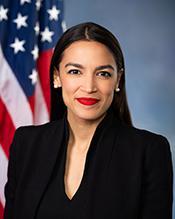
U.S. Representative for New York’s 14th district
Democrat
119th Congress, two-year term
Missed 2.7% of roll calls. Chamber median 1.9%.
The full voting recordCounts roll calls where most Democrats and most Republicans voted differently, leaving out procedural votes.
How we countFrom FEC filings, Voteview roll calls and Congress.gov.
Democrat. In Congress since 2019, 4 terms in total.
Following saves Ocasio-Cortez to your list, which Chamber & Street keeps on its server, linked to a cookie on this browser and not to your name or email. Email alerts will come with constituent verification.
Bills and resolutions Ocasio-Cortez signed on to as a cosponsor. An original cosponsor signed on the day the bill was introduced. Source: govinfo bill status files, last updated Nov 6, 2026.
Polluters Pay Climate Fund Act of 2025
Sponsor Jerrold Nadler (D). Original cosponsor. 25 cosponsors. H.R. 1135 on Congress.gov
Introduced
Scientific Integrity Act
Sponsor Paul Tonko (D). Original cosponsor. 140 cosponsors. H.R. 1106 on Congress.gov(opens in a new tab)
Introduced
Scientific Integrity Act
This bill requires each federal agency that funds, conducts, or oversees scientific research to adopt and enforce a scientific integrity policy.
Under the bill, among other parameters, such policies must (1) ensure that scientific conclusions are not based on political considerations, (2) prohibit the suppression or alteration of findings, and (3) permit researchers to disseminate their findings and engage with the scientific community as appropriate. Scientific integrity policies must also include a mechanism through which stakeholders may report violations of the policy.
Agencies are required to submit their scientific integrity policies to the Office of Science and Technology Policy (OSTP) for approval. Approved policies must be made public, submitted to Congress, and periodically updated. Agencies may use their existing policies provided they satisfy the requirements of the bill. The Government Accountability Office must review implementation of the policies.
Each agency is also required to (1) appoint a Scientific Integrity Officer, (2) establish a process for dispute resolution consistent with the scientific integrity policy, and (3) establish a specified training program for current and new employees.
Protecting Sensitive Locations Act
Sponsor Adriano Espaillat (D). Original cosponsor. 157 cosponsors. H.R. 1061 on Congress.gov(opens in a new tab)
Introduced
Protecting Sensitive Locations Act
This bill prohibits immigration enforcement actions within 1,000 feet of a sensitive location except in exigent circumstances, such as the imminent risk of death, violence, or physical harm to any person.
Sensitive locations include
• health care facilities;
• schools and school bus stops;
• places that provide assistance for people such as children, pregnant women, and abuse victims;
• child care facilities;
• places that provide disaster or emergency services;
• places of worship;
• courthouses and lawyers’ offices;
• facilities used as polling places;
• certain labor union facilities; and
• public assistance offices.
The prohibition shall apply to Department of Homeland Security officers and agents, as well as state employees pursuing immigration enforcement actions.
If an enforcement action is carried out in violation of this prohibition (1) no information resulting from the action may be entered into the record in a resulting removal proceeding, and (2) the affected individual may move to immediately terminate such a proceeding.
U.S. Immigration and Customs Enforcement and U.S. Customs and Border Protection shall annually report to Congress about enforcement actions taken at sensitive locations in the preceding year.
Condemning the pardons for individuals who were found guilty of assaulting Capitol Police Officers.
Sponsor Bonnie Watson Coleman (D). Original cosponsor. 138 cosponsors. H.Res. 116 on Congress.gov(opens in a new tab)
Introduced
This resolution disapproves of pardons for individuals who were found guilty of assaulting U.S. Capitol Police officers.
Right to Contraception Act
Sponsor Lizzie Fletcher (D). Original cosponsor. 211 cosponsors. H.R. 999 on Congress.gov(opens in a new tab)
Introduced
Right to Contraception Act
This bill sets out statutory protections for an individual's right to access and a health care provider's right to provide contraception and related information. Contraception refers to an action taken to prevent pregnancy, including the use of contraceptives (i.e., a device or medication used to prevent pregnancy), fertility-awareness based methods, and sterilization procedures.
Generally, the bill prohibits measures that single out and impede access to contraception and related information. However, a party may defend against a claim that a measure violates the bill's prohibitions by demonstrating, through clear and convincing evidence, that the measure significantly advances the safety of contraception and cannot be achieved through less restrictive means. The bill also specifies that the prohibition preempts inconsistent state and local laws and applies notwithstanding other federal laws, including the Religious Freedom Restoration Act of 1993.
The Department of Justice, individuals, or health care providers may bring a lawsuit to enforce this bill, and states are not immune from suits for violations.
No Tax Breaks for Outsourcing Act
Sponsor Lloyd Doggett (D). Original cosponsor. 140 cosponsors. H.R. 995 on Congress.gov(opens in a new tab)
Introduced
Job Protection Act
Sponsor Lauren Underwood (D). Original cosponsor. 61 cosponsors. H.R. 1035 on Congress.gov(opens in a new tab)
Introduced
Expressing support for the recognition of January as "Muslim-American Heritage Month" and celebrating the heritage and culture of Muslim Americans in the United States.
Sponsor André Carson (D). Joined Feb 4, 2025. 31 cosponsors. H.Res. 61 on Congress.gov(opens in a new tab)
Introduced
This resolution supports the designation of Muslim-American Heritage Month and honors the contributions of Muslim Americans in the economy, culture, and identity of the United States.
To award a Congressional Gold Medal to the Freedom Riders, collectively, in recognition of their unique contribution to Civil Rights, which inspired a revolutionary movement for equality in interstate travel.
Sponsor Henry Johnson (D). Original cosponsor. 124 cosponsors. H.R. 945 on Congress.gov(opens in a new tab)
Introduced
This bill provides for the presentation of a Congressional Gold Medal to the Freedom Riders, in recognition of their contribution to civil rights by fighting for equality in interstate travel.
Stop the Wait Act of 2025
Sponsor Lloyd Doggett (D). Original cosponsor. 88 cosponsors. H.R. 930 on Congress.gov(opens in a new tab)
Introduced
Stop the Wait Act of 2025
This bill phases out the initial waiting period for Social Security Disability Insurance (SSDI) benefits and eliminates the waiting period for certain disabled individuals to become eligible for Medicare.
Under current law, individuals generally must wait five months after the onset of disability to begin receiving SSDI benefits. The bill would gradually reduce this waiting period before eliminating it entirely in the year 2030.
Further, the bill would eliminate the 24-month waiting period for certain disabled workers and other individuals to become eligible for Medicare. Under current law, individuals under the age of 65 may generally enroll in Medicare after they have been eligible for SSDI or Social Security child’s, widow’s, or widower’s benefits by reason of disability for 24 months. The bill would eliminate this waiting period for individuals for whom the annual cost of certain medical insurance would exceed a specified percentage of their household income (i.e., those who cannot afford minimum essential coverage). Medicare eligibility for these individuals must be available retroactively to the first month that an individual qualified for SSDI or Social Security child’s, widow’s, or widower’s benefits by reason of disability.
NO BAN Act
Sponsor Judy Chu (D). Original cosponsor. 122 cosponsors. H.R. 924 on Congress.gov(opens in a new tab)
Introduced
National Origin-Based Antidiscrimination for Nonimmigrants Act or the NO BAN Act
This bill imposes limitations on the President's authority to suspend or restrict aliens from entering the United States. It also prohibits religious discrimination in various immigration-related decisions, such as whether to issue an immigrant or nonimmigrant visa, unless there is a statutory basis for such discrimination.
The President may temporarily restrict the entry of any aliens or class of aliens after the Department of State determines that the restriction would address specific and credible facts that threaten U.S. interests such as public safety.
The bill also imposes limitations on such restrictions, such as requiring the President, State Department, and the Department of Homeland Security (DHS) to (1) only issue a restriction when required to address a compelling government interest, and (2) narrowly tailor the suspension to use the least restrictive means to achieve such an interest.
Before imposing a restriction, the State Department and DHS shall consult with Congress. The State Department and DHS shall report to Congress about the restriction within 48 hours of the restriction's imposition. If such a report is not made, the restriction shall immediately terminate.
Individuals or entities present in the United States and unlawfully harmed by such a restriction may sue in federal court.
The bill transfers the authority to suspend the entry of aliens traveling to the United States on a commercial airline that failed to comply with regulations related to detecting fraudulent travel documents from the Department of Justice to DHS.
SAD Act
Sponsor Suzanne Bonamici (D). Original cosponsor. 86 cosponsors. H.R. 846 on Congress.gov(opens in a new tab)
Introduced
Stop Antiabortion Disinformation Act or the SAD Act
This bill prohibits deceptive advertising for reproductive health services.
Specifically, the bill makes it unlawful for a person (i.e., individual, partnership, corporation, association, or organization) to deceptively advertise the reproductive health services they offer, including by misrepresenting that the person (1) offers or provides contraception or abortion services (or referrals for such contraception or abortion services), or (2) employs or offers access to licensed medical personnel.
The bill provides for enforcement by the Federal Trade Commission.
In addition to any other penalty, violations are subject to a civil penalty that may not exceed the greater of $100,000 (adjusted annually for inflation) or 50% of the revenue earned during the preceding 12-month period by the ultimate parent entity of the person who violated the bill.
Saving the Civil Service Act
Joined Jan 31, 2025. 112 cosponsors. H.R. 492 on Congress.gov(opens in a new tab)
Progress not on file
Saving the Civil Service Act
This bill generally prohibits changes to the classification of positions in the competitive service and excepted service unless certain conditions are met. (Competitive service positions are subject to competitive examination while excepted service positions are appointed under one of five schedules. Competitive service positions have notice and appeal requirements for adverse actions that are not applicable to most excepted positions, including those of a confidential, policy-determining, policy-making, or policy-advocating character under Schedule C.)
On October 21, 2020, President Donald Trump issued an executive order that placed executive agency positions that are of a confidential, policy-determining, policy-making, or policy-advocating character, and that are not normally subject to change as a result of a presidential transition, under a new Schedule F in the excepted service. The order was subsequently revoked by President Joe Biden.
The bill prohibits executive agency positions in the competitive service from being placed in the excepted service, unless such positions are placed in a schedule in the excepted service as in effect on September 30, 2020. The bill also prohibits positions in the excepted service from being placed in any schedule other than the aforementioned schedules.
Additionally, agencies may not (1) transfer occupied positions from the competitive or excepted service into Schedule C without the consent of the Office of Personnel Management, or (2) transfer employees in the excepted service to another schedule or transfer employees in the competitive service to the excepted service without employee consent.
Global Health, Empowerment and Rights Act
Sponsor Lois Frankel (D). Original cosponsor. 138 cosponsors. H.R. 764 on Congress.gov(opens in a new tab)
Introduced
Global Health, Empowerment and Rights Act
This bill establishes that a foreign nongovernmental organization shall not be disqualified from receiving certain U.S. international development assistance solely because the organization provides medical services (including counseling and referral services) using non-U.S. government funds if the medical services do not violate the laws of the country in which they are being provided. Such foreign organizations shall not be subject to requirements relating to their use of non-U.S. funds for advocacy or lobbying activities other than those that apply to U.S. nongovernmental organizations receiving such assistance.
Neighbors Not Enemies Act
Sponsor Ilhan Omar (D). Joined Jan 28, 2025. 67 cosponsors. H.R. 630 on Congress.gov(opens in a new tab)
Introduced
Neighbors Not Enemies Act
This bill repeals provisions authorizing the President to apprehend and remove from the United States the citizens of a particular nation, if the United States has declared war against that nation or that nation has threatened an invasion against the United States.
Expressing strong disapproval of the President's announcement to withdraw the United States from the Paris Agreement.
Sponsor Bradley Schneider (D). Original cosponsor. 162 cosponsors. H.Res. 68 on Congress.gov(opens in a new tab)
Introduced
Health Care Providers Safety Act of 2025
Sponsor Veronica Escobar (D). Original cosponsor. 72 cosponsors. H.R. 612 on Congress.gov(opens in a new tab)
Introduced
Health Care Providers Safety Act of 2025
This bill authorizes the Department of Health and Human Services to award grants to health care providers for security services and other expenses related to physical security and cybersecurity.
Close the Medigap Act of 2025
Sponsor Lloyd Doggett (D). Original cosponsor. 45 cosponsors. H.R. 610 on Congress.gov(opens in a new tab)
Introduced
Close the Medigap Act of 2025
This bill (1) expands guaranteed issue rights with respect to Medigap policies (Medicare supplemental health insurance policies), (2) eliminates certain limitations on Medigap policies for newly eligible Medicare beneficiaries, and (3) modifies other provisions related to Medigap policies. (Guaranteed issue rights require that a policy be offered to any eligible applicant without regard to health status.)
Assuring Medicare’s Promise Act of 2025
Sponsor Lloyd Doggett (D). Original cosponsor. 57 cosponsors. H.R. 609 on Congress.gov(opens in a new tab)
Introduced
Assuring Medicare’s Promise Act of 2025
This bill increases the net investment tax for certain taxpayers and appropriates revenue from the net investment tax to the Federal Hospital Insurance Trust Fund (which finances Medicare Part A). The bill also requires the Internal Revenue Service (IRS) to issue additional guidance on the net investment tax.
The bill requires individuals with a modified adjusted gross income (MAGI) exceeding $400,000 ($500,000 for joint filers and $250,000 for married individuals filing separately), estates, and trusts to pay a tax of 3.8% on the greater of their specified net income or net investment income, subject to limitations. (Under current law, individuals with a MAGI exceeding $200,000 [or $250,000 for joint filers], estates, and trusts pay a 3.8% tax on net investment income.)
The bill defines specified net income by expanding the definition of net investment income to
• include gross income from any trade or business (unless subject to employment taxes), including interest, dividends, annuities, royalties, and rents;
• include net gain from the disposition of business property;
• eliminate the exclusion of income from the investment of working capital; and
• eliminate the exception related to certain active partnership or S corporation interests.
The bill also
• expands the net investment tax definition of a trade or business,
• disallows net operating losses in calculating net investment income,
• includes certain foreign-sourced income in net investment income, and
• requires the IRS to issue guidance on the treatment of certain corporate distributions for purposes of the net investment tax.
Proxy Voting for New Parents Resolution
Sponsor Brittany Pettersen (D). Joined Jan 21, 2025. 175 cosponsors. H.Res. 23 on Congress.gov(opens in a new tab)
Introduced
Proxy Voting for New Parents Resolution
This resolution authorizes proxy voting in the House of Representatives for a Member who has given birth or whose spouse has given birth and pregnant Members who are unable to travel safely or have a serious medical condition.
Under the resolution, a qualifying Member may designate a proxy to cast a vote in a committee, the Committee of the Whole, or on the House floor; however, proxies will not be counted for purposes of establishing a quorum. The proxy designation is valid for up to 12 weeks.
To designate a proxy for House and Committee of the Whole votes, the Member must submit a signed and dated letter to the Clerk stating the Member’s qualifying circumstances and the name and state of the Member who has agreed to be designated as proxy. A Member who has designated a proxy according to these requirements may also designate a proxy for committee votes. To designate a proxy for committee votes, the Member must provide the committee chair and ranking minority member with a signed and dated letter specifying another member of the committee to cast a proxy vote.
The resolution further provides that a Member may revoke the proxy authorization by (1) casting the Member’s own vote; (2) recording the Member’s own presence in the House or in the Committee of the Whole; or (3) in a committee, by submitting a signed letter to the chair and ranking minority member.
Report on Grant Consolidation Authority for Puerto Rico Act
Sponsor Nydia Velázquez (D). Original cosponsor. 7 cosponsors. H.R. 596 on Congress.gov(opens in a new tab)
Introduced
Report on Grant Consolidation Authority for Puerto Rico Act
This bill requires the Government Accountability Office (GAO) to report to Congress regarding the consolidation of certain grant programs currently available to insular areas and the suitability of such consolidation for Puerto Rico. (At present, such consolidation allows insular areas to apply for a consolidated grant in lieu of filing an individual application for each eligible grant program.)
Further, any official of Puerto Rico from whom the GAO seeks information for purposes of that report must promptly and comprehensively respond to such request for information.
To codify Executive Order 14096 relating to revitalizing our Nation's commitment to environmental justice for all.
Sponsor Nanette Barragán (D). Original cosponsor. 34 cosponsors. H.R. 576 on Congress.gov(opens in a new tab)
Introduced
This bill provides statutory authority for Executive Order 14096, which was issued on April 26, 2023, to advance a government-wide approach to environmental justice, including by directing each federal agency to (1) make achieving environmental justice part of its mission, (2) issue an Environmental Justice Strategic Plan every four years, and (3) provide public notice of certain toxic chemical releases. The Executive Order also established the White House Office of Environmental Justice as well as an Environmental Justice Subcommittee of the National Science and Technology Council.
To designate the facility of the United States Postal Service located at 216 Cumberland Street in Rochester, New York, as the "Minister Franklin Florence Memorial Post Office".
Sponsor Joseph Morelle (D). Joined Jan 21, 2025. 25 cosponsors. H.R. 397 on Congress.gov(opens in a new tab)
Passed committee
This bill designates the facility of the United States Postal Service located at 216 Cumberland Street in Rochester, New York, as the "Minister Franklin Florence Memorial Post Office".
Inaugural Fund Integrity Act
Sponsor Mary Gay Scanlon (D). Original cosponsor. 13 cosponsors. H.R. 535 on Congress.gov(opens in a new tab)
Introduced
Inaugural Fund Integrity Act
This bill limits donations to inaugural committees and requires these committees to disclose donations and disbursements.
Specifically, inaugural committees may not solicit, accept, or receive donations from corporations or foreign nationals. An individual may not make a donation in the name of another individual or authorize his or her name to be used to make such a donation. In addition, foreign nationals may not make donations or make promises to make donations to inaugural committees.
Further, the bill caps the amount an individual may donate to an inaugural committee.
Donations to inaugural committees may not be converted to personal use.
Finally, inaugural committees must report certain information on donations and disbursements to the Federal Election Commission.
Equal COLA Act
Original cosponsor. 90 cosponsors. H.R. 491 on Congress.gov(opens in a new tab)
Progress not on file
Equal COLA Act
This bill applies a cost-of-living adjustment (COLA) for annuities paid under the Federal Employees Retirement System that is equal to the increase in inflation, regardless of the amount of the increase.
Specifically, for any year in which the Consumer Price Index (CPI) has increased over the previous year, the COLA amount shall be increased by the change in the CPI from the previous year.
Current law applies an adjustment equal to the change in CPI only if the change is 2% or less. If the change is between 2% and 3%, the adjustment is limited to 2%. If the change is more than 3%, the adjustment is limited to 1% less than the change.