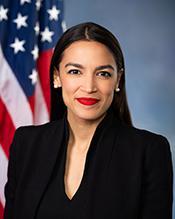
U.S. Representative for New York’s 14th district
Democrat
119th Congress, two-year term
Missed 2.7% of roll calls. Chamber median 1.9%.
The full voting recordCounts roll calls where most Democrats and most Republicans voted differently, leaving out procedural votes.
How we countFrom FEC filings, Voteview roll calls and Congress.gov.
Democrat. In Congress since 2019, 4 terms in total.
Following saves Ocasio-Cortez to your list, which Chamber & Street keeps on its server, linked to a cookie on this browser and not to your name or email. Email alerts will come with constituent verification.
Bills and resolutions Ocasio-Cortez signed on to as a cosponsor. An original cosponsor signed on the day the bill was introduced. Source: govinfo bill status files, last updated Nov 6, 2026.
Providing for congressional disapproval of the proposed foreign military sale to Israel of certain defense articles and services.
Sponsor Pramila Jayapal (D). Original cosponsor. 13 cosponsors. H.J.Res. 68 on Congress.gov
Introduced
This joint resolution prohibits a proposed foreign military sale of certain defense articles and services to Israel.
Expressing the sense of the House of Representatives that Congress should take all appropriate measures to ensure that the United States Postal Service remains an independent establishment of the Federal Government and is not subject to privatization.
Sponsor Stephen Lynch (D). Joined Feb 27, 2025. 238 cosponsors. H.Res. 70 on Congress.gov(opens in a new tab)
Introduced
This resolution expresses the sense of the House of Representatives that Congress should ensure that the U.S. Postal Service is not privatized and remains an independent establishment of the federal government.
Recognizing the seriousness of polycystic ovary syndrome (PCOS) and expressing support for the designation of the month of September as "PCOS Awareness Month".
Original cosponsor. 44 cosponsors. H.Res. 175 on Congress.gov(opens in a new tab)
Progress not on file
This resolution expresses support for the goals and ideals of PCOS Awareness Month. Polycystic ovary syndrome (PCOS) is caused by a hormone imbalance and can cause symptoms such as infertility, weight gain, excess hair growth, and acne.
Restoring the promise of freedom: honoring, preserving, and investing in Freedmen's Settlements.
Sponsor Sydney Kamlager-Dove (D). Original cosponsor. 15 cosponsors. H.Res. 173 on Congress.gov(opens in a new tab)
Introduced
This resolution recognizes, and expresses support for preserving and investing in, freedmen's settlements.
Freedmen's settlements generally were established before and after emancipation by free and formerly enslaved African Americans to create self-sustaining communities away from racial violence and economic discrimination.
Reaffirming the United States commitment to respecting the sovereignty of Mexico and condemning calls for military action in Mexico without Mexico's consent and congressional authorization.
Sponsor Joaquin Castro (D). Original cosponsor. 43 cosponsors. H.Res. 168 on Congress.gov(opens in a new tab)
Introduced
Stop Politicians Profiting from War Act of 2025
Sponsor Rashida Tlaib (D). Original cosponsor. 14 cosponsors. H.R. 1756 on Congress.gov(opens in a new tab)
Introduced
Preventing Deep Fake Scams Act
Sponsor Brittany Pettersen (D). Original cosponsor. 11 cosponsors. H.R. 1734 on Congress.gov(opens in a new tab)
Introduced
Preventing Deep Fake Scams Act
This bill establishes the Task Force on Artificial Intelligence in the Financial Services Sector. Members include representatives from the Department of the Treasury, the Federal Reserve Board, the Federal Deposit Insurance Corporation, and the National Credit Union Administration. The task force must report on (1) how banks and credit unions prevent fraud that utilizes artificial intelligence, (2) best practices for financial institutions to protect their customers, and (3) related legislative and regulatory recommendations.
PAST Act of 2025
Sponsor Brian Fitzpatrick (R). Original cosponsor. 207 cosponsors. H.R. 1684 on Congress.gov(opens in a new tab)
Introduced
Prevent All Soring Tactics Act of 2025 or the PAST Act of 2025
This bill increases protections for horses at shows, exhibitions, sales, or auctions (horse events) to prevent the practice of soring horses. Generally, the soring of horses includes certain actions taken on horses' limbs to produce higher gaits that may cause pain, distress, inflammation, or lameness.
Specifically, the bill expands existing soring prohibitions under the Horse Protection Act, including by banning the use of certain action devices (e.g., nonprotective boots) on specified horse breeds.
The bill also requires soring inspectors at horse events to be assigned by the Animal and Plant Health Inspection Service (APHIS) of the Department of Agriculture rather than appointed by the management of horse events. APHIS must also license, train, and oversee inspectors to detect and diagnose soring at such events.
Additionally, the bill increases penalties for violations of the act. It also directs APHIS to disqualify horses found to be sore from being shown or exhibited for specified periods. Further, APHIS may permanently disqualify violators from participating in horse events after the third or any subsequent violation.
By way of background, APHIS issued a rule in 2024 to increase efforts to protect horses from soring practices. However, in 2025, a court vacated parts of the rule as exceeding APHIS' statutory authority (e.g., prohibiting the use of certain action devices) while deeming other parts acceptable (e.g., establishing APHIS-designated inspectors). APHIS subsequently delayed the effective date of the rule to December 31, 2026.
Keep Americans Safe Act
Sponsor Diana DeGette (D). Original cosponsor. 145 cosponsors. H.R. 1674 on Congress.gov(opens in a new tab)
Introduced
Keep Americans Safe Act
This bill establishes a new criminal offense for the import, sale, manufacture, transfer, or possession of a large capacity ammunition feeding device (LCAFD).
The bill does not prohibit certain conduct with respect to an LCAFD, including the following:
• importation, sale, manufacture, transfer, or possession related to certain law enforcement efforts, or authorized tests or experiments;
• importation, sale, transfer, or possession related to securing nuclear materials; and
• possession by a retired law enforcement officer.
The bill permits continued possession of, but prohibits sale or transfer of, a grandfathered LCAFD.
Newly manufactured LCAFDs must display serial number identification and the date of manufacture.
Additionally, the bill allows a state or local government to use Edward Byrne Memorial Justice Assistance Grant Program funds to compensate individuals who surrender an LCAFD under a buy-back program.
To designate the facility of the United States Postal Service located at 86 Main Street in Haverstraw, New York, as the "Paul Piperato Post Office Building".
Sponsor Michael Lawler (R). Joined Feb 27, 2025. 24 cosponsors. H.R. 1009 on Congress.gov(opens in a new tab)
Passed the House
This bill designates the facility of the U.S. Postal Service located at 86 Main Street in Haverstraw, New York, as the Paul Piperato Post Office Building.
To designate the facility of the United States Postal Service located at 298 Route 292 in Holmes, New York, as the "Sheriff Adrian 'Butch' Anderson Post Office Building".
Sponsor Michael Lawler (R). Joined Feb 27, 2025. 24 cosponsors. H.R. 1008 on Congress.gov(opens in a new tab)
Passed the House
This bill designates the facility of the U.S. Postal Service located at 298 Route 292 in Holmes, New York, as the Sheriff Adrian "Butch" Anderson Post Office Building.
CROWN Act of 2025
Sponsor Bonnie Watson Coleman (D). Original cosponsor. 84 cosponsors. H.R. 1638 on Congress.gov(opens in a new tab)
Introduced
Creating a Respectful and Open World for Natural Hair Act of 2025 or the CROWN Act of 2025
This bill prohibits discrimination based on a person's hair texture or hairstyle if that style or texture is commonly associated with a particular race or national origin. Specifically, the bill prohibits this type of discrimination against those participating in federally assisted programs, housing programs, public accommodations, and employment.
Persons shall not be deprived of equal rights under the law and shall not be subjected to prohibited practices based on their hair texture or style.
The bill provides for enforcement procedures under the applicable laws (e.g., the Civil Rights Act of 1964).
Protect Veteran Jobs Act
Sponsor Derek Tran (D). Original cosponsor. 96 cosponsors. H.R. 1637 on Congress.gov(opens in a new tab)
Introduced
Protect Veteran Jobs Act
This bill provides reinstatement eligibility to veterans who were involuntarily removed or otherwise dismissed without cause from civil service positions from January 20, 2025, through the date of enactment of this bill. Such veterans must be eligible for reinstatement to their former positions or any other civil service positions for which they are qualified.
Each executive branch agency must regularly report through January 20, 2029, to Congress regarding veteran employees who were removed or otherwise dismissed from the agency, including the total number of employees removed and the reasons for the dismissals.
RAISE Act of 2025
Sponsor Jahana Hayes (D). Original cosponsor. 52 cosponsors. H.R. 1611 on Congress.gov(opens in a new tab)
Introduced
Respect, Advancement, and Increasing Support for Educators Act of 2025 or the RAISE Act of 2025
This bill establishes a refundable federal tax credit for eligible educators and increases and expands the federal tax deduction for certain classroom and professional development expenses. The bill also increases federal funding for programs that support effective instruction.
Specifically, the bill allows (1) eligible educators (elementary and secondary public school teachers and early childhood educators) to claim a tax credit of $1,000, and (2) eligible educators employed at a qualifying school to claim an additional tax credit of up to $14,000 ($9,000 for an early childhood educator without a bachelor’s degree) based on the qualifying school’s student poverty ratio.
The bill generally defines a qualifying school as
• a public elementary or secondary school served by a local education agency eligible for federal grants that support the education of disadvantaged children,
• an elementary school or secondary school funded by the Bureau of Indian Education, or
• an early childhood education program serving children who are eligible for certain financial or food assistance.
Further, the bill increases to $500 ($300 in 2025) and continues to adjust annually the above-the-line tax deduction for certain classroom and professional development expenses of educators. The bill also expands eligibility for the credit to include early childhood educators. (Above-the-line tax deductions are subtracted from gross income to calculate adjusted gross income.)
Finally, the bill provides additional funding for education programs, including teacher salary incentive grants and professional development, certificate, and credentialing programs.
American Dream and Promise Act of 2025
Sponsor Sylvia Garcia (D). Original cosponsor. 221 cosponsors. H.R. 1589 on Congress.gov(opens in a new tab)
Introduced
American Dream and Promise Act of 2025
This bill provides certain non-U.S. nationals (aliens under federal law) with a path to receive permanent resident status and contains other immigration-related provisions.
The Department of Homeland Security (DHS) or the Department of Justice (DOJ) shall provide conditional permanent resident status for 10 years to a qualifying individual who entered the United States as a minor and (1) is deportable or inadmissible, (2) has deferred enforced departure (DED) status or temporary protected status (TPS), or (3) is the child of certain classes of nonimmigrants. The bill imposes various qualifying requirements, such as the individual being continuously physically present in the United States since January 1, 2021, passing a background check, and being enrolled in or having completed certain educational programs.
DHS shall remove the conditions placed on permanent resident status granted under this bill if the individual applies and meets certain requirements, such as completing certain programs at an educational institution, serving in the military, or being employed.
Furthermore, DHS or DOJ shall provide lawful permanent resident status to certain individuals who had TPS, were eligible for TPS, or were eligible for DED status on certain dates. Such individuals must meet certain requirements and apply for such status within three years of this bill's enactment.
This bill also repeals a restriction that bars a state from providing higher education benefits to undocumented individuals unless those benefits are available to all U.S. nationals without regard to residency in the state.
Expressing support for the designation of the week of February 24 through February 28, 2025, as "Public Schools Week".
Sponsor Mark Pocan (D). Original cosponsor. 99 cosponsors. H.Res. 159 on Congress.gov(opens in a new tab)
Introduced
This resolution supports the designation of Public Schools Week.
To codify Executive Order 11246 titled "Equal Employment Opportunity".
Sponsor Shontel Brown (D). Joined Feb 24, 2025. 92 cosponsors. H.R. 989 on Congress.gov(opens in a new tab)
Introduced
Honoring the legacy of the Harlem Renaissance, a cultural, social, and political movement in American history.
Sponsor Adriano Espaillat (D). Original cosponsor. 4 cosponsors. H.Res. 146 on Congress.gov(opens in a new tab)
Introduced
Energy Resilient Communities Act
Sponsor Nanette Barragán (D). Original cosponsor. 31 cosponsors. H.R. 1449 on Congress.gov(opens in a new tab)
Introduced
9/11 Responder and Survivor Health Funding Correction Act of 2025
Sponsor Andrew Garbarino (R). Joined Feb 21, 2025. 133 cosponsors. H.R. 1410 on Congress.gov(opens in a new tab)
Introduced
9/11 Responder and Survivor Health Funding Correction Act of 2025
This bill modifies the World Trade Center Health Program (WTCHP), including by updating the formula for determining the program’s annual funding amounts and authorizing mental health providers to provide certain evaluations under the program.
The WTCHP is a federal health care program (terminating in FY2090) providing responders and survivors with monitoring and treatment of certified medical conditions related to the terrorist attacks that occurred on September 11, 2001. Under current law, the program’s annual federal funding is determined based on the amount specifically appropriated in the previous fiscal year, adjusted for inflation.
The bill establishes a new federal funding formula for FY2026-FY2090 that is generally based on annual changes in the number of enrollees. The bill also increases the amounts the program may spend annually on medical research and activities relating to data collection. The bill requires the National Institute for Occupational Safety and Health (NIOSH), which administers the program, to submit a report to Congress on the program’s projected budgetary needs and expenditures.
In addition, the bill authorizes licensed mental health providers to perform initial health evaluations with respect to mental health conditions for purposes of determining eligibility under the WTCHP. NIOSH must issue regulations specifying the categories of mental health providers that may perform these activities.
Expanding Child Care Access Act of 2025
Sponsor Herbert Conaway (D). Joined Feb 21, 2025. 39 cosponsors. H.R. 1296 on Congress.gov(opens in a new tab)
Introduced
Expanding Child Care Access Act of 2025
This bill establishes a temporary (for seven years) refundable tax credit for certain expenses incurred to establish and operate a qualified family child care provider. (Conditions and limitations apply.)
Under the bill, a qualified family child care provider is a child care provider that
• provides child care services at the taxpayer's primary residence for at least two children (other than the children of such taxpayer) for a significant portion of the tax year,
• receives compensation for such child care services, and
• is licensed or registered to provide such child care services by the state in which such services are provided.
The bill allows a taxpayer that operates a qualified family child care provider to claim a tax credit of up to $5,000 for
• child care licensing fees;
• child care supplies (e.g., diapers, food, toys, and learning materials);
• liability insurance;
• fencing (including installation costs);
• outdoor playground equipment (including installation costs);
• furniture necessary to provide child care;
• the salary of an employee (other than the taxpayer);
• printers and computers;
• professional training required by the state for licensing or registration; and
• remediation or renovation of a primary residence to meet state licensing or registration requirements.
The tax credit may only be claimed once and may not be claimed for expenses for which another tax deduction or tax credit is allowed.
Finally, the bill requires the Internal Revenue Service to issue guidance on the tax credit, including guidance related to information reporting requirements.
Setting Consumer Standards for Lithium-Ion Batteries Act
Sponsor Ritchie Torres (D). Joined Feb 12, 2025. 23 cosponsors. H.R. 973 on Congress.gov(opens in a new tab)
Passed the House
Setting Consumer Standards for Lithium-Ion Batteries Act
This bill requires the Consumer Product Safety Commission to issue a final consumer product safety rule for rechargeable lithium-ion batteries used in micromobility devices, such as electric bikes and electric scooters.
Specifically, the rule must require manufacturers and distributors of such products to comply with the applicable safety standards jointly established by the American National Standards Institute, the Standards Council of Canada, and UL Solutions Inc.
Proposing an amendment to the Constitution of the United States providing that the rights protected and extended by the Constitution are the rights of natural persons only.
Sponsor Pramila Jayapal (D). Original cosponsor. 82 cosponsors. H.J.Res. 54 on Congress.gov(opens in a new tab)
Introduced
This joint resolution proposes a constitutional amendment providing that the rights protected and extended by the Constitution are the rights of natural persons only. Artificial entities, such as corporations, shall have no rights under the Constitution and are subject to regulation.
The amendment requires federal, state, and local governments to (1) regulate, limit, or prohibit election contributions and expenditures, including a candidate's own contributions and expenditures, to ensure equal access of citizens to the political process, regardless of economic status; and (2) require that any permissible contributions and expenditures be publicly disclosed.
Additionally, the judiciary is prohibited from construing the spending of money to influence elections to be speech under the First Amendment.
Department of Peacebuilding Act of 2025
Sponsor Ilhan Omar (D). Joined Feb 11, 2025. 52 cosponsors. H.R. 1111 on Congress.gov(opens in a new tab)
Introduced
Taxpayer Data Protection Act
Sponsor Haley Stevens (D). Joined Feb 10, 2025. 205 cosponsors. H.R. 1101 on Congress.gov(opens in a new tab)
Introduced
Taxpayer Data Protection Act
This bill restricts access to any public money receipt or payment system belonging to the Department of the Treasury.
Specifically, access is limited to authorized Treasury officers, employees, or contractors meeting certain performance standards who have held a qualified position for at least a year, or who hold other qualifications as provided by the bill. The bill specifically prohibits special government employees (i.e., temporary appointees hired to perform specific tasks) from having access to such systems. The bill also provides that an individual accessing such systems shall be treated as an executive branch employee for purposes of federal criminal conflict of interest laws.
Treasury's Office of Inspector General must investigate and report on each instance of unauthorized use or other access of such payment systems.