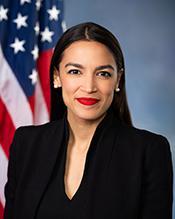
U.S. Representative for New York’s 14th district
Democrat
119th Congress, two-year term
Missed 2.7% of roll calls. Chamber median 1.9%.
The full voting recordCounts roll calls where most Democrats and most Republicans voted differently, leaving out procedural votes.
How we countFrom FEC filings, Voteview roll calls and Congress.gov.
Democrat. In Congress since 2019, 4 terms in total.
Following saves Ocasio-Cortez to your list, which Chamber & Street keeps on its server, linked to a cookie on this browser and not to your name or email. Email alerts will come with constituent verification.
Bills and resolutions Ocasio-Cortez signed on to as a cosponsor. An original cosponsor signed on the day the bill was introduced. Source: govinfo bill status files, last updated Nov 6, 2026.
No Tax Breaks for Union Busting (NTBUB) Act
Sponsor Donald Norcross (D). Original cosponsor. 137 cosponsors. H.R. 2692 on Congress.gov
Introduced
No Tax Breaks for Union Busting (NTBUB) Act
This bill excludes from the tax deduction for ordinary and necessary business expenses amounts paid or incurred to influence employees with respect to labor organizations or labor organization activities. The bill also imposes information reporting requirements related to such expenses and imposes penalties for failure to comply.
Under the bill, amounts paid to influence employees with respect to labor organizations include amounts paid (including wages and other costs)
• in connection with an action that results in a complaint or settlement related to an unfair labor practice or a finding of interference, influence, or coercion related to railway employees’ rights to organize and bargain collectively;
• for any meeting or training attended by employees and at which labor organizations are discussed; and
• that require certain employer disclosures and financial reporting.
(Some exceptions apply.)
The bill requires employers to file a return reporting certain information related to expenses paid to influence employees with respect to labor organizations and imposes a penalty for noncompliance. The amount of the penalty is the greater of (1) $10,000, or (2) $1,000 multiplied by the number full-time equivalent employees. Additional penalties apply for violations that continue for more than 90 days.
The bill also imposes information reporting requirements on persons conducting activities on behalf of another person to influence employees with respect to labor organizations.
The bill allows certain penalties for noncompliance with the reporting requirements to be waived if noncompliance is due to reasonable cause and not willful neglect.
Tax Fairness for Workers Act
Sponsor Brendan Boyle (D). Original cosponsor. 176 cosponsors. H.R. 2671 on Congress.gov(opens in a new tab)
Introduced
Protect America's Workforce Act
Sponsor Jared Golden (D). Joined Apr 7, 2025. 226 cosponsors. H.R. 2550 on Congress.gov(opens in a new tab)
Passed the House
Protect America's Workforce Act
This bill nullifies the Executive Order titled Exclusions from Federal Labor-Management Relations Programs (issued on March 27, 2025), which excludes specified executive agencies and subdivisions from the Federal Service Labor-Management Relations Statute. The statute authorizes federal employees' participation in collective bargaining and enforces collective bargaining rights.
The bill also specifies that a covered collective bargaining agreement in place as of March 26, 2025, shall have full force and effect through the stated term of the agreement.
Federal Firearm Licensee Act
Sponsor Robin Kelly (D). Original cosponsor. 88 cosponsors. H.R. 2618 on Congress.gov(opens in a new tab)
Introduced
Federal Firearm Licensee Act
This bill establishes new security requirements and expands recordkeeping and reporting requirements for federally licensed dealers, importers, and manufacturers of firearms (i.e., federal firearms licensees, or FFLs). The bill also broadens the authority of the Bureau of Alcohol, Tobacco, Firearms and Explosives (ATF) to administer federal firearms laws and enforce violations.
Specifically, bill requires FFLs to implement and comply with a plan to secure their business premises, conduct quarterly physical checks of their business inventories, maintain video surveillance of the area where firearms are sold or transferred, and initiate firearms-related background checks for employees.
Additionally, the bill requires FFLs to report to the ATF any inventory firearm that is lost, stolen, or unaccounted for and to notify the ATF about default-proceed transactions (i.e., allowable firearm transfers to an unlicensed person prior to the completion of a background check when the submitted background check remains incomplete after three business days).
Finally, the bill removes limits on the ATF's authority to conduct activities related to the administration of federal firearms laws. It enhances the ATF's inspection authority, including by removing the limit on the number of annual compliance inspections (currently, one), requiring inspections of high-risk FFLs, and authorizing an additional 650 investigators. Finally, the bill directs the ATF to deny an application for a federal firearms license if it would endanger public safety or if the applicant is unlikely to comply with the law.
Reentry Act of 2025
Sponsor Paul Tonko (D). Original cosponsor. 86 cosponsors. H.R. 2586 on Congress.gov(opens in a new tab)
Introduced
Reentry Act of 2025
This bill allows for Medicaid payment of medical services furnished to an incarcerated individual during the 30-day period preceding the individual's release. The Medicaid and Children's Health Insurance Program (CHIP) Payment and Access Commission must report on specified information relating to the accessibility and quality of health care for incarcerated individuals, including the impact of the bill's changes.
LNG Public Interest Determination Act of 2025
Sponsor Sean Casten (D). Joined Mar 31, 2025. 48 cosponsors. H.R. 381 on Congress.gov(opens in a new tab)
Introduced
LNG Public Interest Determination Act of 2025
This bill modifies and expands requirements for exporting natural gas, including liquefied natural gas (LNG).
Under the existing provisions of the Natural Gas Act, exporters of natural gas must obtain authorization to make such exports from the Federal Energy Regulatory Commission (FERC). Additionally, FERC must authorize such exports if they are consistent with the public interest.
The bill directs exporters of natural gas to obtain authorization from the Department of Energy (DOE) rather than from FERC. Before granting an authorization, DOE must determine that the export would not likely (1) contribute significantly to climate change; (2) materially increase energy prices or energy price volatility for U.S. consumers; or (3) create a disproportionate health or environmental burden on rural, low-income, minority, and other vulnerable communities.
The bill also classifies an authorization of the exportation of natural gas as a major federal action that triggers the environmental review process required under the National Environmental Policy Act of 1969 (NEPA).
Additionally, the bill terminates the categorical exclusion for exports of natural gas, and any associated transportation of LNG by marine vessels, from NEPA environmental review requirements. A categorical exclusion is a class of actions that a federal agency has determined do not significantly affect the quality of the human environment and, thus, do not require either an environmental assessment nor an environmental impact statement.
Hot Foods Act of 2025
Sponsor Grace Meng (D). Original cosponsor. 120 cosponsors. H.R. 2512 on Congress.gov(opens in a new tab)
Introduced
Hot Foods Act of 2025
This bill expands the Supplemental Nutrition Assistance Program (SNAP) to permit the use of SNAP benefits to purchase hot foods or hot food products ready for immediate consumption.
Hunger-Free Future Act of 2025
Sponsor Shontel Brown (D). Original cosponsor. 71 cosponsors. H.R. 2489 on Congress.gov(opens in a new tab)
Introduced
Hunger-Free Future Act of 2025
This bill prohibits any reevaluation or update to the Thrifty Food Plan (TFP) by the Department of Agriculture (USDA) that results in an increase in food insecurity (i.e., an increase in the number of households that lack adequate food as a result of having insufficient money and other resources to acquire food).
As background, USDA created the TFP (the cost of purchasing a nutritionally adequate low-cost diet), which is used to determine maximum monthly benefits under the Supplemental Nutrition Assistance Program (SNAP). USDA calculates the cost of the TFP (i.e., the market basket of goods) each year to account for food price inflation. Under a provision of the 2018 farm bill, USDA must reevaluate the market basket of goods every five years based on current food prices, food composition data, consumption patterns, and dietary guidance.
Transgender Health Care Access Act
Sponsor Becca Balint (D). Original cosponsor. 82 cosponsors. H.R. 2487 on Congress.gov(opens in a new tab)
Introduced
Heating and Cooling Relief Act
Sponsor Yassamin Ansari (D). Original cosponsor. 53 cosponsors. H.R. 2486 on Congress.gov(opens in a new tab)
Introduced
Providing for congressional disapproval of the report of enhancement or upgrade of sensitive foreign military related to a sale to the Government of Israel of certain defense articles and services.
Sponsor Rashida Tlaib (D). Original cosponsor. 14 cosponsors. H.J.Res. 86 on Congress.gov(opens in a new tab)
Introduced
This joint resolution prohibits a proposed foreign military sale of certain defense articles and services to Israel.
Providing for congressional disapproval of the proposed foreign military sale to Israel of certain defense articles and services.
Sponsor Rashida Tlaib (D). Original cosponsor. 16 cosponsors. H.J.Res. 85 on Congress.gov(opens in a new tab)
Introduced
This joint resolution prohibits a proposed foreign military sale of certain defense articles and services to Israel.
Providing for congressional disapproval of the proposed foreign military sale to Israel of certain defense articles and services.
Sponsor Pramila Jayapal (D). Original cosponsor. 15 cosponsors. H.J.Res. 84 on Congress.gov(opens in a new tab)
Introduced
This joint resolution prohibits a proposed foreign military sale of certain defense articles and services to Israel.
Providing for congressional disapproval of the proposed foreign military sale to Israel of certain defense articles and services.
Sponsor Pramila Jayapal (D). Original cosponsor. 19 cosponsors. H.J.Res. 83 on Congress.gov(opens in a new tab)
Introduced
This joint resolution prohibits a proposed foreign military sale of certain defense articles and services to Israel.
Recognizing the heritage, culture, and contributions of Latinas in the United States.
Sponsor J. Correa (D). Original cosponsor. 31 cosponsors. H.Res. 261 on Congress.gov(opens in a new tab)
Introduced
UNRWA Funding Emergency Restoration Act of 2025
Sponsor André Carson (D). Original cosponsor. 81 cosponsors. H.R. 2411 on Congress.gov(opens in a new tab)
Introduced
Raise the Age Act of 2025
Sponsor Glenn Ivey (D). Original cosponsor. 176 cosponsors. H.R. 2368 on Congress.gov(opens in a new tab)
Introduced
Raise the Age Act of 2025
This bill establishes new restrictions on the sale or transfer of certain semiautomatic firearms to individuals under 21 years of age.
Specifically, this bill makes it unlawful for a licensed gun dealer, importer, manufacturer, or collector to sell or deliver a semiautomatic center-fire rifle or semiautomatic center-fire shotgun that has (or has the capacity to accept) an ammunition feeding device with a capacity of more than five rounds to an individual who the licensee knows or has reasonable cause to believe is under age 21.
The prohibition does not apply if the individual under age 21 is a full-time law enforcement officer or active-duty member of the Armed Forces.
The bill also requires the Federal Bureau of Investigation to report on the operation of its public access line, including a description of information sharing protocols and recommendations for improving such protocols.
Food Secure Strikers Act of 2025
Sponsor Alma Adams (D). Original cosponsor. 89 cosponsors. H.R. 2357 on Congress.gov(opens in a new tab)
Introduced
Food Secure Strikers Act of 2025
This bill allows certain striking workers and their households to maintain their eligibility for the Supplemental Nutrition Assistance Program (SNAP).
Specifically, the bill provides that a household that would otherwise be eligible to participate in SNAP is eligible for benefits if any member of the household is on strike because of a labor dispute. Current law generally prohibits a household from participating in SNAP if any member of the household is on strike unless the household was eligible for SNAP immediately prior to the strike. Also, under current law, households are not eligible for an increased SNAP allotment as a result of the decreased income of a striking member of the household. The bill expands SNAP eligibility for households with striking workers by repealing both of these restrictions.
The bill also allows a government employee who is dismissed for striking and their household to maintain SNAP program eligibility. Specifically, current law prohibits certain individuals who voluntarily and without good cause quit a job from participating in SNAP. Further, a federal, state, or local government employee who participates in a strike against the government that results in their dismissal is considered to have voluntarily quit without good cause. The bill eliminates the provision that considers the dismissed government employee to have voluntarily quit without good cause, thereby allowing the employee and their household to maintain SNAP program eligibility if they are otherwise eligible for the program.
Children’s Health Protection Act of 2025
Sponsor Jerrold Nadler (D). Original cosponsor. 22 cosponsors. H.R. 2339 on Congress.gov(opens in a new tab)
Introduced
Paycheck Fairness Act
Sponsor Rosa DeLauro (D). Original cosponsor. 221 cosponsors. H.R. 17 on Congress.gov(opens in a new tab)
Introduced
Recognizing the significance of equal pay and the disparity between wages paid to men and women.
Sponsor Lois Frankel (D). Original cosponsor. 132 cosponsors. H.Con.Res. 21 on Congress.gov(opens in a new tab)
Introduced
To designate the facility of the United States Postal Service located at 1200 William Street, Room 200, in Buffalo, New York, as the "William J. Donovan Post Office Building".
Sponsor Timothy Kennedy (D). Joined Mar 24, 2025. 26 cosponsors. H.R. 1706 on Congress.gov(opens in a new tab)
Passed the House
This bill designates the facility of the United States Postal Service located at 1200 William Street, Room 200, in Buffalo, New York, as the "William J. Donovan Post Office Building".
Establishing the ratification of the Equal Rights Amendment.
Sponsor Ayanna Pressley (D). Original cosponsor. 221 cosponsors. H.J.Res. 80 on Congress.gov(opens in a new tab)
Introduced
This joint resolution provides that the Equal Rights Amendment, which prohibits discrimination on the basis of sex, was ratified by three-fourths of the states and is therefore a valid constitutional amendment, regardless of any time limit that was in the original proposal.
The Equal Rights Amendment was originally proposed to the states in 1972. The original proposal included a deadline for ratification of March 22, 1979; Congress subsequently extended the deadline to June 30, 1982. Although the requisite 38 states have ratified the amendment, three of these states did so after the deadlines, and five states subsequently rescinded their ratifications. The status of the amendment has been the subject of litigation.
Expressing the sense of the House of Representatives that every person has the basic right to emergency health care, including abortion care.
Sponsor Emilia Sykes (D). Original cosponsor. 111 cosponsors. H.Res. 238 on Congress.gov(opens in a new tab)
Introduced
This resolution expresses the sense of the House of Representatives that every individual has the right to emergency health care, including abortion care.
Social Security Expansion Act
Sponsor Val Hoyle (D). Joined Mar 21, 2025. 41 cosponsors. H.R. 1700 on Congress.gov(opens in a new tab)
Introduced
Social Security Expansion Act
This bill increases Social Security benefits, expands Social Security payroll taxes, and makes other changes to the Social Security program.
Specifically, the bill changes the way Social Security benefits are calculated by increasing the primary insurance amount applicable to average monthly earnings that fall below a specified amount, and increasing bend points for individuals who become eligible for Social Security after 2025. (Bend points are dollar amounts at which earnings are segmented for the purpose of calculating an individual’s primary insurance amount. The share of an individual’s earnings that are replaced by Social Security decreases at each escalating bend point.)
The bill also revises the method of calculating cost-of-living adjustments to account for the spending of individuals over the age of 62 and establishes a new minimum benefit for certain low earners. Further, the bill permits full-time students who are the children of deceased or disabled workers to collect Social Security or railroad retirement child’s benefits until they reach age 22.
With respect to taxes, the bill extends payroll taxes on wages, salaries, and self-employment earnings to income above $250,000. (In 2025, the maximum amount subject to Social Security payroll tax is $176,100.) The bill also increases the net investment income tax and subjects active trade or business income to this tax.
Finally, the bill combines the existing Federal Old-Age and Survivors Insurance Trust Fund and the Federal Disability Insurance Trust Fund into a single Social Security Trust Fund.