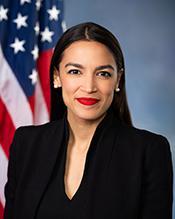
U.S. Representative for New York’s 14th district
Democrat
119th Congress, two-year term
Missed 2.7% of roll calls. Chamber median 1.9%.
The full voting recordCounts roll calls where most Democrats and most Republicans voted differently, leaving out procedural votes.
How we countFrom FEC filings, Voteview roll calls and Congress.gov.
Democrat. In Congress since 2019, 4 terms in total.
Following saves Ocasio-Cortez to your list, which Chamber & Street keeps on its server, linked to a cookie on this browser and not to your name or email. Email alerts will come with constituent verification.
Bills and resolutions Ocasio-Cortez signed on to as a cosponsor. An original cosponsor signed on the day the bill was introduced. Source: govinfo bill status files, last updated Nov 6, 2026.
Domestic Workers Bill of Rights Act
Sponsor Pramila Jayapal (D). Original cosponsor. 115 cosponsors. H.R. 3971 on Congress.gov
Introduced
Medical Research for Our Troops Act
Sponsor André Carson (D). Original cosponsor. 54 cosponsors. H.R. 3906 on Congress.gov(opens in a new tab)
Introduced
Enhanced Background Checks Act of 2025
Sponsor James Clyburn (D). Original cosponsor. 136 cosponsors. H.R. 3868 on Congress.gov(opens in a new tab)
Introduced
Enhanced Background Checks Act of 2025
This bill establishes more stringent background check requirements for proposed firearm transfers from a federal firearms licensee (e.g., a licensed gun dealer) to an unlicensed person.
Specifically, it increases the amount of time, from 3 business days to a minimum of 10 business days, that a federal firearms licensee must wait to receive a completed background check prior to transferring a firearm to an unlicensed person. (This type of transaction is often referred to as a default proceed transaction.)
If a submitted background check remains incomplete after 10 business days, then the prospective purchaser may submit a petition for a final firearms eligibility determination. If an additional 10 days elapse without a final determination, then the federal firearms licensee may transfer the firearm to the prospective purchaser.
The Government Accountability Office must report on the extent to which the changes have prevented firearms transfers to prohibited persons.
The Federal Bureau of Investigation must report on the number of petitions it receives for final federal firearms determinations.
The Department of Justice, in consultation with the National Resource Center on Domestic Violence and Firearms, must report on further amendments to the background check process that would likely reduce the risk of death or great bodily harm to victims of domestic violence, domestic abuse, dating partner violence, sexual assault, and stalking.
Bipartisan Background Checks Act of 2025
Sponsor Mike Thompson (D). Original cosponsor. 214 cosponsors. H.R. 18 on Congress.gov(opens in a new tab)
Introduced
Bipartisan Background Checks Act of 2025
This bill establishes new background check requirements for firearm transfers between private parties (i.e., unlicensed individuals).
Specifically, it prohibits a firearm transfer between private parties unless a licensed gun dealer, manufacturer, or importer first takes possession of the firearm to conduct a background check.
The prohibition does not apply to certain firearm transfers or exchanges, such as a gift between spouses.
Combating Deceptive Immigration Enforcement Practices Act of 2025
Sponsor Nydia Velázquez (D). Original cosponsor. 10 cosponsors. H.R. 3828 on Congress.gov(opens in a new tab)
Introduced
Workplace Violence Prevention for Health Care and Social Service Workers Act
Sponsor Joe Courtney (D). Joined Jun 6, 2025. 134 cosponsors. H.R. 2531 on Congress.gov(opens in a new tab)
Introduced
Workplace Violence Prevention for Health Care and Social Service Workers Act
This bill requires the Department of Labor to address workplace violence in health care, social service, and similar sectors.
Specifically, Labor must issue an occupational safety and health standard that requires certain employers to take actions to protect workers and other personnel from workplace violence. The standard applies to employers in the health care sector, in the social service sector, and in sectors that conduct activities similar to those in the health care and social service sectors. Among other elements, the standard must require each employer to (1) develop a workplace violence prevention plan, (2) promptly investigate incidents of workplace violence, and (3) provide relevant training and education to employees.
The bill requires certain hospitals and skilled nursing facilities to comply with this standard as a condition of Medicare participation.
Calling for the urgent delivery and disbursement of humanitarian aid to address the needs of civilians in Gaza.
Sponsor Pramila Jayapal (D). Original cosponsor. 125 cosponsors. H.Res. 473 on Congress.gov(opens in a new tab)
Introduced
This resolution expresses the House of Representatives' grave concern with (1) the humanitarian crisis and acute suffering of Palestinian civilians in Gaza, and (2) the suffering of the hostages and hostage families.
The resolution also calls on the White House, the Department of State, and other relevant federal agencies to use all available diplomatic tools to bring about the release of the hostages, the disbursement of food and humanitarian aid to Palestinian civilians, and a durable end to the Gaza conflict.
Menstrual Equity For All Act of 2025
Sponsor Grace Meng (D). Original cosponsor. 77 cosponsors. H.R. 3644 on Congress.gov(opens in a new tab)
Introduced
Menstrual Equity For All Act of 2025
This bill expands access to menstrual products (e.g., tampons) in certain locations and for particular groups, such as in schools and for low-income individuals, through federal programs and requirements. It also prohibits state or local sales taxes for these products.
The bill expands access to menstrual products through federal programs by
• requiring Medicaid to cover such products,
• establishing grants within the Temporary Assistance for Needy Families (TANF) program to provide benefits to ensure access to such products,
• authorizing the Emergency Food and Shelter Program to provide menstrual products to homeless individuals, and
• increasing Social Services Block Grant funding to provide such products to low-income individuals.
Also, the bill sets out requirements to make free menstrual products available in federal and state correctional facilities (including Department of Homeland Security detention facilities) and restrooms in federal buildings that are open to the public.
Further, the bill (1) establishes grants to provide free menstrual products to students at institutions of higher education, and (2) permits elementary and secondary schools to use certain grant funds to provide menstrual products to students.
In addition, the bill requires employers with at least 100 employees to provide free menstrual products for employees.
Finally, the bill prohibits states and local governments from taxing retail sales of menstrual products.
Andrew Kearse Accountability for Denial of Medical Care Act of 2025
Sponsor Ayanna Pressley (D). Original cosponsor. 10 cosponsors. H.R. 3603 on Congress.gov(opens in a new tab)
Introduced
Andrew Kearse Accountability for Denial of Medical Care Act of 2025
This bill establishes a new federal criminal offense for failing to obtain medical attention for an individual in federal custody who displays medical distress.
Specifically, the bill requires federal law enforcement officers and the Bureau of Prisons' personnel to provide or obtain immediate medical attention for an individual in federal custody who displays medical distress. It criminalizes the negligent failure to obtain or provide such medical attention that results in unnecessary pain, injury, or death.
A violator is subject to criminal penalties—a fine, a prison term of up to one year, or both.
Ending Qualified Immunity Act
Sponsor Ayanna Pressley (D). Original cosponsor. 18 cosponsors. H.R. 3602 on Congress.gov(opens in a new tab)
Introduced
To provide for a limitation on the transfer of defense articles and defense services to Israel.
Sponsor Delia Ramirez (D). Original cosponsor. 82 cosponsors. H.R. 3565 on Congress.gov(opens in a new tab)
Introduced
This bill prohibits the President from selling, transferring, or exporting certain defense articles or services to Israel, except in specified circumstances.
Defense articles covered by the prohibition include BLU-109 bunker busting bombs, Joint Direct Attack Munition (JDAM) assemblies, and 155mm artillery ammunition. Defense services directly related to such articles are also covered.
The President may sell, transfer, or export such defense articles or services to Israel if (1) a law is enacted specifying the purposes for which such articles or services may be used, and (2) Israel provides written assurances that the defense articles or services will be used for those specific statutory purposes and in a manner consistent with certain other laws, including international human rights laws.
Supreme Court Tenure Establishment and Retirement Modernization Act of 2025
Sponsor Henry Johnson (D). Original cosponsor. 91 cosponsors. H.R. 3544 on Congress.gov(opens in a new tab)
Introduced
College for All Act of 2025
Sponsor Pramila Jayapal (D). Original cosponsor. 78 cosponsors. H.R. 3543 on Congress.gov(opens in a new tab)
Introduced
College for All Act of 2025
This bill establishes measures to expand access to higher education, including by eliminating tuition and required fees for eligible students, revising the Federal Pell Grant program, and reauthorizing certain programs to assist students from disadvantaged backgrounds.
Specifically, the bill provides funding to enable states and tribal colleges and universities, through a federal-state partnership, to eliminate tuition and required fees for (1) all students at community colleges and two-year tribal colleges and universities, and (2) working- and middle-class students at four-year public institutions of higher education and tribal colleges and universities.
The bill provides funding to enable private, nonprofit historically Black colleges and universities and minority-serving institutions to eliminate tuition and required fees for eligible students.
The bill permanently reauthorizes and otherwise revises the Federal Pell Grant program by
• providing funding to increase the maximum award for each eligible student,
• increasing the duration limit for the use of Pell Grants,
• allowing students to use their awards to cover living and nontuition expenses, and
• expanding eligibility to Dreamer students (i.e., students who have been granted Deferred Action for Childhood Arrivals status and who entered the United States before the age of 16) and students with other immigration statuses.
Further, the bill requires the Department of Education to award grants to eligible states and tribal colleges and universities for improving student outcomes.
The bill reauthorizes through FY2035 the Federal TRIO Programs and reauthorizes through FY2029 the Gaining Early Awareness and Readiness for Undergraduate Programs.
Tyler’s Law
Sponsor Ted Lieu (D). Joined May 21, 2025. 65 cosponsors. H.R. 2004 on Congress.gov(opens in a new tab)
Passed the House
Tyler’s Law
This bill requires the Department of Health and Human Services (HHS) to complete, within one year after the bill’s enactment, a study on how frequently Medicare-participating hospital emergency departments test for fentanyl in patients experiencing an overdose, the costs associated with such testing, and how such testing may impact patients.
Within six months after the study’s completion and based on its results, HHS must issue guidance regarding (1) whether hospital emergency departments should implement fentanyl testing as a routine procedure for patients experiencing an overdose, (2) how to ensure clinicians know which substances they are testing for in routine drug tests, and (3) how fentanyl testing may affect the future risk of overdose and other health outcomes.
Stronger Communities through Better Transit Act
Sponsor Henry Johnson (D). Original cosponsor. 150 cosponsors. H.R. 3449 on Congress.gov(opens in a new tab)
Introduced
Stronger Communities through Better Transit Act
This bill requires the Department of Transportation (DOT) to establish a grant program to support operating projects for public transportation and related service improvements, particularly in underserved communities and areas of persistent poverty.
Specifically, the bill requires DOT to allocate funding under the program for urbanized areas, states, and Indian tribes that are recipients of funds under either the Federal Transit Administration's (FTA's) Urbanized Area Formula Funding program or Formula Grants for Rural Areas program. Eligible recipients may use funding for operating costs associated with projects that improve public transportation service for transit-dependent populations and support increased transit ridership (e.g., service expansion, information technology enhancements, and workforce development). DOT must apportion the funding so that recipients receive funds that are proportional to their share of operating costs.
The bill also provides for an increased federal cost share for operating assistance for projects or programs carried out in areas of persistent poverty or underserved communities.
DOT must set up a multimodal access measurement interface for public agencies to aid transit agencies in determining and reporting on access to jobs and essential services.
A grant recipient must (1) report specific information to the FTA for inclusion in the National Transit Database, and (2) survey transit riders and non-riding residents regarding transit service improvements.
Further, the bill expands the purposes of the public transportation programs to include supporting public transportation's role in combating climate change through growing/retaining transit ridership.
Recognizing the ongoing Nakba and Palestinian refugees' rights.
Sponsor Rashida Tlaib (D). Original cosponsor. 8 cosponsors. H.Res. 409 on Congress.gov(opens in a new tab)
Introduced
Nurse Staffing Standards for Hospital Patient Safety and Quality Care Act of 2025
Sponsor Janice Schakowsky (D). Original cosponsor. 49 cosponsors. H.R. 3415 on Congress.gov(opens in a new tab)
Introduced
Nurse Staffing Standards for Hospital Patient Safety and Quality Care Act of 2025
This bill requires hospitals to implement and submit to the Department of Health and Human Services (HHS) a staffing plan that complies with specified minimum nurse-to-patient ratios by unit. Hospitals must post a notice regarding nurse-to-patient ratios in each unit and maintain records of actual ratios for each shift in each unit. The bill also requires hospitals to follow certain procedures regarding how ratios are determined, and other staff are prohibited from performing nurse functions unless specifically authorized within a state's scope of practice rules.
HHS must adjust Medicare payments to hospitals to cover additional costs attributable to compliance with these ratios.
Nurses may object to, or refuse to participate in, an assignment if it would violate minimum ratios or if they are not prepared by education or experience to fulfill the assignment without compromising the safety of a patient or jeopardizing their nurse's license. Hospitals may not (1) take adverse actions against a nurse based on the nurse's reasonable refusal to accept an assignment; or (2) discriminate against individuals for good faith complaints relating to the care, services, or conditions of the hospital or related facilities. HHS may impose civil monetary penalties on hospitals violating the ratio requirements and must publish the names of such hospitals.
The bill provides stipends to the nurse workforce loan repayment and scholarship program and expands the nurse retention grant program to include nurse preceptorship and mentorship projects.
Water Affordability, Transparency, Equity, and Reliability Act of 2025
Sponsor Bonnie Watson Coleman (D). Original cosponsor. 90 cosponsors. H.R. 3376 on Congress.gov(opens in a new tab)
Introduced
Born in the USA Act of 2025
Sponsor Delia Ramirez (D). Original cosponsor. 140 cosponsors. H.R. 3368 on Congress.gov(opens in a new tab)
Introduced
Therapeutic Fraud Prevention Act of 2025
Sponsor Ted Lieu (D). Joined May 13, 2025. 204 cosponsors. H.R. 3243 on Congress.gov(opens in a new tab)
Introduced
VA Employee Fairness Act of 2025
Sponsor Mark Takano (D). Original cosponsor. 120 cosponsors. H.R. 3261 on Congress.gov(opens in a new tab)
Introduced
Disaster Relief for Farm Workers Act
Sponsor Andrea Salinas (D). Original cosponsor. 18 cosponsors. H.R. 3254 on Congress.gov(opens in a new tab)
Introduced
HABLA Act of 2025
Sponsor Pablo Hernández (D). Original cosponsor. 6 cosponsors. H.R. 3238 on Congress.gov(opens in a new tab)
Introduced
Closing the Bump Stock Loophole Act of 2025
Sponsor Dina Titus (D). Joined May 7, 2025. 152 cosponsors. H.R. 2799 on Congress.gov(opens in a new tab)
Introduced
Closing the Bump Stock Loophole Act of 2025
This bill generally prohibits the import, sale, manufacture, transfer, receipt, or possession of
• a device that is primarily designed, or redesigned, to increase the rate of fire when attached to a semiautomatic firearm;
• a device, part, or combination of parts that is designed and functions to increase the rate of fire of a firearm; or
• a semiautomatic firearm that has been modified to materially increase the rate of fire or to approximate the action or rate of fire of a machine gun.
Additionally, the bill adds to the list of firearms subject to regulation under the National Firearms Act semiautomatic firearms that have been modified to materially increase the rate of fire or approximate the action or rate of fire of a machine gun.
25th Anniversary of 9/11 Commemorative Coin Act
Sponsor Daniel Goldman (D). Joined May 7, 2025. 302 cosponsors. H.R. 1993 on Congress.gov(opens in a new tab)
Passed the House
25th Anniversary of 9/11 Commemorative Coin Act
This bill directs the Department of the Treasury to mint and issue coins to commemorate the 25th anniversary of the September 11, 2001, terrorist attacks on the United States and the establishment of the National September 11 Memorial and Museum at the World Trade Center.
The sale of all coins issued under this bill must include a surcharge to be paid to the National September 11 Memorial and Museum at the World Trade Center to support operations and maintenance. However, if the issuance of this commemorative coin exceeds certain annual limits, no surcharge may be included.