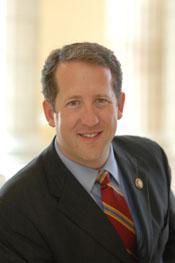
U.S. Representative for Nebraska’s 3rd district
Republican
119th Congress, two-year term
Missed 1.6% of roll calls. Chamber median 1.9%.
The full voting recordCounts roll calls where most Democrats and most Republicans voted differently, leaving out procedural votes.
How we countFrom FEC filings, Voteview roll calls and Congress.gov.
Republican. In Congress since 2007, 10 terms in total.
Following saves Smith to your list, which Chamber & Street keeps on its server, linked to a cookie on this browser and not to your name or email. Email alerts will come with constituent verification.
Bills and resolutions Smith signed on to as a cosponsor. An original cosponsor signed on the day the bill was introduced. Source: govinfo bill status files, last updated Nov 6, 2026.
Modernizing Rural Physician Assistant and Nurse Practitioner Utilization Act of 2025
Sponsor Tracey Mann (R). Original cosponsor. 26 cosponsors. H.R. 5199 on Congress.gov
Introduced
Rural Health Clinic Location Modernization Act of 2025
Sponsor Tracey Mann (R). Original cosponsor. 28 cosponsors. H.R. 5198 on Congress.gov(opens in a new tab)
Introduced
To amend the Internal Revenue Code of 1986 to modify the railroad track maintenance credit.
Sponsor Mike Kelly (R). Joined Sep 3, 2025. 183 cosponsors. H.R. 516 on Congress.gov(opens in a new tab)
Introduced
This bill increases the annual limit on the tax credit for qualified railroad track maintenance expenses (also referred to as the short line railroad tax credit) and expands eligibility for claiming the credit.
Under current law, the tax credit is limited each tax year to $3,500 multiplied by the sum of the number of miles of railroad track owned or leased by the taxpayer (miles owned or leased) and the number of railroad track miles assigned to the taxpayer by a Class II or III railroad (miles assigned). This bill increases the annual limit to $6,100 multiplied by the sum of miles owned or leased and miles assigned. The $6,100 amount used in the calculation of the tax credit limit is adjusted for inflation for tax years beginning after 2025.
The bill also expands eligibility for the tax credit to include gross expenses for maintaining railroad tracks owned or leased as of January 1, 2024. Under current law, the tax credit is limited to gross expenses for maintaining railroad tracks owned or leased as of January 1, 2015.
Veteran Burial Timeliness and Death Certificate Accountability Act
Sponsor Tom Emmer (R). Joined Sep 3, 2025. 158 cosponsors. H.R. 4398 on Congress.gov(opens in a new tab)
Introduced
Reducing Regulatory Burdens Act of 2025
Sponsor David Rouzer (R). Joined Sep 3, 2025. 9 cosponsors. H.R. 3824 on Congress.gov(opens in a new tab)
Introduced
Protection of Women in Olympic and Amateur Sports Act of 2026
Sponsor W. Steube (R). Joined Sep 3, 2025. 73 cosponsors. H.R. 1028 on Congress.gov(opens in a new tab)
Introduced
Protection of Women in Olympic and Amateur Sports Act
This bill requires certified national governing bodies (NGBs) of amateur sports (e.g., USA Gymnastics) to prohibit a person whose sex is male from participating in an amateur athletic competition that is designated for females, women, or girls.
Under the bill, male means an individual who has, had, will have—or would have, but for a developmental or genetic anomaly or historical accident—the reproductive system that at some point produces, transports, and utilizes sperm for fertilization.
American Protein Processing Modernization Act
Sponsor Brad Finstad (R). Original cosponsor. 7 cosponsors. H.R. 5038 on Congress.gov(opens in a new tab)
Introduced
DETECT Act of 2025
Sponsor Vern Buchanan (R). Joined Aug 26, 2025. 7 cosponsors. H.R. 4974 on Congress.gov(opens in a new tab)
Introduced
Digital Evaluation for Tax Enforcement and Compliance Tracking Act of 2025 or the DETECT Act of 2025
This bill directs the Government Accountability Office to submit a report to Congress within 180 days from the date of enactment on the potential of artificial intelligence to assist the Internal Revenue Service in detecting tax fraud.
Expressing support for the Japanese Diet's Caucus for Universal Values in the Indo-Pacific and for continued United States-Japan interparliamentary collaboration to advance democracy in the region.
Sponsor Joaquin Castro (D). Original cosponsor. 3 cosponsors. H.Res. 653 on Congress.gov(opens in a new tab)
Introduced
Data BRIDGE Act
Sponsor Erin Houchin (R). Original cosponsor. 15 cosponsors. H.R. 4950 on Congress.gov(opens in a new tab)
Passed committee
Data Broadband Reporting and Integration for Deployment in Geographically Essential Areas Act or the Data BRIDGE Act
This bill requires the Federal Communications Commission (FCC) to update the National Broadband Map to include data on the location of agricultural areas as a layer of the map and to maintain this data in the map moving forward. (The map depicts the availability of broadband internet service across the United States.)
In incorporating this data, the FCC must consult with (1) the Department of Agriculture, including with respect to existing data on the location of agricultural areas; and (2) with the National Telecommunications and Information Administration, states, and other relevant stakeholders.
Recognizing the 20th anniversary of the Renewable Fuel Standard and its foundational role in strengthening United States energy security, supporting rural communities, growing the United States economy, and improving environmental performance.
Sponsor Max Miller (R). Original cosponsor. 9 cosponsors. H.Res. 628 on Congress.gov(opens in a new tab)
Introduced
Save Our Bacon Act
Sponsor Ashley Hinson (R). Original cosponsor. 25 cosponsors. H.R. 4673 on Congress.gov(opens in a new tab)
Introduced
Save Our Bacon Act
This bill prohibits a state or local government from enacting or enforcing a condition or standard on livestock production for livestock physically raised in another state or locality.
Further, the bill prohibits a state or local government from enacting or enforcing a condition for sale or consumption that requires an out-of-state livestock producer to meet any of the state or local government’s conditions or standards of production that are in addition to, or different from, those in the state of production.
Under the bill, production means the raising (including breeding) of a domestic animal for the purpose of (1) slaughter for human consumption, or (2) producing products manufactured for human consumption which are derived from milk processing (e.g., fluid milk). The bill excludes domestic animals raised for the primary purpose of egg production.
320th Barrage Balloon Battalion Gold Medal Act
Sponsor Marc Veasey (D). Original cosponsor. 14 cosponsors. H.R. 4621 on Congress.gov(opens in a new tab)
Introduced
Seasonal Agriculture CDL Modernization Act
Sponsor Tracey Mann (R). Original cosponsor. 22 cosponsors. H.R. 4601 on Congress.gov(opens in a new tab)
Introduced
Clergy Act
Sponsor Vince Fong (R). Joined Jul 21, 2025. 21 cosponsors. H.R. 227 on Congress.gov(opens in a new tab)
Became law
Clergy Act
This act establishes a two-year window for members of the clergy who have opted out of Social Security and Medicare taxes (and are thus ineligible for benefits under those programs) to opt back in.
Under current law, certain ministers, members of religious orders, and Christian Science practitioners who object to participation in public insurance programs on religious or conscientious grounds may apply to the Internal Revenue Service (IRS) for an exemption from Social Security and Medicare taxes on ministerial earnings. Individuals who are approved for the exemption do not receive Social Security or Medicare benefits in retirement unless they have qualifying credits from other employment. The exemption is irrevocable.
Under the act, clergy members may choose to revoke their exemption by filing an application with the IRS by the due date of their federal income tax return for the second taxable year after December 31, 2028 (i.e., April 15, 2031, unless an individual obtains an extension to file their taxes). A clergy member may choose for the revocation to take effect in taxable year 2029 or taxable year 2030. A revocation under the act is permanent.
Clergy members who opt back in will generally need 10 years of covered employment (40 credits) to be eligible for Social Security and Medicare benefits, as is currently required for these programs.
The IRS must develop a plan to inform clergy members of their eligibility to revoke prior exemptions, pursuant to the act's changes.
Promotion and Expansion of Private Employee Ownership Act of 2025
Sponsor Mike Kelly (R). Joined Jul 15, 2025. 68 cosponsors. H.R. 3105 on Congress.gov(opens in a new tab)
Introduced
Expressing support for the designation of June 2025 as "National Dairy Month" to recognize the critical role dairy plays in maintaining a healthy diet and preserving our Nation's agricultural economy.
Sponsor Claudia Tenney (R). Joined Jun 24, 2025. 13 cosponsors. H.Res. 527 on Congress.gov(opens in a new tab)
Introduced
This resolution supports the designation of National Dairy Month.
Renewable Fuel for Ocean-Going Vessels Act
Sponsor Mariannette Miller-Meeks (R). Joined Jun 24, 2025. 23 cosponsors. H.R. 1896 on Congress.gov(opens in a new tab)
Introduced
Visa Overstays Penalties Act
Sponsor Nathaniel Moran (R). Joined Jun 17, 2025. 13 cosponsors. H.R. 3781 on Congress.gov(opens in a new tab)
Introduced
Designation of English as the Official Language of the United States Act of 2025
Sponsor Robert Aderholt (R). Joined Jun 10, 2025. 21 cosponsors. H.R. 1772 on Congress.gov(opens in a new tab)
Introduced
Designation of English as the Official Language of the United States Act of 2025
This bill establishes English as the official language of the United States.
The bill specifies that the official functions of government in the United States, including in each state and the District of Columbia, shall be conducted in English. Exceptions to this requirement include (1) actions or documents to protect the public health or safety, (2) actions or documents that protect the rights of victims of crimes or criminal defendants, and (3) requirements under the Individuals with Disabilities Education Act.
The bill also establishes a framework for implementation and enforcement, including by testing English language ability as part of the naturalization process.
EASE Act of 2025
Sponsor Jodey Arrington (R). Joined Jun 9, 2025. 22 cosponsors. H.R. 2533 on Congress.gov(opens in a new tab)
Introduced
Ensuring Access to Specialty care Everywhere Act of 2025 or the EASE Act of 2025
This bill requires the Center for Medicare and Medicaid Innovation (CMMI) to test a model that uses a network of providers to remotely furnish specialty health care to Medicare, Medicaid, and Children's Health Insurance Program (CHIP) beneficiaries in rural areas.
To conduct the model, the CMMI must select at least one provider network that is a nonprofit entity and that consists of at least 50 federally qualified health centers, rural health clinics, critical access hospitals, or rural emergency hospitals. At least half of the providers in the network must be located in rural areas. Providers must use digital methods (e.g., telehealth technology) to provide specialty care and must coordinate with beneficiaries' primary care providers.
Protecting Access to Ground Ambulance Medical Services Act of 2025
Sponsor Claudia Tenney (R). Joined Jun 9, 2025. 54 cosponsors. H.R. 2232 on Congress.gov(opens in a new tab)
Introduced
Protecting Access to Ground Ambulance Medical Services Act of 2025
This bill extends the specialized rate increase for Medicare payment of ground ambulance services in rural areas for an additional three years (until January 1, 2028).
Improving Seniors’ Timely Access to Care Act of 2025
Sponsor Mike Kelly (R). Joined Jun 4, 2025. 308 cosponsors. H.R. 3514 on Congress.gov(opens in a new tab)
Passed committee
Improving Seniors' Timely Access to Care Act of 2025
This bill establishes several requirements and standards relating to prior authorization processes under Medicare Advantage (MA) plans.
Specifically, MA plans must (1) establish an electronic prior authorization program that meets specified standards; (2) annually submit to the CMS for publication specified prior authorization information, including the percentage of requests approved and the average response time; and (3) meet other standards, as set by the Centers for Medicare & Medicaid Services (CMS), relating to the quality and timeliness of prior authorization determinations.
The CMS and the Office of the National Coordinator for Health Information Technology must publish on the CMS' website a report that analyzes the information received from MA plans, the feasibility of implementing real-time decision making with respect to prior authorization requests, and the impact of decisions that are made using artificial intelligence on patient access.
Crime Victims Fund Stabilization Act of 2025
Sponsor Ann Wagner (R). Joined Jun 3, 2025. 327 cosponsors. H.R. 909 on Congress.gov(opens in a new tab)
Passed the House
Crime Victims Fund Stabilization Act of 2025
This bill adds a new source of revenue for the Crime Victims Fund (CVF). Specifically, the bill requires certain civil monetary penalties collected from settlements and judgments in cases involving fraud and false claims against the federal government to be deposited into the CVF through FY2029.
The CVF supports federal, state, and local programs and activities to compensate and assist victims of crimes. Currently, the CVF is funded by deposits from a variety of sources, including federal criminal fines, penalties, and assessments; forfeited bail bonds; and certain other gifts, donations, and bequests.
Sanctioning Russia Act of 2025
Sponsor Brian Fitzpatrick (R). Joined Jun 3, 2025. 155 cosponsors. H.R. 2548 on Congress.gov(opens in a new tab)
Introduced
Sanctioning Russia Act of 2025
This bill imposes penalties on certain persons (individuals and entities) if the President determines that the Russian government or a person acting at Russia's direction is involved with (1) refusing to negotiate a peace agreement with Ukraine; (2) violating a negotiated peace agreement; (3) initiating another invasion of Ukraine; or (4) overthrowing, dismantling, or seeking to subvert the Ukrainian government.
If the President makes such a determination, the bill requires certain actions including
• the President must impose visa- and property-blocking sanctions on specified persons such as the Russian president, certain Russian military commanders, and any foreign person that knowingly provides defense items to the Russian armed forces;
• the President must increase the rate of duty on all goods and services imported from Russia into the United States to at least 500% relative to the value of such goods and services;
• the President must increase the rate of duty on all goods and services imported into the United States from countries that knowingly engage in the exchange of Russian-origin uranium and petroleum products to at least 500% relative to the value of such goods and services;
• the Department of the Treasury must impose property-blocking sanctions on any financial institution organized under Russian law and owned wholly or partly by Russia, and any financial institution that engages in transactions with those entities; and
• the Department of Commerce must prohibit the export, reexport, or in-country transfer to or in Russia of any U.S.-produced energy or energy product.