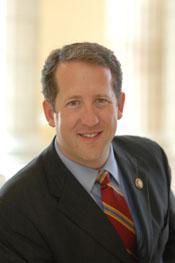
U.S. Representative for Nebraska’s 3rd district
Republican
119th Congress, two-year term
Missed 1.6% of roll calls. Chamber median 1.9%.
The full voting recordCounts roll calls where most Democrats and most Republicans voted differently, leaving out procedural votes.
How we countFrom FEC filings, Voteview roll calls and Congress.gov.
Republican. In Congress since 2007, 10 terms in total.
Following saves Smith to your list, which Chamber & Street keeps on its server, linked to a cookie on this browser and not to your name or email. Email alerts will come with constituent verification.
Bills and resolutions Smith signed on to as a cosponsor. An original cosponsor signed on the day the bill was introduced. Source: govinfo bill status files, last updated Nov 6, 2026.
FIND Act
Sponsor Jack Bergman (R). Joined Jan 7, 2025. 154 cosponsors. H.R. 45 on Congress.gov
Introduced
Firearm Industry Non-Discrimination Act or the FIND Act
This bill prohibits the federal government from entering into contracts with an entity that discriminates against firearm trade associations or businesses that deal in firearms, ammunition, or related products.
Specifically, the bill requires a federal agency to include in each contract for the procurement of goods or services awarded by the agency a clause requiring the prime contractor to certify that it (1) has no policy, practice, guidance, or directive that discriminates against a firearm entity or firearm trade association; and (2) will not adopt a policy, practice, guidance, or directive that discriminates against a firearm entity or firearm trade association during the term of the contract.
The bill establishes (1) a similar requirement with respect to subcontracts, and (2) penalties for violations.
The bill makes such prohibition inapplicable to a contract for the procurement of goods or services that is a sole-source contract.
Born-Alive Abortion Survivors Protection Act
Sponsor Ann Wagner (R). Joined Jan 7, 2025. 163 cosponsors. H.R. 21 on Congress.gov(opens in a new tab)
Passed the House
Born-Alive Abortion Survivors Protection Act
This bill establishes requirements for the degree of care a health care practitioner must provide in the case of a child born alive following an abortion or attempted abortion.
Specifically, a health care practitioner who is present must (1) exercise the same degree of care as would reasonably be provided to any other child born alive at the same gestational age, and (2) ensure the child is immediately admitted to a hospital. Additionally, a health care practitioner or other employee who has knowledge of a failure to comply with the degree-of-care requirements must immediately report such failure to law enforcement.
A health care practitioner who fails to provide the required degree of care, or a health care practitioner or other employee who fails to report such failure, is subject to criminal penalties—a fine, up to five years in prison, or both.
An individual who intentionally kills or attempts to kill a child born alive is subject to prosecution for murder.
The bill bars the criminal prosecution of a mother of a child born alive under this bill and allows her to bring a civil action against a health care practitioner or other employee for violations.
To amend the Internal Revenue Code of 1986 to provide special rules for the taxation of certain residents of Taiwan with income from sources within the United States.
Sponsor Jason Smith (R). Joined Jan 6, 2025. 46 cosponsors. H.R. 33 on Congress.gov(opens in a new tab)
Passed the House
Regulations from the Executive in Need of Scrutiny Act of 2025
Sponsor Kat Cammack (R). Original cosponsor. 93 cosponsors. H.R. 142 on Congress.gov(opens in a new tab)
Introduced
Regulations from the Executive in Need of Scrutiny Act of 2025
This bill revises provisions relating to congressional review of agency rulemaking.
Specifically, the bill establishes a congressional approval process for a major rule. A major rule may only take effect if Congress approves of the rule. A major rule is a rule that has resulted in or is likely to result in (1) an annual effect on the economy of $100 million or more; (2) a major increase in costs or prices for consumers, individual industries, government agencies, or geographic regions; or (3) significant adverse effects on competition, employment, investment, productivity, innovation, or the ability of U.S.-based enterprises to compete with foreign-based enterprises.
The bill generally preserves the current congressional review process for a nonmajor rule.
TCJA Permanency Act
Sponsor Vern Buchanan (R). Original cosponsor. 53 cosponsors. H.R. 137 on Congress.gov(opens in a new tab)
Introduced
TCJA Permanency Act
This bill makes permanent multiple federal tax provisions enacted in 2017 by the Tax Cuts and Jobs Act.
The bill makes permanent the
• individual tax rates of 10%, 12%, 22%, 24%, 32%, 35%, and 37%;
• increased standard deduction;
• personal exemption allowance repeal;
• exclusion from income of student loans discharged due to death or disability;
• qualified business income tax deduction (199A tax deduction);
• allowance of ABLE account contributions in excess of the annual gift tax exclusion amount;
• base estate and gift tax exclusion amount of $10 million (adjusted annually); and
• alternative minimum tax exemption and phaseout amounts for noncorporate taxpayers.
The bill makes permanent the child tax credit amounts of $2,000 per child and $500 for dependents, the $200,000 phaseout threshold ($400,000 for joint filers), and the refundable portion of the tax credit.
The bill expands the expenses eligible for tax-free withdrawals from qualified tuition plans (529 plans) to include additional expenses associated with homeschool and elementary and secondary schools (e.g., instructional materials, tutoring, test and enrollment fees, and educational therapies).
The bill permanently eliminates certain miscellaneous itemized deductions and makes permanent the
• state and local tax deduction limit of $10,000 ($5,000 for married individuals filing separately),
• mortgage interest tax deduction limit of $750,000 ($375,000 for married individuals filing separately),
• limit on the deduction of cash charitable contributions to 60% of a taxpayer’s adjusted gross income, and
• certain limits on casualty loss tax deductions.
The bill also permanently eliminates the exclusion from income for employer-reimbursed bicycle commuting expenses.