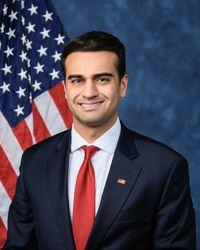
U.S. Representative for Arizona’s 8th district
Republican
119th Congress, two-year term
Missed 1.0% of roll calls. Chamber median 1.9%.
The full voting recordCounts roll calls where most Democrats and most Republicans voted differently, leaving out procedural votes.
How we countFrom FEC filings, Voteview roll calls and Congress.gov.
Republican. In Congress since 2025, 1 term in total.
Following saves Hamadeh to your list, which Chamber & Street keeps on its server, linked to a cookie on this browser and not to your name or email. Email alerts will come with constituent verification.
Bills and resolutions Hamadeh signed on to as a cosponsor. An original cosponsor signed on the day the bill was introduced. Source: govinfo bill status files, last updated Nov 6, 2026.
Hamadeh also withdrew as a cosponsor from 1 bill, not listed here.
LEDGER Act
Sponsor Mike Haridopolos (R). Original cosponsor. 60 cosponsors. H.R. 4091 on Congress.gov
Introduced
Locating Every Disbursement in Government Expenditure Records Act or the LEDGER Act
This bill requires the Department of the Treasury to implement a system that tracks all outlays from each appropriation, receipt, or other fund account in the Treasury by each department, agency, office, or other establishment in the executive, legislative, or judicial branches of the federal government. The system must also track the period of availability of the amounts in the applicable appropriation, receipt, or other fund account.
CLOUD Aircraft Act
Sponsor Cory Mills (R). Joined Jun 24, 2025. 5 cosponsors. H.R. 3848 on Congress.gov(opens in a new tab)
Introduced
COUNTER Act
Sponsor August Pfluger (R). Joined Jun 23, 2025. 40 cosponsors. H.R. 3463 on Congress.gov(opens in a new tab)
Introduced
STATES Act
Sponsor Richard McCormick (R). Original cosponsor. 3 cosponsors. H.R. 4042 on Congress.gov(opens in a new tab)
Introduced
SAFE Cities Act
Sponsor Tony Wied (R). Joined Jun 13, 2025. 17 cosponsors. H.R. 3894 on Congress.gov(opens in a new tab)
Introduced
Expressing the sense of the House of Representatives that Social Security should be preserved and protected for current beneficiaries, and for future generations to come.
Sponsor Claudia Tenney (R). Original cosponsor. 9 cosponsors. H.Res. 506 on Congress.gov(opens in a new tab)
Introduced
Condemning the antisemitic terrorist attack in Boulder, Colorado.
Sponsor Randy Fine (R). Joined Jun 11, 2025. 30 cosponsors. H.Res. 472 on Congress.gov(opens in a new tab)
Introduced
Safe Prescribing Through Reporting Act of 2025
Sponsor Mike Kennedy (R). Joined Jun 10, 2025. 7 cosponsors. H.R. 3595 on Congress.gov(opens in a new tab)
Introduced
To modernize Federal firearms laws to account for advancements in technology and less-than-lethal weapons, and for other purposes.
Sponsor Scott Fitzgerald (R). Joined Jun 10, 2025. 95 cosponsors. H.R. 2189 on Congress.gov(opens in a new tab)
Passed the House
Law-Enforcement Innovate to De-Escalate Act
This bill removes less-than-lethal projectile devices (e.g., certain TASERs) from regulation under the Gun Control Act.
The term less-than-lethal projectile device means a device that (1) is not designed or intended to expel (and may not be readily converted to discharge) commonly used ammunition or projectiles exceeding a velocity of 500 feet per second; (2) is designed and intended to be used in a manner not likely to cause death or serious bodily injury; and (3) does not accept (and cannot be readily modified to accept) an ammunition feeding device.
The bill also requires the Bureau of Alcohol, Tobacco, Firearms and Explosives to determine whether a device satisfies the definition of a less-than-lethal projectile device within 90 days of a request.
Safe Passage on Interstates Act of 2025
Sponsor Mike Collins (R). Joined Jun 10, 2025. 19 cosponsors. H.R. 1057 on Congress.gov(opens in a new tab)
Introduced
Safe Passage on Interstates Act of 2025
This bill establishes a new federal criminal offense for the obstruction of interstate highways.
Specifically, the bill makes it unlawful to knowingly engage in a listed activity with the intent to obstruct the free, convenient, and normal use of the interstate highway. The listed activities are (1) deliberately delaying traffic, (2) standing or approaching a motor vehicle, or (3) endangering the safe movement of a motor vehicle.
A violation is subject to criminal penalties.
The bill provides an exception for any lawful activity conducted or authorized by the federal government or by a state or local government.
Condemning the rise in ideologically motivated attacks on Jewish individuals in the United States, including the recent violent assault in Boulder, Colorado, and reaffirming the House of Representatives commitment to combating antisemitism and politically motivated violence.
Sponsor Jefferson Van Drew (R). Original cosponsor. 70 cosponsors. H.Res. 481 on Congress.gov(opens in a new tab)
Passed the House
This resolution condemns the June 1, 2025, targeted act of terror in Boulder, Colorado, as an act of ideologically motivated violence and reaffirms the House of Representatives' commitment to protecting the rights of all Americans to assemble peacefully and practice their faith without fear of violence.
Border Operations Service Medal Act
Sponsor Tim Moore (R). Original cosponsor. 14 cosponsors. H.R. 3780 on Congress.gov(opens in a new tab)
Introduced
Preventing the Abuse of Immigration Parole Act
Sponsor Addison McDowell (R). Original cosponsor. 27 cosponsors. H.R. 3725 on Congress.gov(opens in a new tab)
Introduced
Preventing the Abuse of Immigration Parole Act
This bill places limits on the authority of the Department of Homeland Security (DHS) to parole individuals into the United States.
Currently, DHS is allowed to parole non-U.S. nationals (aliens under federal law) temporarily into the United States on public benefit or urgent humanitarian grounds.
Under the bill, the total number of parolees allowed annually is capped at 3,000. Additionally, parole may not be granted to nationals of China, Russia, Iran, North Korea, Cuba, or Syria without a waiver from the Department of State. The bill also eliminates DHS’s authority to parole refugees into the United States on separate public interest grounds.
Restoring American Freedom Act
Sponsor Bill Huizenga (R). Original cosponsor. 10 cosponsors. H.R. 3719 on Congress.gov(opens in a new tab)
Introduced
Fallen Servicemembers Religious Heritage Restoration Act
Sponsor Debbie Wasserman Schultz (D). Joined Jun 2, 2025. 41 cosponsors. H.R. 2701 on Congress.gov(opens in a new tab)
Passed the House
Fallen Servicemembers Religious Heritage Restoration Act
This bill requires the American Battle Monuments Commission (ABMC) to establish the Fallen Servicemembers Religious Heritage Restoration Program to identify deceased members of the Armed Forces who were Jewish and buried in a U.S. military cemetery located outside of the United States under a marker indicating the member was not Jewish. The program must contact survivors and descendants of such members.
The ABMC must seek to enter into a contract with a nonprofit organization to carry out the program during the first 10 fiscal years beginning after the date of enactment of the bill.
Patriots Over Politics Act
Sponsor Tom Barrett (R). Original cosponsor. 23 cosponsors. H.R. 3619 on Congress.gov(opens in a new tab)
Introduced
Condemning antisemitism and remembering Yaron Lischinsky and Sarah Milgrim.
Sponsor Addison McDowell (R). Original cosponsor. 72 cosponsors. H.Res. 447 on Congress.gov(opens in a new tab)
Introduced
Calling upon all Americans on this Memorial Day, 2025, to honor the men and women of the Armed Forces who have died in the pursuit of freedom and peace.
Sponsor Michael Guest (R). Original cosponsor. 43 cosponsors. H.Res. 444 on Congress.gov(opens in a new tab)
Introduced
SAGA Act
Sponsor Claudia Tenney (R). Joined May 19, 2025. 4 cosponsors. H.R. 373 on Congress.gov(opens in a new tab)
Introduced
Second Amendment Guarantee Act or the SAGA Act
This bill prohibits a state or local government from establishing a regulation, prohibition, or registration or licensing requirement with respect to a rifle or shotgun that is more restrictive (or that imposes a greater penalty or tax) than federal law.
Freedom of Association in Higher Education Act of 2026
Sponsor Erin Houchin (R). Joined May 19, 2025. 43 cosponsors. H.R. 2555 on Congress.gov(opens in a new tab)
Introduced
Freedom of Association in Higher Education Act of 2025
This bill establishes freedom of association protections for college students in single-sex social organizations.
Specifically, the bill gives students (or groups of students) enrolled at institutions of higher education (IHEs) the right to form or join social organizations, including single-sex social organizations.
Additionally, the bill prohibits IHEs that participate in federal student aid programs from
• taking adverse actions against single-sex social organizations or students who are members or prospective members of such organizations based solely on the practice of limiting membership to only individuals of one sex;
• taking actions that require or coerce members or prospective members of such organizations to waive protections provided under the bill, including as a condition of enrolling in the IHE; or
• imposing a recruitment restriction on a single-sex social organization that is not imposed upon other student organizations, unless the organization and IHE have entered into a written agreement allowing the restriction.
Freedom to Invest in Tomorrow’s Workforce Act
Sponsor Robert Wittman (R). Joined May 19, 2025. 203 cosponsors. H.R. 1151 on Congress.gov(opens in a new tab)
Introduced
Freedom to Invest in Tomorrow’s Workforce Act
This bill expands the expenses eligible for tax-free withdrawals from a qualified tuition program (known as a 529 plan) to include tuition, fees (including test fees), books, supplies, equipment, and other expenses related to the enrollment or attendance in a recognized postsecondary credentialing program.
Under the bill, a recognized postsecondary credentialing program includes certain programs identified by a state as providing training services, a program listed in the Web Enabled Approval Management System (WEAMS) maintained by the Department of Veterans Affairs, certain examinations required to obtain or maintain a credential, and other reputable credentialing programs.
Further, under the bill, such programs must be designed for an individual to obtain
• an industry-recognized postsecondary employment credential (e.g., project management professional certificate, advanced emergency medical technician certificate, and welding supervisor certificate),
• a certificate of completion of a registered and certified apprenticeship,
• an occupational or professional license issued or recognized by a state or the federal government (and any certification required for obtaining such license), or
• an associate or baccalaureate degree.
PLCAA Federal Jurisdiction Act
Sponsor Harriet Hageman (R). Joined May 19, 2025. 4 cosponsors. H.R. 1068 on Congress.gov(opens in a new tab)
Introduced
No User Fees for Gun Owners Act
Sponsor Ronny Jackson (R). Joined May 15, 2025. 51 cosponsors. H.R. 943 on Congress.gov(opens in a new tab)
Introduced
No User Fees for Gun Owners Act
This bill prohibits a state or local government from imposing any insurance requirement, tax, user fee, or similar charge on the manufacture, import, acquisition, transfer, or continued ownership of a firearm or ammunition. The bill includes an exception for a generally applicable sales tax that is assessed against firearms or ammunition in the same proportion to which the tax applies to other goods or services.
RIFLE Act of 2025
Sponsor Tracey Mann (R). Joined May 15, 2025. 34 cosponsors. H.R. 624 on Congress.gov(opens in a new tab)
Introduced
Reining In Federal Licensing Enforcement Act of 2025 or the RIFLE Act of 2025
This bill revises the federal statutory framework governing the licensing, inspection, and enforcement of federally licensed dealers, importers, and manufacturers of firearms (i.e., federal firearms licensees, or FFLs) by the Bureau of Alcohol, Tobacco, Firearms and Explosives (ATF).
With respect to an application for a license, this bill requires the ATF to make a preliminary determination, provide notice of a proposed denial, and allow the applicant to request a hearing.
With respect to inspections, this bill requires the ATF to establish standards for how it inspects, examines, or investigates FFLs for possible violations.
With respect to the enforcement of violations, this bill establishes a new framework. The new framework establishes a presumption that a violation by an FFL is not willful and requires the ATF to provide notice of and work with an FFL to rectify a violation.
In the case of a violation that is willful, the ATF has the burden of proving by clear and convincing evidence that the violation was committed willfully. The term willfully means that the person had actual knowledge of a legal duty, understood the obligation imposed by the legal duty, and deliberately disregarded the legal duty. The ATF may pursue revocation of an FFL’s license, but only after (1) providing notice and an opportunity to comply; and (2) finding that a lesser administrative action (e.g., warning, warning letter, or warning conference) is not likely to lead to future compliance.
ATF Transparency Act
Sponsor Russ Fulcher (R). Joined May 15, 2025. 1 cosponsor. H.R. 613 on Congress.gov(opens in a new tab)
Introduced
ATF Transparency Act
This bill modifies procedural requirements related to the transfer or making of firearms that are subject to regulation under the National Firearms Act (e.g., machine guns, short-barreled shotguns, and silencers).
The bill permits the transfer of a firearm if 90 days have elapsed since the application to transfer the firearm was filed, and the application has not been denied. Additionally, the bill establishes an administrative relief process with respect to an application to transfer that is denied.
The bill permits the making of a firearm if 90 days have elapsed since the application to make the firearm was filed, and the application has not been denied.
Finally, the bill requires reports on firearms-related background check inquiries that remain unresolved after 90 days and the percentage of firearms-related background check inquiries related to the transfer of a firearm that were administered by the Federal Bureau of Investigation.