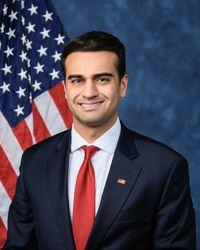
U.S. Representative for Arizona’s 8th district
Republican
119th Congress, two-year term
Missed 1.0% of roll calls. Chamber median 1.9%.
The full voting recordCounts roll calls where most Democrats and most Republicans voted differently, leaving out procedural votes.
How we countFrom FEC filings, Voteview roll calls and Congress.gov.
Republican. In Congress since 2025, 1 term in total.
Following saves Hamadeh to your list, which Chamber & Street keeps on its server, linked to a cookie on this browser and not to your name or email. Email alerts will come with constituent verification.
Bills and resolutions Hamadeh signed on to as a cosponsor. An original cosponsor signed on the day the bill was introduced. Source: govinfo bill status files, last updated Nov 6, 2026.
Hamadeh also withdrew as a cosponsor from 1 bill, not listed here.
A resolution solemnly marking the one-year anniversary of the attempted assassination of President Donald J. Trump, condemning the multiple attempts against the President's life, condemning those who incite violence against political officials, and honoring the victims of the shooting.
Sponsor Mike Kelly (R). Original cosponsor. 54 cosponsors.
Introduced
Defending Veterans’ Second Amendment Rights Act
Sponsor Chip Roy (R). Joined Jul 10, 2025. 1 cosponsor. H.R. 962 on Congress.gov(opens in a new tab)
Introduced
Defending Veterans' Second Amendment Rights Act
This bill prohibits the Department of Veterans Affairs from transmitting personally identifiable information of veterans or their beneficiaries to the national instant criminal background check system utilized by licensed importers or dealers of firearms solely on the basis that a veteran has a service-connected disability.
No Retaining Every Gun In a System That Restricts Your Rights Act
Sponsor Michael Cloud (R). Joined Jul 10, 2025. 74 cosponsors. H.R. 563 on Congress.gov(opens in a new tab)
Introduced
No Retaining Every Gun In a System That Restricts Your Rights Act
This bill modifies the retention requirements for firearm transaction records of federal firearms licensees (FFLs) that go out of business.
Current law generally requires FFLs that go out of business to deliver their firearm transaction records to the Bureau of Alcohol, Tobacco, Firearms and Explosives (ATF).
This bill removes the requirement for FFLs that go out of business to deliver their firearm transaction records to the ATF. Further, the bill requires the ATF to destroy all out-of-business records it has collected from FFLs.
Abraham Accords Defense Against Terror Act
Sponsor Michael Lawler (R). Original cosponsor. 35 cosponsors. H.R. 4335 on Congress.gov(opens in a new tab)
Passed committee
Firearm Due Process Protection Act of 2025
Sponsor Tom Emmer (R). Joined Jul 10, 2025. 24 cosponsors. H.R. 2184 on Congress.gov(opens in a new tab)
Introduced
Firearm Due Process Protection Act of 2025
This bill expands the grounds for pursuing judicial remedies related to the denial of certain firearm transfers. Additionally, the bill establishes procedural rules applicable to actions for judicial remedies.
Current law authorizes judicial remedies for an individual who is erroneously denied a firearm (e.g., an individual is denied a firearm but the individual is eligible to receive or possess a firearm). This bill authorizes remedies for an individual who experiences an extended delay (i.e., a delay of more than 60 days) on a firearm transfer.
Additionally, the bill requires an expedited hearing on an action for judicial remedies and places the burden of proof on the respondent (i.e., the government) to show that the individual was ineligible to receive or possess a firearm.
Protect Our Military Families’ 2nd Amendment Rights Act
Sponsor Gregory Murphy (R). Joined Jul 10, 2025. 3 cosponsors. H.R. 2070 on Congress.gov(opens in a new tab)
Introduced
Protect Our Military Families' 2nd Amendment Rights Act
This bill broadens the scope of allowable firearms transactions involving active-duty service members and their spouses.
Specifically, the bill allows a licensed gun dealer, importer, or manufacturer to sell or ship a firearm or ammunition to the spouse of a member of the Armed Forces on active duty outside the United States. Current law already allows a licensed dealer, importer, or manufacturer to sell or ship a firearm or ammunition to a member of the Armed Forces on active duty outside the United States.
The bill also specifies that, for purposes of federal firearms laws, a member of the Armed Forces on active duty, or his or her spouse, is a resident of the state in which (1) the member or spouse maintains legal residence, (2) the permanent duty station of the member is located, and (3) the member maintains a home from which he or she commutes to the permanent duty station.
Traveler’s Gun Rights Act
Sponsor Dusty Johnson (R). Joined Jul 10, 2025. 6 cosponsors. H.R. 2060 on Congress.gov(opens in a new tab)
Introduced
Traveler's Gun Rights Act
This bill broadens the scope of allowable firearms transactions involving active duty servicemembers and their spouses and individuals who do not have a residence in any state.
Currently, federal firearms laws generally prohibit a federal firearms licensee (e.g., a gun dealer) from selling or delivering a firearm to an individual whose state of residence is different than the state where the licensee's place of business is located.
This bill defines the term state of residence as the state in which an individual is present with an intention of making a home.
In the case of an individual who does not have a physical residence in any state, the term state of residence means the address of the individual's private mailbox or post office box.
In the case of a member of the Armed Forces on active duty, or his or her spouse, the term state of residence means (1) the state in which the member's permanent duty station is located, and (2) the state where the member maintains a place of abode from which he or she commutes to the permanent duty station.
Fighter Force Preservation and Recapitalization Act of 2025
Sponsor Don Bacon (R). Joined Jul 7, 2025. 40 cosponsors. H.R. 1851 on Congress.gov(opens in a new tab)
Introduced
Amending the Rules of the House of Representatives to exclude employees of the offices of Members who serve on certain committees of the House from the allotment of the number of employees of the office who may hold security clearances processed by the Office of House Security if such employees are members of the armed forces who hold a security clearance issued by the Department of Defense, and for other purposes.
Sponsor Cory Mills (R). Joined Jul 2, 2025. 1 cosponsor. H.Res. 46 on Congress.gov(opens in a new tab)
Introduced
This resolution creates an exception to the House limit on the number of employees who may hold security clearances within certain Member offices. Specifically, any member of the Armed Forces who holds a security clearance issued by the Department of Defense does not count toward the number of employees of a Member who may hold security clearances issued by the Office of House Security. The exception applies to employees of Members on the Committees on Armed Services, Foreign Affairs, or Homeland Security; the Permanent Select Committee on Intelligence; or specified subcommittees of the Committee on Appropriations.
Iranian Campaign Medal Act
Joined Jul 2, 2025. 14 cosponsors. H.R. 4254 on Congress.gov(opens in a new tab)
Progress not on file
Tren de Aragua Border Security Threat Assessment Act
Sponsor Brad Knott (R). Joined Jul 2, 2025. 31 cosponsors. H.R. 4070 on Congress.gov(opens in a new tab)
Passed the House
Tren de Aragua Border Security Threat Assessment Act
This bill requires the Department of Homeland Security (DHS) to submit a border threat assessment and strategic plan regarding Tren de Aragua and other transnational criminal organizations. (Tren de Aragua is a gang that originated in Venezuela.)
The threat assessment must include current and potential criminal threats from Tren de Aragua and a description of its origins, strategic aims, funding sources, and U.S. growth and presence.
DHS must submit a strategic plan not later than one year after submission of the threat assessment. The plan must include, for example, a consideration of the threat assessment and mitigation efforts regarding Tren de Aragua and other transnational criminal organizations and efforts to disseminate information between DHS and other departments, agencies, and law enforcement entities with missions associated with the border.
Improving SCRA Benefit Utilization Act
Sponsor April McClain Delaney (D). Joined Jul 2, 2025. 18 cosponsors. H.R. 3159 on Congress.gov(opens in a new tab)
Passed committee
Improving SCRA Benefit Utilization Act
This bill expands interest rate protections under the Servicemembers Civil Relief Act (SCRA) and requires expanded training for and outreach to servicemembers regarding financial literacy and SCRA protections.
The SCRA caps the maximum interest charged on any debt incurred by a servicemember prior to entering active duty at 6% annually if the servicemember's ability to pay is materially affected by active-duty status; servicemembers must provide notice and other documentation to creditors to receive this cap.
The bill requires creditors to apply this cap to all of a servicemember’s obligations or liabilities with that creditor, regardless of whether a certain obligation or liability was specifically mentioned in the required notice provided by the member to invoke SCRA rights. Further, the bill requires creditors to provide all necessary mechanisms to ensure a servicemember is able to submit any required documentation.
The bill also requires that the financial literacy training program provided to servicemembers include information about consumer financial protections afforded to such members and their dependents, including protections regarding interest rate limits under the SCRA.
Additionally, the bill requires the military department concerned to provide written notice of benefits under the SCRA to servicemembers at the time they first enter military service and, for members of the reserve components, at the time they first enter service in the reserves and at any time when they are mobilized or ordered to active duty for more than 30 days.
BNA Fairness Act
Sponsor Steve Womack (R). Joined Jun 30, 2025. 19 cosponsors. H.R. 715 on Congress.gov(opens in a new tab)
Introduced
BNA Fairness Act
This bill excludes from gross income (for federal income tax purposes) the basic needs allowance received by eligible members of the Armed Forces.
Under current law, members of the Armed Forces may be eligible to receive the basic needs allowance (additional monthly payment) if (1) they have completed initial training, (2) they have at least one dependent, and (3) their total household income does not exceed 200% of the federal poverty level (based on the location and number of individuals in the household). Further, under current law, certain qualified military benefits may be excluded from gross income. However, the basic needs allowance is not included within the definition of qualified military benefits and must be included in gross income for federal tax purposes.
Under the bill, the definition of qualified military benefits that may be excluded from gross income is expanded to include the basic needs allowance.
Enhancing Safety for Animals Act of 2025
Sponsor Paul Gosar (R). Original cosponsor. 12 cosponsors. H.R. 4255 on Congress.gov(opens in a new tab)
Passed committee
Guard and Reserve GI Bill Parity Act of 2025
Sponsor Mike Levin (D). Joined Jun 30, 2025. 57 cosponsors. H.R. 1423 on Congress.gov(opens in a new tab)
Introduced
Guard and Reserve GI Bill Parity Act of 2025
This bill expands eligibility for Post-9/11 educational assistance for members of the reserve components of the Armed Forces and members of the National Guard. Specifically, the bill expands the types of activities that count towards Post-9/11 GI Bill eligibility to include active duty, inactive-duty training, annual training duty, and full-time National Guard duty or active duty. (Generally, under current law, only federal active duty counts towards educational assistance eligibility.)
Coast Guard Combat-Injured Tax Fairness Act
Sponsor Donald Davis (D). Joined Jun 27, 2025. 2 cosponsors. H.R. 2973 on Congress.gov(opens in a new tab)
Introduced
Supporting the designation of Guam War Survivors Remembrance Day.
Sponsor James Moylan (R). Joined Jun 26, 2025. 6 cosponsors. H.Res. 545 on Congress.gov(opens in a new tab)
Introduced
To designate the facility of the United States Postal Service located at 100 North Taylor Lane in Patagonia, Arizona, as the "Jim Kolbe Memorial Post Office".
Sponsor Juan Ciscomani (R). Original cosponsor. 5 cosponsors. H.R. 4164 on Congress.gov(opens in a new tab)
Introduced
This bill designates the facility of the United States Postal Service located at 100 North Taylor Lane in Patagonia, Arizona, as the "Jim Kolbe Memorial Post Office".
To amend the Internal Revenue Code of 1986 to exclude military bonuses from gross income.
Sponsor Jennifer Kiggans (R). Joined Jun 26, 2025. 2 cosponsors. H.R. 3515 on Congress.gov(opens in a new tab)
Introduced
Disabled Veterans Tax Termination Act
Sponsor Sanford Bishop (D). Joined Jun 26, 2025. 3 cosponsors. H.R. 333 on Congress.gov(opens in a new tab)
Introduced
Disabled Veterans Tax Termination Act
This bill modifies provisions related to military retired pay. Specifically, the bill authorizes veterans with a service-connected disability of less than 50% to concurrently receive both retired pay and disability compensation. The bill also makes qualified disability retirees with less than 20 years of retirement-creditable service eligible for concurrent receipt, subject to specified reductions in retired pay.
No Tax on Bonuses Act of 2025
Sponsor Brian Mast (R). Joined Jun 26, 2025. 3 cosponsors. H.R. 2565 on Congress.gov(opens in a new tab)
Introduced
Servicemember Residence Protection Act
Sponsor Brian Mast (R). Joined Jun 26, 2025. 1 cosponsor. H.R. 2334 on Congress.gov(opens in a new tab)
Passed the House
This bill amends the Servicemembers Civil Relief Act to preempt state laws that establish squatter’s rights for premises owned by a servicemember in situations where the premises is occupied by a squatter during a period of military service of the servicemember.
DEFENSE Act
Sponsor W. Steube (R). Joined Jun 25, 2025. 10 cosponsors. H.R. 3207 on Congress.gov(opens in a new tab)
Introduced
Disabling Enemy Flight Entry and Neutralizing Suspect Equipment Act or the DEFENSE Act
This bill allows the Department of Homeland Security (DHS) or the Department of Justice (DOJ) to deputize state or local law enforcement officers to take certain drone countermeasures to protect stadiums and other public gatherings.
Specifically, DHS or DOJ may provide state or local law enforcement officers with the authority to identify, monitor, and track drones; warn drone operators; disrupt or take control of drones; or use reasonable force to disable, damage, and seize or destroy drones deemed to pose a threat.
This authority applies for the purposes of protecting an event, stadium, or venue; certain large public gatherings (e.g., gatherings that are primarily outdoors with an estimated attendance of at least 100,000 people); or other public gatherings protected by specific temporary flight restrictions imposed by the Federal Aviation Administration (FAA).
Prior to being deputized, a state or local law enforcement officer must complete training in the use of the drone countermeasure authority.
DHS or DOJ, in coordination with the Department of Transportation and the FAA, must exercise oversight over the use of this authority by deputized state or local law enforcement officers.
Finally, the bill limits the equipment authorized for detecting, identifying, monitoring, or tracking drones to systems or technologies that are included on a list of authorized equipment maintained by DHS, in coordination with DOJ, the FAA, the Federal Communications Commission, and the National Telecommunications and Information Administration.
GOLDEN DOME Act of 2025
Sponsor Mark Messmer (R). Original cosponsor. 27 cosponsors. H.R. 4107 on Congress.gov(opens in a new tab)
Introduced
Protect RAIL Act
Sponsor Paul Gosar (R). Original cosponsor. 39 cosponsors. H.R. 4092 on Congress.gov(opens in a new tab)
Introduced