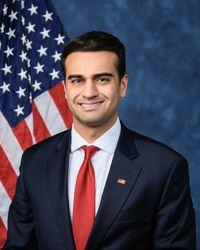
U.S. Representative for Arizona’s 8th district
Republican
119th Congress, two-year term
Missed 1.0% of roll calls. Chamber median 1.9%.
The full voting recordCounts roll calls where most Democrats and most Republicans voted differently, leaving out procedural votes.
How we countFrom FEC filings, Voteview roll calls and Congress.gov.
Republican. In Congress since 2025, 1 term in total.
Following saves Hamadeh to your list, which Chamber & Street keeps on its server, linked to a cookie on this browser and not to your name or email. Email alerts will come with constituent verification.
Bills and resolutions Hamadeh signed on to as a cosponsor. An original cosponsor signed on the day the bill was introduced. Source: govinfo bill status files, last updated Nov 6, 2026.
Hamadeh also withdrew as a cosponsor from 1 bill, not listed here.
Censuring Representative Al Green of Texas.
Sponsor Michael Rulli (R). Joined Mar 3, 2026. 2 cosponsors. H.Res. 1085 on Congress.gov
Introduced
This resolution censures Representative Al Green.
Brandon Act Training and Protocol Act
Sponsor Gilbert Cisneros (D). Joined Feb 25, 2026. 7 cosponsors. H.R. 6383 on Congress.gov(opens in a new tab)
Introduced
To amend title 14, United States Code, to require the retention of certain enlisted members of the Coast Guard who have completed 18 or more, but less than 20, years of service, and for other purposes.
Sponsor Jennifer Kiggans (R). Joined Feb 24, 2026. 20 cosponsors. H.R. 2200 on Congress.gov(opens in a new tab)
Introduced
To include the Czech Republic in the list of foreign states whose nationals are eligible for admission into the United States as E1 nonimmigrants if United States nationals are treated similarly by the Government of the Czech Republic.
Sponsor Steve Cohen (D). Joined Feb 24, 2026. 26 cosponsors. H.R. 1056 on Congress.gov(opens in a new tab)
Introduced
This bill allows a national of the Czech Republic to qualify for E-1 nonimmigrant status if the Czech Republic provides similar nonimmigrant status to U.S. nationals. E-1 classification allows nationals of certain countries (i.e., those with a treaty of commerce and navigation with the United States, those under a qualifying international agreement, or those deemed to qualify through statute) to be admitted solely to engage in international trade, along with their families and employees.
Servicemember Healthcare Freedom Act of 2025
Sponsor Jennifer Kiggans (R). Joined Feb 10, 2026. 3 cosponsors. H.R. 3547 on Congress.gov(opens in a new tab)
Introduced
Dismantle DEI Act of 2025
Sponsor Michael Cloud (R). Joined Feb 9, 2026. 109 cosponsors. H.R. 925 on Congress.gov(opens in a new tab)
Introduced
SAFE Olympic Sports Act
Sponsor Michael Cloud (R). Original cosponsor. 17 cosponsors. H.R. 7421 on Congress.gov(opens in a new tab)
Introduced
SAVE America Act
Sponsor Chip Roy (R). Joined Feb 9, 2026. 111 cosponsors. H.R. 7296 on Congress.gov(opens in a new tab)
Introduced
Safeguard American Voter Eligibility Act or the SAVE America Act
This bill requires individuals to provide documentary proof of U.S. citizenship when registering to vote, and requires photo identification to vote, in federal elections.
Specifically, the bill prohibits states from accepting and processing an application to register to vote in a federal election unless the applicant presents documentary proof of U.S. citizenship. The bill specifies what documents are considered acceptable proof of U.S. citizenship, such as identification that complies with the REAL ID Act of 2005 that indicates U.S. citizenship.
Further, the bill (1) prohibits states from registering an individual to vote in a federal election unless, at the time the individual applies to register to vote, the individual provides documentary proof of U.S. citizenship; and (2) requires states to establish an alternative process to demonstrate U.S. citizenship.
Each state must take affirmative steps on an ongoing basis to ensure that only U.S. citizens are registered to vote, which shall include establishing a program to identify individuals who are not U.S. citizens using information supplied by certain sources.
Additionally, states must remove noncitizens from their official lists of eligible voters.
The bill (1) provides for a private right of action for certain violations, and (2) establishes criminal penalties for certain offenses.
Individuals voting in federal elections must present an eligible photo identification document. An individual who votes by absentee ballot must submit a copy of their identification document with both the request for, and the submission of, the absentee ballot.
Credit Card Competition Act of 2026
Sponsor Lance Gooden (R). Joined Feb 9, 2026. 8 cosponsors. H.R. 7035 on Congress.gov(opens in a new tab)
Introduced
Form 5500 Filing Simplification Act
Sponsor Glenn Grothman (R). Original cosponsor. 11 cosponsors. H.R. 7362 on Congress.gov(opens in a new tab)
Passed committee
Make Elections Great Again Act
Sponsor Bryan Steil (R). Original cosponsor. 70 cosponsors. H.R. 7300 on Congress.gov(opens in a new tab)
Introduced
Disqualifying Dual Loyalty Act of 2025
Sponsor Randy Fine (R). Joined Jan 27, 2026. 10 cosponsors. H.R. 5817 on Congress.gov(opens in a new tab)
Introduced
No Welfare for Non-Citizens Act
Sponsor Randy Fine (R). Joined Jan 22, 2026. 9 cosponsors. H.R. 6854 on Congress.gov(opens in a new tab)
Introduced
Foreign Adversary AI Risk Assessment and Diplomacy Act
Sponsor Michael Baumgartner (R). Original cosponsor. 10 cosponsors. H.R. 7058 on Congress.gov(opens in a new tab)
Passed committee
American Dream Act
Sponsor John McGuire (R). Original cosponsor. 12 cosponsors. H.R. 7051 on Congress.gov(opens in a new tab)
Introduced
Love Lives On Act of 2025
Sponsor Richard Hudson (R). Joined Jan 14, 2026. 183 cosponsors. H.R. 1004 on Congress.gov(opens in a new tab)
Introduced
Love Lives On Act of 2025
This bill extends entitlement for various benefit programs and services for surviving spouses of deceased members of the Armed Forces or veterans.
The bill provides that the remarriage of a surviving spouse must not bar the furnishing of dependency and indemnity compensation or special pension benefits to such spouse.
Additionally, the Department of Defense may not terminate the payment of an annuity for a surviving spouse under the Survivor Benefit Plan solely because the surviving spouse remarries.
The bill also expands the definition of a dependent under TRICARE to include a remarried widow or widower whose subsequent marriage has ended due to death, divorce, or annulment.
Stop Tax Penalties on American Hostages Act of 2025
Sponsor J. Hill (R). Joined Jan 13, 2026. 14 cosponsors. H.R. 1868 on Congress.gov(opens in a new tab)
Introduced
Stop Tax Penalties on American Hostages Act of 2025
This bill extends certain federal tax deadlines for U.S. nationals who are unlawfully or wrongfully detained abroad or held hostage abroad and their spouses. The bill also allows for an abatement and refund of additional taxes, interest, and penalties assessed to such individuals for failing to meet a federal tax deadline during a period of detention.
Specifically, under the bill, the time period during which a U.S. national is unlawfully or wrongfully detained abroad or held hostage abroad is disregarded in determining certain federal tax deadlines, including deadlines for
• filing a return for and paying federal income, estate, gift, employment, or excise taxes;
• a tax credit or refund claim; and
• the determination, assessment, and collection of additional taxes, interest, or penalties.
The bill requires the Department of State and the Department of Justice to annually provide the Internal Revenue Service (IRS) with lists to identify U.S. nationals who qualify for an extension.
The bill also requires the IRS to (1) abate and refund additional taxes, interest, and penalties assessed for any tax year ending during a period of detention for which an extension of a federal tax deadline is permitted; and (2) establish a program allowing U.S. nationals unlawfully or wrongfully detained abroad or taken hostage abroad (or their spouse or dependent) to claim a refund of additional taxes, interest, and penalties assessed for any tax year ending during a period of detention from 2021 to the bill’s enactment date.
American Victims of Terrorism Compensation Act
Sponsor Michael Lawler (R). Joined Jan 13, 2026. 73 cosponsors. H.R. 1530 on Congress.gov(opens in a new tab)
Introduced
Fairness for Khobar Act of 2025
Sponsor Pete Sessions (R). Joined Jan 12, 2026. 46 cosponsors. H.R. 4863 on Congress.gov(opens in a new tab)
Introduced
Fairness for Khobar Act of 2025
This bill authorizes lump sum catch-up payments from the United States Victims of State Sponsored Terrorism (USVSST) Fund to certain victims of the 1983 Beirut barracks bombing or the 1996 Khobar Towers bombing who did not apply for catch-up payments during the application period. The USVSST Fund is administered by the Department of Justice (DOJ) and provides compensation to certain U.S. persons injured in acts of international state sponsored terrorism and their immediate family members.
The Fairness for 9/11 Families Act, enacted in 2022, authorized and provided funding for lump sum catch-up payments from the USVSST Fund to victims of the 1983 Beirut barracks bombing or the 1996 Khobar Towers bombing. Claimants who were previously found eligible for regular payment distributions from the USVSST Fund were also eligible for lump sum payments, but the act required them to apply from December 29, 2022, to June 27, 2023. In a 2024 report, the Government Accountability Office found that up to 274 eligible victims did not apply for lump sum catch-up payments because of DOJ guidance that stated, in part, that claimants who were previously found eligible for regular payment distributions are not eligible for the lump sum catch-up payments.
No Paydays for Hostage-Takers Act
Sponsor Michael Baumgartner (R). Joined Jan 12, 2026. 13 cosponsors. H.R. 2619 on Congress.gov(opens in a new tab)
Passed committee
SAFE Services Act
Sponsor Cory Mills (R). Original cosponsor. 1 cosponsor. H.R. 6882 on Congress.gov(opens in a new tab)
Introduced
Protecting Children from Foreign Mutilation Act
Sponsor Addison McDowell (R). Original cosponsor. 10 cosponsors. H.R. 6876 on Congress.gov(opens in a new tab)
Introduced
To amend the Legislative Reorganization Act of 1946 to adjust the timing of the Congressional summer adjournment, and other purposes.
Sponsor Michael Cloud (R). Joined Dec 18, 2025. 3 cosponsors. H.R. 5459 on Congress.gov(opens in a new tab)
Introduced
761st Tank Battalion Congressional Gold Medal Act
Sponsor Gary Palmer (R). Joined Dec 18, 2025. 290 cosponsors. H.R. 1628 on Congress.gov(opens in a new tab)
Introduced
761st Tank Battalion Congressional Gold Medal Act
This bill provides for the award of a Congressional Gold Medal to the 761st Tank Battalion in recognition of their role in the success of Allied forces in Europe during World War II and for the example they set as the first Black soldiers to go to war as part of an American armored unit.
Following the award of the gold medal, the gold medal shall be given to the National Museum of African American History and Culture where it shall be available for display and research.
High-Capacity Grid Act
Sponsor Julie Fedorchak (R). Joined Dec 17, 2025. 4 cosponsors. H.R. 6633 on Congress.gov(opens in a new tab)
Passed the House
High-Capacity Grid Act
This bill requires public electric utilities to use the best-available transmission conductor for certain interstate transmission lines (i.e., power lines) in order to recover the costs of the conductor through consumers' electric bills.
Specifically, in any filing seeking to recover the costs of a transmission conductor for the transmission line and in any proceeding to determine if the costs may be recovered through rates, the bill directs the Federal Energy Regulatory Commission to presume that (1) the use of a best-available transmission conductor is a prudent practice and that the associated costs are just and reasonable, and (2) the use of a transmission conductor that is not a best-available transmission conductor is not prudent and that the associated costs are not just and reasonable.
A best-available transmission conductor is a conductor that (1) provides the greatest feasible and commercially available energy-carrying capacity at a given voltage level, (2) provides the highest feasible and commercially available electrical efficiency at that voltage level, and (3) mitigates thermal sag (drooping of power lines) at the maximum rated transmission-carrying capacity of the facility.
The bill applies to projects to (1) construct new transmission facilities; or (2) modify, upgrade, or replace an existing transmission line.