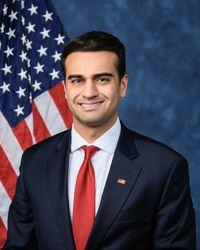
U.S. Representative for Arizona’s 8th district
Republican
119th Congress, two-year term
Missed 1.0% of roll calls. Chamber median 1.9%.
The full voting recordCounts roll calls where most Democrats and most Republicans voted differently, leaving out procedural votes.
How we countFrom FEC filings, Voteview roll calls and Congress.gov.
Republican. In Congress since 2025, 1 term in total.
Following saves Hamadeh to your list, which Chamber & Street keeps on its server, linked to a cookie on this browser and not to your name or email. Email alerts will come with constituent verification.
Bills and resolutions Hamadeh signed on to as a cosponsor. An original cosponsor signed on the day the bill was introduced. Source: govinfo bill status files, last updated Nov 6, 2026.
Hamadeh also withdrew as a cosponsor from 1 bill, not listed here.
Designation of English as the Official Language of the United States Act of 2025
Sponsor Robert Aderholt (R). Original cosponsor. 21 cosponsors. H.R. 1772 on Congress.gov
Introduced
Designation of English as the Official Language of the United States Act of 2025
This bill establishes English as the official language of the United States.
The bill specifies that the official functions of government in the United States, including in each state and the District of Columbia, shall be conducted in English. Exceptions to this requirement include (1) actions or documents to protect the public health or safety, (2) actions or documents that protect the rights of victims of crimes or criminal defendants, and (3) requirements under the Individuals with Disabilities Education Act.
The bill also establishes a framework for implementation and enforcement, including by testing English language ability as part of the naturalization process.
SAVE Act
Sponsor Greg Stanton (D). Original cosponsor. 1 cosponsor. H.R. 1746 on Congress.gov(opens in a new tab)
Introduced
Expressing support for the Iranian people's desires for a democratic, secular, and nonnuclear Republic of Iran, and condemning the Iranian regime's terrorism, regional proxy war, internal suppression, and for other purposes.
Sponsor Tom McClintock (R). Original cosponsor. 230 cosponsors. H.Res. 166 on Congress.gov(opens in a new tab)
Introduced
No Tax on Tips Act
Sponsor Vern Buchanan (R). Joined Feb 26, 2025. 27 cosponsors. H.R. 482 on Congress.gov(opens in a new tab)
Introduced
No Tax on Tips Act
This bill establishes a new tax deduction of up to $25,000 for tips, subject to limitations. The bill also expands the business tax credit for the portion of payroll taxes an employer pays on certain tips to include payroll taxes paid on tips received in connection with certain beauty services.
Under the bill, the new tax deduction for tips is limited to cash tips (1) received by an employee during the course of employment in an occupation that customarily receives tips, and (2) reported by the employee to the employer for purposes of withholding payroll taxes. (Under current law, an employee is required to report tips exceeding $20 per month to their employer.)
Further, an employee with compensation exceeding a specified threshold ($160,000 in 2025 and adjusted annually for inflation) in the prior tax year may not claim the new tax deduction for tips.
Finally, the bill expands the business tax credit for the portion of payroll taxes that an employer pays on certain tips to include payroll taxes paid on tips received in connection with barbering and hair care, nail care, esthetics, and body and spa treatments. (Under current law, an employer is allowed a business tax credit for the amount of payroll taxes paid on certain tips received by an employee in connection with providing, delivering, or serving food or beverages.)
Protecting American Agriculture from Foreign Adversaries Act of 2025
Sponsor Dan Newhouse (R). Original cosponsor. 60 cosponsors. H.R. 1576 on Congress.gov(opens in a new tab)
Introduced
Protecting American Agriculture from Foreign Adversaries Act of 2025
This bill makes changes to the Committee on Foreign Investment in the United States (CFIUS), including by requiring CFIUS to determine whether a national security review is necessary for reportable agricultural land transactions that are referred by the Department of Agriculture (USDA). (CFIUS oversees the national security risks of certain foreign investment in the United States. CFIUS has the authority to review covered transactions, which include mergers, acquisitions, and takeovers that could result in foreign control of a U.S. business; certain investments in businesses involved in critical technologies, critical infrastructure, or sensitive personal data; and certain real estate transactions.)
Specifically, the bill directs CFIUS to, after receiving notification from USDA, determine (1) whether a reportable agricultural land transaction is a covered transaction, and (2) whether CFIUS should initiate a national security review or take another action with respect to the transaction.
Reportable agricultural land transaction means a transaction (1) that USDA has reason to believe is a covered transaction; (2) that involves the acquisition of an interest in agricultural land by a foreign person of China, North Korea, Russia, or Iran; and (3) with respect to which a foreign person is required to submit a report to USDA regarding their agricultural land transactions.
The bill also expands the membership of CFIUS to include the Secretary of Agriculture for covered transactions that involve agricultural land, agricultural biotechnology, or the agriculture industry (e.g., agricultural transportation, storage, and processing).
No American Land for Communist China Act
Sponsor Dan Newhouse (R). Original cosponsor. 60 cosponsors. H.R. 1575 on Congress.gov(opens in a new tab)
Introduced
RECOGNIZING Judea and Samaria Act
Sponsor Claudia Tenney (R). Joined Feb 24, 2025. 11 cosponsors. H.R. 902 on Congress.gov(opens in a new tab)
Introduced
Retiring the Egregious Confusion Over the Genuine Name of Israel’s Zone of Influence by Necessitating Government-use of Judea and Samaria Act or the RECOGNIZING Judea and Samaria Act
This bill prohibits the use of federal funds to prepare or promulgate certain materials (including any policy, guidance, regulation, executive order, or other work products) that refers to Judea and Samaria as the West Bank. The prohibition does not apply to U.S. obligations under international treaties or other agreements.
The bill also amends certain laws to replace the term the West Bank with Judea and Samaria.
Impeaching Paul Adam Engelmayer, United States District Court Judge for the Southern District of New York, for high crimes and misdemeanors.
Sponsor Elijah Crane (R). Original cosponsor. 12 cosponsors. H.Res. 145 on Congress.gov(opens in a new tab)
Introduced
Senior Citizens Tax Elimination Act
Sponsor Thomas Massie (R). Joined Feb 18, 2025. 34 cosponsors. H.R. 1040 on Congress.gov(opens in a new tab)
Introduced
Downwinders Parity Act of 2025
Sponsor Paul Gosar (R). Original cosponsor. 9 cosponsors. H.R. 1362 on Congress.gov(opens in a new tab)
Introduced
Embassy Construction Integrity Act of 2025
Sponsor Cory Mills (R). Joined Feb 14, 2025. 1 cosponsor. H.R. 1134 on Congress.gov(opens in a new tab)
Introduced
One Flag for All Act
Sponsor Diana Harshbarger (R). Original cosponsor. 25 cosponsors. H.R. 1313 on Congress.gov(opens in a new tab)
Introduced
Uncovering UNRWA’s Terrorist Crimes Act
Sponsor Ronny Jackson (R). Original cosponsor. 10 cosponsors. H.R. 1252 on Congress.gov(opens in a new tab)
Introduced
Uncovering UNRWA’s Terrorist Crimes Act
This bill prohibits federal funds from being used to provide funding, directly or indirectly, to the United Nations Relief and Works Agency for Palestine Refugees in the Near East (UNRWA).
The bill also requires the Department of State to report to Congress on (1) the total U.S. funding to UNRWA from FY2020 through FY2024, and (2) how such funds were spent.
Agent Raul Gonzalez Officer Safety Act
Sponsor Juan Ciscomani (R). Joined Feb 10, 2025. 32 cosponsors. H.R. 35 on Congress.gov(opens in a new tab)
Passed the House
Agent Raul Gonzalez Officer Safety Act
This bill establishes new federal criminal offenses for operating a motor vehicle within 100 miles of the U.S. border while fleeing from a U.S. Border Patrol agent or a federal, state, or local law enforcement officer who is actively assisting or under the command of the U.S. Border Patrol.
The bill establishes criminal penalties for an offense, including a mandatory minimum prison term for an offense resulting in death or serious bodily injury. Additionally, a non-U.S. national who is convicted of or admits to committing an offense is inadmissible, deportable, and ineligible for immigration relief (including asylum).
Proposing an amendment to the Constitution of the United States to require that the Supreme Court of the United States be composed of nine justices.
Sponsor Dusty Johnson (R). Joined Feb 7, 2025. 108 cosponsors. H.J.Res. 28 on Congress.gov(opens in a new tab)
Introduced
This joint resolution proposes a constitutional amendment requiring the Supreme Court to consist of nine Justices.
LASSO Act
Sponsor Paul Gosar (R). Joined Feb 6, 2025. 16 cosponsors. H.R. 34 on Congress.gov(opens in a new tab)
Introduced
Land And Social Security Optimization Act or the LASSO Act
This bill requires 10% of revenue generated by public lands, including submerged lands on the Outer Continental Shelf, under the jurisdiction of the Department of the Interior and the Forest Service to be deposited into the Federal Old-Age and Survivors Insurance Trust Fund, which is used to pay Social Security benefits to retirees and their families and to survivors of deceased workers.
Veterans 2nd Amendment Protection Act
Sponsor Mike Bost (R). Original cosponsor. 70 cosponsors. H.R. 1041 on Congress.gov(opens in a new tab)
Passed the House
Veterans 2nd Amendment Protection Act
This bill prohibits the Department of Veterans Affairs (VA) from transmitting certain information to the National Instant Criminal Background Check System (NICS) utilized by licensed importers or dealers of firearms.
Specifically, the bill prohibits the VA from transmitting personally identifying information of a veteran or a beneficiary to the NICS solely on the basis that such veteran or beneficiary has an appointed fiduciary to manage their benefits, unless there is an order or finding of a judicial authority that such veteran or beneficiary is a danger to themselves or others.
To prohibit individuals who are not citizens of the United States from voting in elections in the District of Columbia and to repeal the Local Resident Voting Rights Amendment Act of 2022.
Sponsor August Pfluger (R). Original cosponsor. 14 cosponsors. H.R. 884 on Congress.gov(opens in a new tab)
Passed the House
This bill prohibits a non-U.S. citizen from voting in a District of Columbia (DC) election and repeals relevant provisions of DC law.
Federal law prohibits noncitizens from voting in a federal election; however, in 2022, DC enacted a law allowing noncitizens who meet residency and other requirements to vote in local elections. This bill repeals the DC law, which went into effect on February 23, 2023.
No Foreign Persons Administering Our Elections Act
Sponsor August Pfluger (R). Original cosponsor. 9 cosponsors. H.R. 882 on Congress.gov(opens in a new tab)
Introduced
No Foreign Persons Administering Our Elections Act
This bill prohibits states and local jurisdictions from hiring noncitizens to administer federal elections.
IGO Anti-Boycott Act
Sponsor Michael Lawler (R). Original cosponsor. 24 cosponsors. H.R. 867 on Congress.gov(opens in a new tab)
Introduced
IGO Anti-Boycott Act
This bill penalizes U.S. persons (individuals or entities) that participate in certain boycotts imposed by international governmental organizations (IGOs).
The bill expands an existing law that prohibits various actions by U.S. persons in relation to boycotts imposed by foreign governments on a country that is friendly to the United States and not itself the object of a U.S. boycott. This bill applies those prohibitions to similar boycotts imposed by IGOs.
Prohibited actions include (1) refusing to do business with companies organized under the laws of the boycotted country, if the refusal is pursuant to an agreement with or request from the country or IGO imposing the boycott; (2) furnishing information about whether any person has a business relationship with or in the boycotted country; and (3) furnishing information about whether someone is associated with charitable or fraternal organizations that support the boycotted country.
Criminal penalties for willful violations of this law include fines of up to $1 million. In addition to such fines, individuals may be imprisoned for up to 20 years. Civil penalties may include fines and revocations of export licenses for certain national security-related items.
The bill also requires the President to annually submit to Congress and make available to the public a report describing these boycotts and listing the foreign countries and international organizations involved in fostering or imposing them.
No Medicaid for Illegal Immigrants Act of 2025
Sponsor Kevin Kiley (I). Joined Jan 31, 2025. 10 cosponsors. H.R. 584 on Congress.gov(opens in a new tab)
Introduced
No Medicaid for Illegal Immigrants Act of 2025
This bill prohibits state Medicaid programs from covering individuals who are unlawfully present in the United States, except for certain emergency services for which federal payment is authorized under current law.
Proposing an amendment to the Constitution of the United States to prohibit persons who are not citizens, nationals, or lawful permanent residents of the United States from voting in elections.
Sponsor August Pfluger (R). Original cosponsor. 8 cosponsors. H.J.Res. 31 on Congress.gov(opens in a new tab)
Introduced
This joint resolution proposes a constitutional amendment prohibiting persons who are not U.S. citizens, nationals, or lawful permanent residents from voting in elections. Specifically, the joint resolution prohibits such a person from voting in any election for federal, state, tribal, or local office, including offices in the District of Columbia or in any of the territories or possessions of the United States.
Critical Mineral Consistency Act of 2025
Sponsor Juan Ciscomani (R). Original cosponsor. 13 cosponsors. H.R. 755 on Congress.gov(opens in a new tab)
Passed the House
Critical Mineral Consistency Act of 2025
This bill modifies the Energy Act of 2020 to expand the definition of critical minerals to include critical materials designated by the Department of Energy (DOE).
Under current law, DOE's critical materials list contains certain materials that are essential for energy, including those on the critical minerals list of the U.S. Geological Survey (USGS). The USGS's list, which contains certain minerals that are essential to the nation's economic or national security, is not required to include the materials on DOE's list. Currently, both lists include minerals with a high risk of supply chain disruptions, and both DOE and USGS must conduct a variety of efforts to ensure a secure and reliable supply chain of the minerals.
By expanding the definition of critical minerals, this bill requires the USGS to include on its list the materials on DOE's list. Within 45 days of DOE adding a mineral, element, substance, or material to its critical materials list, the USGS must update its list to include such mineral, element, substance, or material.
Stop Illegal Reentry Act
Sponsor Stephanie Bice (R). Original cosponsor. 15 cosponsors. H.R. 749 on Congress.gov(opens in a new tab)
Introduced
Stop Illegal Reentry Act
This bill increases criminal penalties for certain non-U.S. nationals (aliens under federal law) who illegally reenter the United States after removal or exclusion.
Generally, an individual who had been denied entry into or removed from the United States and who later enters or attempts to enter the United States without prior approval from the Department of Homeland Security shall be fined, imprisoned for up to five years, or both. Current law requires a fine, imprisonment for up to two years, or both, for such an individual.
An individual who had been denied entry or removed three or more times and who later enters or attempts to enter the United States shall be fined, imprisoned for up to 10 years, or both.
An individual who was convicted of an aggravated felony or convicted at least two times before removal or departure and who subsequently enters or tries to enter the United States shall be imprisoned at least 5 years and for up to 20 years and may also be fined. Currently, there is no minimum term of imprisonment for an individual who reenters after a conviction for an aggravated felony, and there are no criminal penalties for a reentering individual who had been convicted at least two times (other than the penalties for illegal reentry generally).
PROTECTS Act of 2025
Sponsor Richard McCormick (R). Original cosponsor. 39 cosponsors. H.R. 742 on Congress.gov(opens in a new tab)
Introduced
Protecting Resources Of Taxpayers to Eliminate Childhood Transgender Surgeries Act of 2025 or the PROTECTS Act of 2025
This bill prohibits providing or using federal funds to perform, refer for, or reimburse any entity for certain gender transition procedures for an individual under the age of 18.
The bill’s prohibition applies to certain gender transition procedures that are performed to intentionally change an individual’s body to no longer correspond to the individual's biological sex, including surgeries, medications, and implants specified in the bill. The bill provides exceptions for specified procedures, such as treating certain genetic abnormalities or preventing imminent death or impairment of a major bodily function, when performed by a health care provider with the consent of the individual’s parent or legal guardian.